
Introduction
When your core banking system crashes at 9 AM on a Monday, nobody cares about the values poster in the break room. What matters is whether your leadership team panics, points fingers, or steps up. That moment tells your employees, customers, and regulators everything they need to know about who you really are.
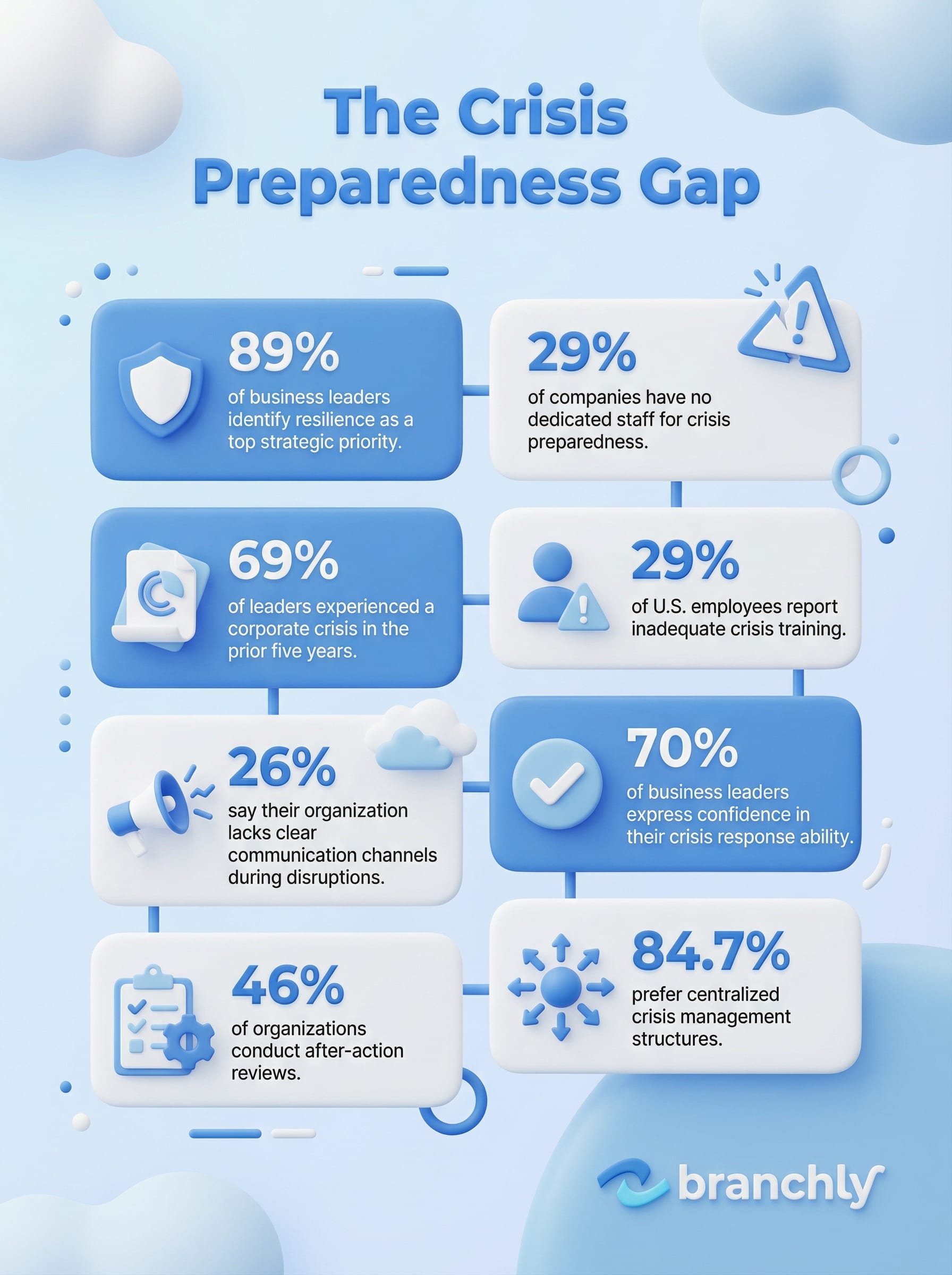
Research shows that 89% of business leaders identify resilience as a top strategic priority, yet 29% of companies have no dedicated staff for crisis preparedness. That gap between stated values and actual preparation gets exposed the moment something goes wrong. Your crisis response doesn't create your culture. It reveals it.
The Corporate Veneer Falls Away Fast
Companies spend millions crafting mission statements about transparency, accountability, and people-first values. But when a data breach hits or a facility floods, those words get tested against actual behavior. Do leaders communicate openly about what went wrong, or do they go silent and let rumors fill the void?
A 2019 study found that 69% of leaders experienced a corporate crisis in the prior five years, with larger organizations averaging about one per year. Each incident becomes a live audit of stated values versus lived behavior. Employees notice when executives who preach open-door policies suddenly become unreachable. Customers remember when brands that promise loyalty prioritize legal protection over honest communication.
The disconnect shows up in preparation gaps too. If your organization truly values employee safety but conducts zero crisis drills, you're telling people that safety is just marketing copy. If customer trust matters but nobody has pre-approved communication templates ready, you're saying that trust takes a back seat to convenience.
Test Your Leadership Culture Before Crisis Hits
Run a tabletop exercise where your executive team has to respond to a simulated crisis without preparation time. Watch who steps up, who defers, and who disappears. That's your real culture under pressure.
What Employees Actually See During Disruption
Your team watches how quickly leadership shows up, how honestly they communicate, and whether they protect people or just the brand. Research on crisis leadership following COVID-19 identified compassion, open communication, adaptiveness, and courage as the attributes that actually matter. One study noted that leaders must remain positive and cannot show fear, because if you are frightened, you will fail.
But remaining positive isn't the same as pretending everything's fine. Employees can smell manufactured optimism. What builds trust is transparency paired with action. When leaders say, 'Here's what we know, here's what we don't, and here's what we're doing right now,' people can work with that. When they hear corporate-speak and evasion, trust erodes fast.
The Training Gap Is a Culture Gap
29% of U.S. employees report inadequate crisis training, and 26% say their organization lacks clear communication channels during disruptions. When you don't prepare people, you're telling them they're not worth the investment.
Role clarity matters just as much. During Hurricane Katrina, 29 agencies responded without clear responsibility definitions. The result was chaos, delayed action, and a textbook case of how unclear roles destroy effective response. Your org chart looks clean on paper, but a crisis reveals whether people actually know who owns what decisions.
Employees also watch whether leadership protects the most vulnerable first. Do you account for your overnight shift before issuing facility closure updates? Do your communications consider frontline staff who can't check email every 10 minutes? If not, you're signaling that some people matter more than others, no matter what your DEI statement says.
The Regulatory and Stakeholder Lens
Regulators don't care about your intentions. They care about documented actions, timestamps, and whether you followed your own policies. For financial institutions, NCUA and FFIEC aren't interested in hearing that your team worked hard. They want to see audit trails proving you executed your continuity plan as written.
This is where leadership culture gets tested against compliance culture. If your executives treat business continuity planning as a box to check, that attitude cascades down. Staff skip drills. Documentation gets sloppy. When an actual incident occurs, the gaps become evidence.
Organizations with centralized crisis management structures perform better, with 84.7% preferring some level of centralization to break down silos and speed up decision-making. But centralization only works if senior leadership participates. Nearly a quarter of organizations report insufficient senior leadership involvement in post-incident reviews, which means they're not learning from what went wrong.
Customers and partners judge you on outcomes, not effort. When your systems go down and their operations suffer, they don't care that your team stayed up all night. They care whether you communicated proactively, had a backup plan, and got things running again. A brand that promises reliability but delivers excuses during outages has revealed that reliability is just positioning, not priority.
Document Everything in Real Time
Assign one person to log every decision, who made it, and when during live incidents. This isn't just for regulators. It's how you build an honest account of what actually happened versus what people remember happening.
How Preparation Reveals Leadership Priorities
The best indicator of crisis leadership culture is what happens before anything goes wrong. Organizations that conduct regular tabletop exercises, test their communication systems, and update playbooks quarterly are telling their teams that preparation matters. Those that treat continuity planning as an annual chore are saying something different.
After-action reviews are where learning happens or doesn't. About 46% of organizations conduct these reviews, but that leaves more than half that don't formally capture lessons. If your leadership team treats incidents as one-off problems rather than data points for improvement, you're building a culture that repeats mistakes instead of fixing them.
Training investment shows what you value. When leadership approves budget for crisis management software, drills, and specialized staff, they're prioritizing resilience. When those requests get delayed or defunded year after year, employees hear that revenue targets matter more than operational stability. Both are valid choices, but don't pretend it's not a choice.
70% Confidence, But Is It Earned?
70% of business leaders express confidence in their organization's crisis response ability. But confidence without testing is just optimism. The only way to know if your plans work is to stress test them under realistic conditions.
Technology choices matter too. Organizations that invest in platforms providing unified, real-time visibility into operations can identify vulnerabilities proactively. Those still running crisis management through email chains and spreadsheets are accepting risk that modern tools could reduce. That's a cultural statement about whether you value agility or just familiarity.
Building Culture That Survives Contact With Reality
Leadership during crises doesn't create organizational culture, but it can reshape it. When executives demonstrate the behaviors they want to see throughout decision-making under pressure, open communication during uncertainty, accountability when things go wrong they reinforce those values. When they don't, they teach people that stated values are situational.
Transformational and adaptive leadership styles work best in crises because they balance inspiration with flexibility. They emphasize intellectual engagement, encouraging teams to think through problems rather than just following orders. This builds capability that persists beyond individual incidents.
But adaptation requires psychological safety. Teams need to know they can raise concerns, report mistakes, and challenge plans without punishment. If your crisis response culture punishes messengers or scapegoats people who report problems early, you're training your organization to hide issues until they become catastrophic.
Collaboration across functions is another cultural indicator. Siloed organizations struggle in crises because information doesn't flow and decisions bottleneck. Leaders who break down those barriers during preparation through cross-functional planning teams, shared playbooks, and joint exercises build muscle memory that activates when things go wrong.

Test Your Culture Before It Gets Tested
The only way to know if your values hold up is to pressure-test them before an actual crisis
What Gets Exposed Can Be Fixed
The uncomfortable truth is that most organizations don't know what their crisis leadership culture actually looks like until something breaks. The good news is that once you see the gaps between stated values and lived behavior, you can close them.
Start by examining what your preparation habits reveal. Do you conduct regular drills with executive participation? Are communication templates pre-approved and ready to deploy? Can frontline staff access crisis plans without hunting through folders? These operational details reflect cultural priorities more accurately than any values statement.
Then look at your last incident response, even if it was minor. Who stepped up? What communication worked? Where did information get stuck? Did leadership show up and stay visible, or did they delegate and disappear? Those patterns will repeat when stakes get higher.
Your crisis response will reveal your leadership culture whether you want it to or not. The only question is whether you discover the gaps during a drill or during an actual emergency with customers, regulators, and employees watching.
Summary
Crisis moments don't build organizational culture, they expose it. The way leadership communicates, makes decisions, and treats people during disruption reveals whether stated values are real or just positioning. Organizations that invest in preparation, conduct regular drills, document actions, and learn from incidents build resilience that holds up under pressure. Those that treat continuity planning as compliance theater discover the gap between what they claim to value and what they actually prioritize. The good news is that once you see what your crisis response reveals about your culture, you can fix it before the next test comes.
Key Things to Remember
- ✓Your crisis response exposes the gap between stated values and actual leadership behavior when pressure hits.
- ✓Employees, regulators, and customers judge you on actions during disruption, not intentions or mission statements.
- ✓Preparation habits reveal cultural priorities better than any corporate communication.
- ✓Organizations that conduct regular drills, document decisions, and learn from incidents build resilience that holds up under real pressure.
How Branchly Can Help
Branchly helps leadership teams close the gap between stated values and crisis execution. The platform automatically generates location-specific playbooks with clear role assignments, pre-approved communication templates, and real-time tracking so leaders can see exactly what's happening across every location. Built-in audit trails document every decision and action, giving you defensible records for regulators while the intelligence layer analyzes each response to identify bottlenecks and suggest improvements. When your next crisis hits, your team will execute with the clarity and coordination that reflects the culture you've been building.
Citations & References
- [1]ncbi.nlm.nih.gov View source ↗
- [2]mdpi.com View source ↗
- [3]multijournals.org View source ↗
- [4]
- [5]
- [6]valpo.edu View source ↗
- [7]ncbi.nlm.nih.gov View source ↗
- [8]macrothink.org View source ↗
- [9]tandfonline.com View source ↗
- [10]
- [11]
- [12]tandfonline.com View source ↗
- [13]
- [14]
- [15]
- [16]Resilience Professionals Are Transforming Their Crisis Management Practices thebci.org View source ↗
- [17]