
Introduction
When the network goes down at 47 branches simultaneously, your CFO isn't thinking about incident response protocols. They're calculating lost revenue per minute, potential regulatory fines, and the cost to customer lifetime value. And they're wondering why the finance team learned about it from Twitter instead of your crisis management system.
Crisis management has traditionally lived in the operations or risk departments, treated as a compliance checkbox rather than a strategic investment. But CFOs are starting to connect the dots. Unplanned downtime costs businesses an average of $5,600 per minute, according to Gartner research. For a multi-location organization, that number multiplies fast.
This isn't about fear-mongering. It's about quantifying risk, protecting capital, and building the kind of operational resilience that shows up in your balance sheet. Here's why your CFO should care about crisis management, and how to speak their language when making the case.
The Hidden Cost of Operational Disruptions
Most organizations track direct costs like emergency repair bills or overtime pay during a crisis. But the real financial damage runs deeper. Customer churn accelerates after service disruptions. Employee productivity drops during recovery periods. Insurance premiums increase after claims. Regulatory scrutiny intensifies, often triggering expensive audits.
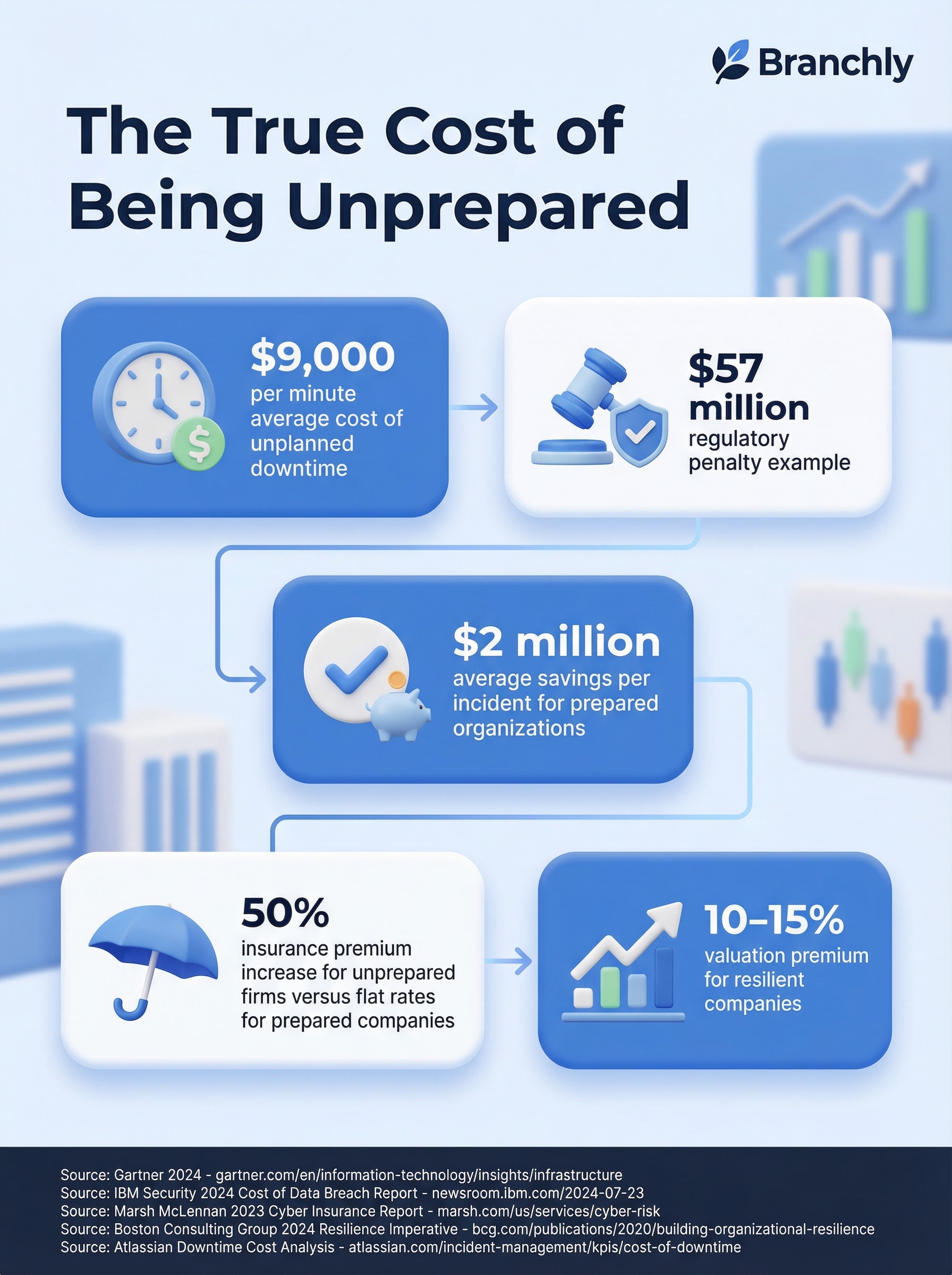
A study by the Ponemon Institute found that the average cost of unplanned downtime has increased 32% since 2020, now averaging $9,000 per minute for large enterprises. For mid-market companies operating 50 to 200 locations, even a four-hour outage can result in losses exceeding $2 million when you factor in lost transactions, recovery expenses, and reputational damage.
Your CFO already knows disruption is expensive. What they may not realize is how much of that cost is preventable with the right preparation. Response time matters more than incident severity in most cases. Organizations with documented, tested crisis plans recover 50% faster than those relying on improvised responses, according to research from the Business Continuity Institute.
Calculate Your Risk Exposure
Multiply your average revenue per location by the number of locations vulnerable to a specific threat (power outage, system failure, etc.). Then multiply by realistic downtime hours. That's your financial exposure for a single incident type. Now calculate this for your top five risks.
Regulatory Compliance Isn't Optional
For financial services organizations, crisis preparedness isn't a best practice. It's a regulatory requirement with teeth. The FFIEC expects banks and credit unions to maintain comprehensive business continuity programs. FINRA Rule 4370 mandates broker-dealers document business continuity plans and test them annually. The NCUA examines credit unions for operational resilience as part of safety and soundness reviews.
The financial consequences of non-compliance are severe. In 2020, Robinhood was fined $57 million by the SEC and FINRA, partly due to system outages that prevented customers from trading. While the outages themselves were technical failures, the inadequate crisis response and lack of proper business continuity planning contributed significantly to the penalty.
But compliance isn't just about avoiding fines. It's about maintaining your license to operate. Regulators can restrict business activities, require enhanced oversight, or in extreme cases, force leadership changes. From a CFO perspective, regulatory risk directly impacts your cost of capital, ability to grow, and company valuation.
The True Cost of Regulatory Penalties
Beyond the direct fine amount, factor in legal fees (often 2-3x the penalty), remediation costs, increased audit frequency, and reputational damage that affects customer acquisition costs and retention rates for years.
Crisis Management as a Capital Allocation Decision
CFOs think in terms of return on investment, payback periods, and opportunity cost. The challenge with crisis management is that it's a negative ROI proposition until something goes wrong. You're investing to prevent losses, not generate revenue. That's a tough sell in budget meetings.
But smart CFOs reframe the question. Instead of asking what crisis management costs, ask what inadequate preparedness costs. A 2019 study by IBM Security found that organizations with incident response teams and tested plans saved an average of $2 million per data breach compared to those without. The preparation investment typically runs 5-10% of the potential loss exposure.
Consider it insurance with a better payout ratio. You're self-insuring against operational risk, but unlike traditional insurance, your investment builds organizational capability that compounds over time. Each drill improves response speed. Each playbook refinement reduces decision-making time. Each communication template saves hours during the next incident.
There's also a competitive advantage angle. Research from McKinsey shows that resilient organizations grow revenue 2-3x faster than peers during periods of disruption. When your competitors are scrambling to recover, you're maintaining service levels and capturing market share. That's a growth investment, not just a cost center.
The Board Is Asking About Operational Risk
Board governance expectations around operational resilience have changed dramatically in the past five years. Boards are asking pointed questions about crisis preparedness, often prompted by regulatory guidance or high-profile failures at other companies. If your CFO can't answer those questions with specifics, it reflects poorly on the entire executive team.
The National Association of Corporate Directors issued guidance recommending that boards directly oversee cyber risk and business continuity planning. This isn't delegated to management anymore. Directors want to see metrics: recovery time objectives, tabletop exercise results, third-party dependency analyses, and incident response times.
Your CFO is in the unique position of translating operational capabilities into financial risk language the board understands. When you give them concrete data about preparedness, they can confidently report progress. When you leave them guessing, they face uncomfortable questions they can't answer.

Board-Level Crisis Oversight
What directors are asking about operational resilience
Insurance Costs Are Rising for Unprepared Organizations
Commercial insurance carriers are getting selective about operational risk. Cyber insurance applications now routinely ask about incident response capabilities, business continuity plans, and testing frequency. Organizations without documented programs face higher premiums or coverage exclusions. Some can't get coverage at all.
This directly impacts your CFO's budget planning. According to a 2023 report from Marsh McLennan, cyber insurance premiums increased an average of 50% year-over-year for companies without strong risk management programs. Meanwhile, organizations that demonstrated crisis preparedness saw flat or declining premiums despite the hardening market.
Think of crisis management investment as insurance premium reduction. A $100,000 annual investment in crisis preparedness that saves $150,000 in insurance costs isn't a cost at all. It's a positive cash flow decision that also happens to improve your operational capability.
Talk to Your Insurance Broker
Before your next policy renewal, ask your broker what crisis management capabilities would positively impact your premiums. Many carriers offer discounts for documented plans, regular testing, and technology platforms that demonstrate preparedness.
The Competitive Advantage of Resilience
Crisis management isn't just about surviving disruptions. It's about maintaining competitive position while others struggle. When a regional weather event hits your market, the organization that keeps 90% of locations operational captures customers from competitors who shut down completely.
This is particularly relevant in franchise systems and multi-location retail. Customers develop loyalty to brands they can rely on, especially during challenging circumstances. A restaurant chain that keeps serving customers during a power outage while competitors close builds brand equity that shows up in revenue months later.
Your CFO should care because resilience affects market share, customer lifetime value, and ultimately, enterprise value. Research from Boston Consulting Group found that companies with strong operational resilience trade at valuation premiums of 10-15% compared to less prepared competitors in the same sector.
Making the Business Case to Your CFO
When you pitch crisis management investment to your CFO, lead with numbers they already care about. Calculate your current exposure to operational disruptions across your top five risk scenarios. Quantify potential revenue loss, recovery costs, and regulatory exposure. Show them the cost of doing nothing.
Then present the solution cost as a percentage of that exposure. A $200,000 platform investment that protects against $50 million in annual risk exposure is a 0.4% insurance premium with compounding benefits. Frame it as capital protection, not operational expense.
Include the softer financial benefits too. Improved insurance terms. Reduced audit costs through better documentation. Faster regulatory approval for expansion plans because you demonstrate operational maturity. Lower employee turnover because your teams feel supported during crises. These all have dollar values, even if they're harder to quantify precisely.
Most importantly, offer to track and report ROI. Commit to measuring response times, recovery speed, cost avoidance, and incident frequency. Give your CFO the data they need to defend the investment to the board and demonstrate that crisis management isn't just an operational nice-to-have. It's a strategic financial decision with measurable returns.
Summary
Crisis management is a financial issue that happens to be executed by operations teams. CFOs who understand this connection protect capital more effectively, satisfy board oversight requirements, reduce insurance costs, and position their organizations for competitive advantage during disruptions. The conversation isn't about whether you can afford to invest in crisis preparedness. It's about whether you can afford not to. When you speak your CFO's language with concrete numbers, defensible assumptions, and measurable outcomes, the business case makes itself.
Key Things to Remember
- ✓Unplanned downtime costs organizations an average of $9,000 per minute, with hidden costs in customer churn, productivity loss, and regulatory scrutiny multiplying the financial impact.
- ✓Regulatory penalties for inadequate crisis preparedness can exceed $50 million, with additional costs in legal fees, remediation, and reputational damage lasting years.
- ✓Organizations with tested crisis response plans save an average of $2 million per incident and recover 50% faster than unprepared competitors.
- ✓Insurance premiums increased 50% for organizations without strong risk management programs, while prepared organizations saw flat or declining costs despite market hardening.
- ✓Companies with operational resilience programs trade at 10-15% valuation premiums and grow revenue 2-3x faster during disruption periods compared to less prepared peers.
How Branchly Can Help
Branchly gives CFOs the visibility and metrics they need to treat crisis management as a measurable financial investment. Our platform quantifies risk exposure across all locations, tracks response performance in real-time, and generates audit-ready documentation that satisfies regulatory requirements. With automated playbooks that reduce recovery time by up to 50%, defensible cost-avoidance reporting, and compliance features built specifically for financial services regulations, Branchly transforms crisis management from an operational expense into a strategic asset that protects capital and competitive position.
Citations & References
- [1]
- [2]
- [3]
- [4]
- [5]
- [6]
- [7]Business Continuity Management: Global Good Practice Guidelines 2024 Business Continuity Institute View source ↗
- [8]NACD Director's Handbook on Cyber-Risk Oversight National Association of Corporate Directors View source ↗
- [9]
- [10]
- [11]
- [12]