
Introduction
Here's a scenario that plays out more often than anyone admits: A front-line employee spots a serious problem brewing. Maybe it's a system glitch that could cascade into an outage. Maybe it's a safety concern that violates protocol. They know they should say something. But they also know what happened last time someone raised an issue. So they stay quiet. And the small problem becomes a full-blown crisis.
This isn't about bad employees. It's about psychological safety, and it's one of the most overlooked factors in crisis management. When people don't feel safe speaking up, reporting mistakes, or challenging decisions, your crisis response plans are built on sand. No playbook can compensate for a culture where employees choose silence over risk.
What Psychological Safety Actually Means in Crisis Situations
Psychological safety is the belief that you can speak up with ideas, questions, concerns, or mistakes without fear of embarrassment or punishment. It's not about being nice or avoiding accountability. It's about creating conditions where people share critical information even when it's uncomfortable.
During a crisis, psychological safety becomes the difference between coordinated response and organizational paralysis. When a system fails or an incident escalates, you need accurate information flowing up from people who are closest to the problem. But if those people are worried about blame, they'll sanitize their reports or stay silent entirely.
Google's Project Aristotle studied hundreds of teams and identified psychological safety as the single most important factor in team effectiveness. High-performing teams weren't smarter or more experienced. They were teams where people felt safe taking risks and admitting uncertainty. In crisis management, that willingness to say 'I don't know' or 'We have a problem' can prevent disasters.
The Cost of Silence
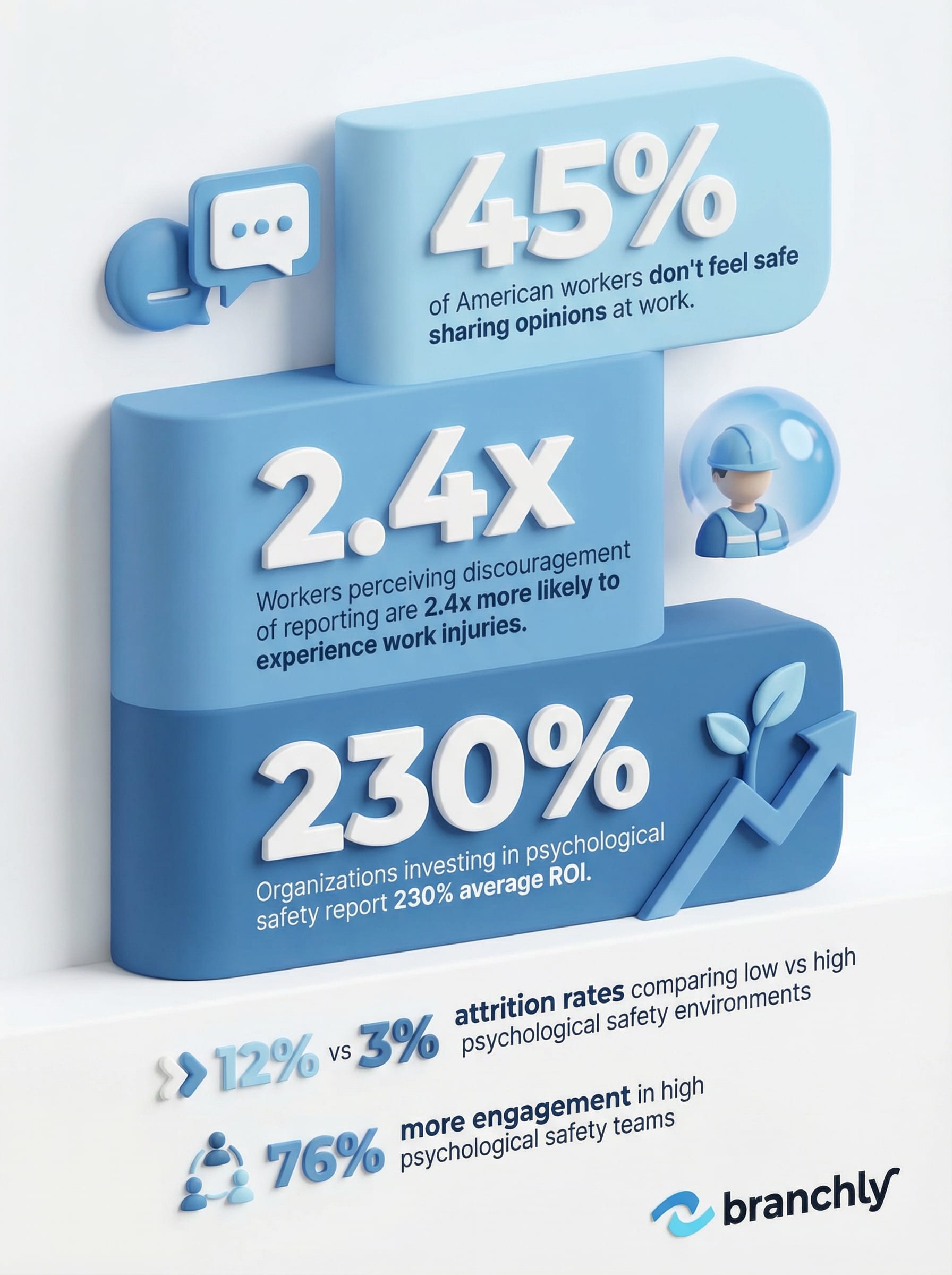
45% of American workers don't feel safe sharing opinions at work due to fear of negative consequences. Workers who perceive their employers discourage reporting are 2.4x more likely to experience a work injury.
The numbers tell a stark story. According to the American Psychological Association's 2024 Work in America Survey, only 18% of employees in psychologically safe environments felt their workplace negatively impacted their mental health. That number jumped to 57% in environments with low psychological safety. When people are stressed and disengaged, they're less likely to notice problems and even less likely to report them.
Why Employees Stay Silent When You Need Them Most
Fear of retaliation isn't paranoia. It's learned behavior based on past experience. Maybe someone raised a concern last year and got labeled as 'not a team player.' Maybe mistakes trigger public criticism rather than private coaching. Maybe the last person who questioned a decision found themselves excluded from important meetings.
In crisis situations, these fears intensify. The stakes are higher. The visibility is greater. The pressure to project confidence and control can make leaders less receptive to bad news. Staff see this and adjust their behavior accordingly. They filter information, soften warnings, or wait for someone else to speak up first.
Watch for These Warning Signs
Meetings where only senior leaders speak. Incidents that surprise leadership but not front-line staff. High turnover in roles that require escalating problems. Anonymous surveys revealing concerns that never surface in person.
Hierarchical structures common in financial services, healthcare, and law enforcement can make this worse. When rigid chains of command meet crisis pressure, information gets stuck. A branch employee spots an operational risk but hesitates to jump levels. By the time it reaches someone with decision authority, the window to prevent the crisis has closed.
Research in healthcare and public safety shows that inclusive leadership styles predict higher psychological safety. When leaders actively seek diverse perspectives and reduce power distance, staff are more willing to report safety concerns. But the inverse is also true. Leaders who shoot the messenger create cultures where critical information stays hidden until it's too late.
The Business Impact of Low Psychological Safety
Let's get specific about what this costs. Healthcare workers in environments with higher psychological safety showed less burnout and greater job retention during COVID-19. The protective effect wasn't small. Psychological safety measured in 2019 correlated with job retention intentions two years later, through one of the most stressful periods in healthcare history.
The attrition numbers are striking. In environments with low psychological safety, 12% of employees intend to leave within a year. In high psychological safety environments, that drops to 3%. During a crisis, turnover isn't just a long-term HR problem. It's an immediate operational risk. The people who know your systems and processes are walking out the door.
ROI of Psychological Safety
Organizations investing in psychological safety report a 230% average return on investment through improved productivity, retention, and innovation. Teams with high psychological safety show 76% more engagement and 27% lower turnover risk.
Performance suffers too. Employees in psychologically safe environments report being 2.1 times more motivated, 2.7 times happier, and 3.3 times more enabled to reach their full potential. Google's research found high psychological safety teams experienced lower turnover, greater revenue, and were rated effective twice as often by executives.
For multi-location organizations, the impact multiplies. If psychological safety is low at your headquarters, that's one problem. If it's low across 50 or 200 branches, you have a systemic vulnerability. Each location becomes its own information silo, with local issues escalating into crises because nobody felt safe raising them early.
How Leaders Build Psychological Safety Before Crisis Hits
You can't manufacture psychological safety in the middle of an incident. It's built over time through consistent leadership behavior. Start by acknowledging your own uncertainty. Leaders who model vulnerability signal that it's safe for others to do the same. When you say 'I don't have all the answers' or 'I made a mistake,' you're giving permission for honest dialogue.
Create multiple channels for escalation. Not everyone will speak up in a team meeting. Some people need anonymous reporting tools. Others need one-on-one conversations. The easier you make it to surface concerns, the more likely people are to use those channels. And when someone does speak up, respond in a way that encourages them to do it again.
Response Matters More Than the Message
How you handle the first person who reports bad news sets the tone for everyone watching. Thank them for speaking up before you do anything else. Ask questions to understand, not to assign blame. Make the conversation about solving the problem, not finding a scapegoat.
Empathetic leadership isn't soft. It's strategic. Leaders who demonstrate understanding and respect for employees' emotions and situations create environments where people trust enough to be honest. That trust is what you'll rely on when a crisis hits and you need accurate, unfiltered information fast.
Training helps, but only if it goes beyond checkbox compliance. Effective programs include debriefing after incidents, inclusive leadership development, and team-based exercises that practice speaking up in low-stakes scenarios. New employees are particularly vulnerable. Research shows psychological safety often declines after the first year, but strong team cultures can buffer that decline.
Communication Strategies That Support Employee Voice During Crisis
When crisis hits, communication patterns change. Leaders default to command-and-control mode. Information flows one direction. The urgency to act can override the patience to listen. This is exactly when you need psychological safety most, and exactly when it's most likely to break down.
Clear, early, and transparent communication prevents the information vacuum that breeds fear and speculation. Misinformation spreads fastest when official channels stay silent. Give people the facts you know, acknowledge what you don't know yet, and tell them when you'll update them next. That predictability builds confidence.
But communication can't be one-way. Build feedback loops into your crisis response. Check in with front-line staff. Ask what they're seeing. Create space for questions, even difficult ones. When people feel heard, they stay engaged. When they feel ignored, they disengage at the moment you need them most.
The Information Loop
Effective crisis communication runs both ways: leaders share what's happening and staff share what they're experiencing. Without that loop, your crisis response is flying blind.
Normalize uncertainty during crisis response. Saying 'we're still gathering information' is better than pretending you have answers you don't. It also signals to your team that admitting uncertainty is acceptable. If the leader can say it, so can everyone else. That openness prevents the dangerous optimism that downplays problems.
Celebrate contributions publicly, address failures privately. When someone spots a problem early or suggests a better approach, acknowledge it where others can see. When mistakes happen and they will, handle them in a way that focuses on learning rather than punishment. The audience for praise should be wider than the audience for criticism.
Building Resilience Through Cultural Investment
Psychological safety isn't a program you implement. It's a culture you build. That means it requires ongoing attention, not a one-time initiative. The organizations that handle crises well aren't lucky. They've invested in creating environments where people speak up, take smart risks, and treat problems as opportunities to improve.
Start measuring psychological safety in your organization. Anonymous surveys can reveal gaps between what leaders think is happening and what employees actually experience. Ask direct questions: Do you feel comfortable raising concerns? Do you believe speaking up will hurt your career? Have you seen problems that you didn't report?
Look at the pattern of how information flows during normal operations. Are issues surfacing early or late? Are they coming from diverse voices or always the same people? Are problems identified through formal reporting or informal hallway conversations? These patterns predict what will happen when stakes are higher.
Test Your Culture Before Crisis Tests It
Run tabletop exercises that specifically measure information sharing. Watch who speaks up, who stays quiet, and how leaders respond to bad news. The dynamics you see in drills are the dynamics you'll get in real incidents.
Treat failures as data, not disasters. After-action reviews should focus on what you learned, not who to blame. When people see that mistakes lead to process improvements rather than career damage, they become more willing to report them. That feedback loop is how organizations get better at handling crises over time.
There's nuance here worth mentioning. Research suggests psychological safety benefits plateau around the 80th percentile and may decline at extremely high levels. Some productive friction is healthy. The goal isn't to eliminate all discomfort, but to ensure people feel safe enough to have difficult conversations when it matters.

The Psychological Safety Cycle
How trust, voice, and learning reinforce organizational resilience
Making It Practical: What to Do Monday Morning
Theory is useful. Action is better. If you're convinced psychological safety matters for crisis management, here's where to start. First, audit your own behavior. In the last month, how did you respond when someone brought you bad news? Did you thank them or did you immediately focus on why the problem happened? Your reaction trains people on whether to come to you next time.
Second, create explicit permission to escalate. Don't assume people know they can skip levels in urgent situations. Make it clear in writing and repeat it verbally. When someone does escalate, make sure they don't get punished by their immediate supervisor for going around them. That happens once and your escalation path becomes decoration.
Third, practice speaking up in low-stakes scenarios. Use team meetings to invite dissenting opinions. When someone disagrees, engage with their concern rather than defending the decision. That practice creates muscle memory for higher-stakes situations. People learn they can challenge ideas without challenging relationships.
Fourth, build psychological safety into your crisis plans. Include explicit steps for gathering ground truth from front-line staff. Assign someone the role of devil's advocate in incident reviews. Create anonymous channels for reporting concerns during active incidents. These aren't soft additions. They're operational necessities.
Finally, connect psychological safety to your business outcomes. Show leadership that organizations with high psychological safety have lower turnover, higher engagement, better crisis outcomes, and stronger financial performance. The ROI is documented at 230% on average. This isn't about being nice. It's about being prepared.
Summary
Psychological safety isn't a luxury for crisis management. It's infrastructure. When people feel safe speaking up, problems surface early. Information flows freely. Teams adapt quickly. Your crisis response becomes what it should be: coordinated action based on accurate information rather than improvisation based on filtered reports. The organizations that handle crises well aren't the ones with perfect plans. They're the ones where employees trust leadership enough to tell them when those plans aren't working. That trust starts long before the crisis hits, with consistent leadership behavior that rewards honesty over optimism, learning over blame, and speaking up over staying quiet. Build that culture now. You'll need it when things go wrong.
Key Things to Remember
- ✓Psychological safety enables early problem detection and honest reporting during crises when accurate information matters most
- ✓Fear of retaliation keeps 45% of workers from sharing opinions, and those who feel discouraged from reporting are 2.4x more likely to experience work injuries
- ✓High psychological safety environments see 12% lower attrition intent, 76% more engagement, and deliver 230% average ROI through productivity and retention gains
- ✓Leaders build psychological safety by modeling vulnerability, responding constructively to bad news, and creating multiple escalation channels
- ✓Effective crisis communication requires two-way information flow, normalizing uncertainty, and treating failures as learning opportunities rather than grounds for punishment
How Branchly Can Help
Branchly's Command Center creates the infrastructure that supports psychological safety during crises. Our platform includes anonymous reporting channels, structured escalation paths that bypass hierarchy when needed, and real-time feedback loops that keep front-line staff engaged. Every team member can surface concerns through multiple channels, and leaders get visibility into ground-truth conditions across all locations without filtering. Our automated audit trails document who reported what and when, protecting employees who speak up. After-action intelligence analyzes what worked and what didn't, creating the learning culture that makes psychological safety sustainable. When your crisis response technology reinforces rather than undermines employee voice, your organization becomes more resilient where it counts.
Citations & References
- [1]What Role Does Psychological Safety Play in Effective Leadership? oxford-management.com View source ↗
- [2]
- [3]Antecedents of Workplace Psychological Safety in Public Safety and Frontline Healthcare: A Scoping Review mdpi.com View source ↗
- [4]
- [5]
- [6]
- [7]apa.org View source ↗
- [8]Psychological Safety at Work: A Comprehensive, Science-Backed Guide fo leadershipiq.com View source ↗
- [9]In Tough Times, Psychological Safety Is an Asset, Not a Luxury | Working Knowledge hbs.edu View source ↗
- [10]
- [11]apa.org View source ↗
- [12]Leaders Who Prioritize Psychological Safety Can Reduce Attrition Risk to Less than 3% of Workers bcg.com View source ↗
- [13]Leaders Who Prioritize Psychological Safety Can Reduce Attrition Risk to Less than 3% of Workers prnewswire.com View source ↗
- [14]New Hires Lose Psychological Safety After Year One. How to Fix It. | Working Knowledge hbs.edu View source ↗