
Introduction
When a crisis hits, most organizations scramble. Employees don't know who to call. Managers improvise communication. Leadership makes rushed decisions without playbooks. The damage compounds not because the crisis was unavoidable, but because the response was unprepared.
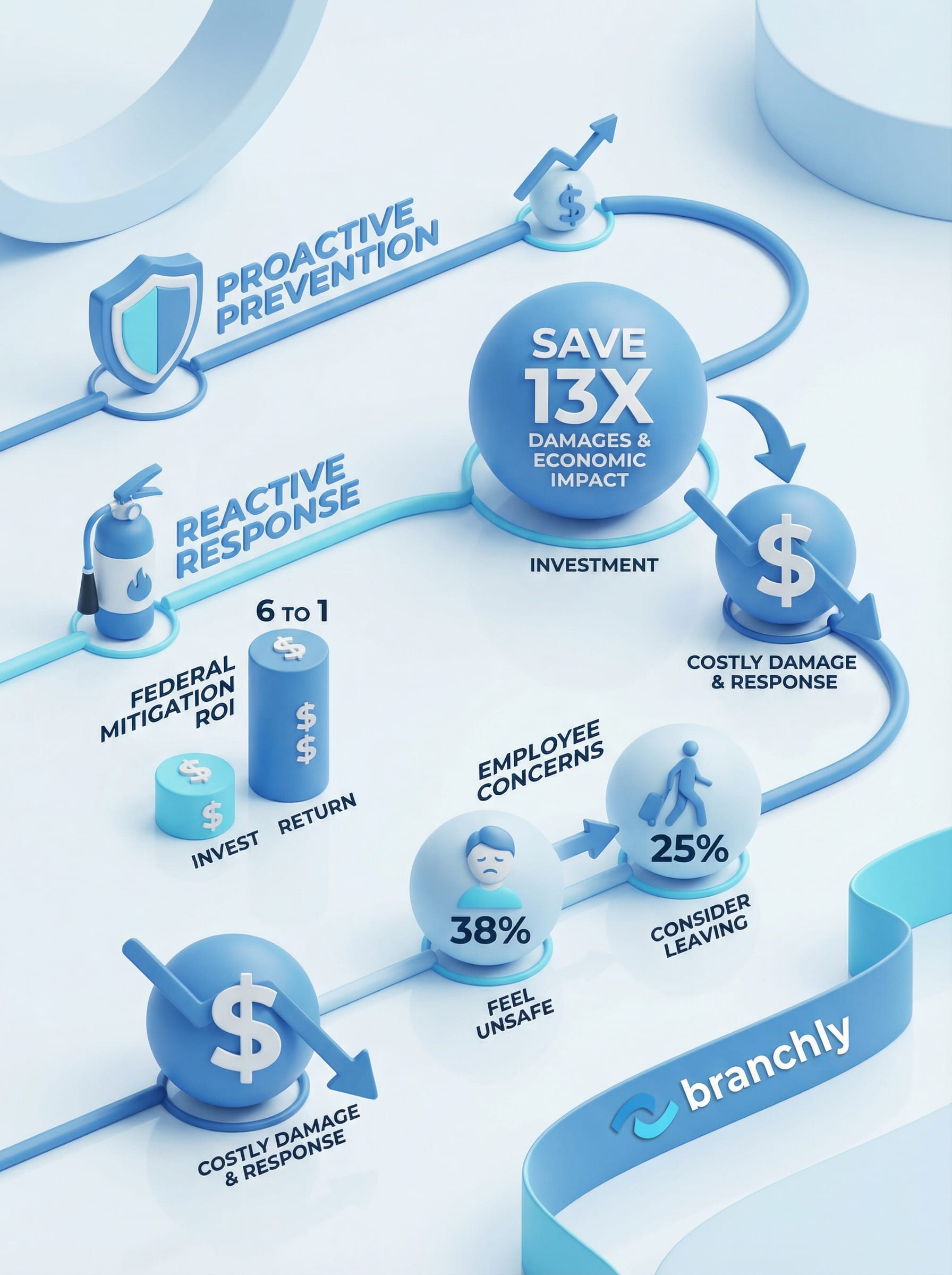
The math is straightforward: every dollar spent on crisis preparedness saves $13 in damages, cleanup costs, and economic impact according to climate resilience studies. For federal mitigation efforts, the return is $6 for every dollar invested. Yet many mid-market organizations still treat preparedness as an optional expense rather than a strategic investment. The gap between knowing you should prepare and actually doing it often comes down to one thing: not knowing where to start.
The Hidden Cost of Reactive Crisis Management
Reactive crisis management looks decisive in the moment. A pipe bursts and you call a plumber. A server crashes and IT works overtime. A disgruntled customer posts on social media and PR crafts a response. Problem solved, right?
Not quite. What you don't see is the cascade of costs: overtime wages for staff covering emergency repairs, lost revenue while operations are disrupted, customer trust that erodes with each fumbled response, and regulatory scrutiny triggered by poor documentation. A 2023 survey found that 38% of employees would feel unsafe at work following a crisis, and 25% would consider leaving their job. That's not just a crisis response problem. That's a retention crisis.
Organizations with reactive postures also pay more for insurance, face higher audit costs, and spend more on legal fees. When billion-dollar disasters become increasingly common, treating each incident as a surprise becomes unsustainable.
The Real Numbers
Communities that invest $1 in crisis preparedness save $13 in damages and economic impact. Federal mitigation efforts return $6 for every dollar spent.
Building a Proactive Risk Culture Starts at the Top
Leadership sets the tone for crisis preparedness. When executives talk about resilience only after an incident, employees learn that preparation isn't a priority. When leaders model proactive behavior, communicate transparently about risks, and invest in training, the entire organization shifts.
A proactive risk culture means employees at all levels are encouraged to identify, report, and address potential threats early. It's not about creating a culture of fear. It's about making risk awareness a shared responsibility instead of something isolated in a compliance department. Organizations with this mindset survived COVID-19 better, maintained employee engagement during remote operations, and adapted faster to supply chain disruptions.
But culture change requires more than a memo. It requires embedding risk management into daily operations through performance metrics, regular training, and accessible technology platforms. When preparedness becomes routine, response becomes instinctive.
Start Small
Don't wait for a perfect plan. Start with your top 3 operational risks and build playbooks for those scenarios first. Add more as you go.
Risk Assessment: Moving From Guesswork to Data
Most organizations know they have risks. Fewer can articulate which risks matter most. A structured risk assessment solves this by identifying vulnerabilities, prioritizing them by likelihood and impact, and creating a roadmap for mitigation.
Tools like SWOT analysis or PEST analysis help, but they're only as good as the data behind them. Pull weather patterns for your locations. Review local crime statistics. Map supply chain dependencies. Audit your technology stack for single points of failure. The goal isn't to predict every possible crisis. It's to understand which scenarios would cause the most damage and prepare accordingly.
Once you've identified top risks, implement early warning systems. Monitor social media for brand mentions that could signal a PR issue. Track financial indicators that might forecast a liquidity crisis. Set up alerts for severe weather in regions where you operate. Early detection gives you time to act before a problem becomes a crisis.
Planning That Actually Works When You Need It
Crisis plans fail when they're written once, stored in a binder, and forgotten. Effective planning requires three things: documentation, testing, and updates. Skip any one of those and your plan becomes a liability during an actual crisis.
Your crisis plan should include business continuity protocols, emergency response procedures, crisis communication templates, and recovery strategies. But here's what matters more: can your team actually use it? If someone has to dig through 50 pages to find the phone tree, your plan is too complex. If managers don't know where to find pre-approved messages, you'll waste critical time during an incident.
Testing reveals gaps you didn't know existed. Run tabletop exercises quarterly. Simulate a cyber outage and see if IT can execute their recovery plan. Stage a severe weather drill and check if branch managers know who to contact. Record what worked, what didn't, and what confused people. Then update your plan accordingly.
Test Realistically
Don't announce drills in advance. Test during busy periods when staff is stressed. Real crises don't wait for convenient timing.
Why Employees Are Your First Line of Defense
A 2023 survey showed that 78% of employed Americans are concerned about future pandemics, 65% worry about severe weather, and 64% fear cyberattacks. Your employees are already thinking about crises. The question is whether you're preparing them to respond effectively.
Engaged employees who know what to do during a crisis stay loyal and adapt faster. Unprepared employees panic, make poor decisions, or leave. Training doesn't have to be elaborate. Short monthly sessions on specific scenarios (fire evacuation, active shooter, system outage) build muscle memory. Role-specific training ensures managers know their responsibilities and front-line staff know who to contact.
Cross-functional collaboration improves response quality. Your operations team knows where bottlenecks happen. Your customer service team hears complaints first. Your IT team understands system dependencies. Involve all of them in crisis planning, and you'll catch risks others miss.
Technology as a Force Multiplier, Not a Magic Bullet
Technology can speed up preparedness, but only if it fits your workflow. AI-driven analytics can predict risks by analyzing patterns in your operations, weather data, and industry trends. But if the system requires a data scientist to interpret results, it won't get used. Automation can generate playbooks, send alerts, and log compliance actions. But if it's not integrated with your existing tools, adoption will be low.
The best technology platforms do three things well: they make preparedness easier than improvisation, they scale across multiple locations without requiring custom setup for each one, and they provide audit trails that regulators accept. If you're evaluating tools, prioritize those criteria over feature lists.
Platform Checklist
Ask vendors: Can non-technical users modify plans? Does it work when internet is down? Can it auto-generate location-specific playbooks?
Measuring Preparedness ROI
CFOs want numbers. How do you quantify the value of something that prevents problems? Start by calculating the cost of your last crisis. Add direct expenses like repair costs and overtime wages. Include indirect costs like lost revenue, customer churn, and staff turnover. Now compare that to your annual preparedness investment.
Track response times before and after implementing preparedness programs. Measure how quickly you resolve incidents now versus a year ago. Monitor employee confidence through surveys. Count the number of drills completed and playbooks updated. These metrics demonstrate progress even when you haven't faced a major crisis recently.
Insurance premiums offer another data point. Organizations with documented preparedness programs and regular testing often negotiate lower rates. Audit costs decrease when you can produce tamper-resistant logs and demonstrate compliance. These tangible savings build the business case for continued investment.
Learning From Every Incident
Post-crisis reviews separate good organizations from great ones. After every incident or drill, gather the team and ask three questions: What worked? What didn't? What confused people? Document the answers and update your plans immediately.
Look for patterns. If multiple locations struggled with the same step, the playbook needs clarification. If managers consistently skipped a particular approval, it's probably unnecessary. If response times improved after a specific change, replicate it across other scenarios.
This feedback loop transforms static plans into continuously improving systems. Organizations that treat every drill as a learning opportunity build institutional knowledge faster than those who only evaluate performance during real crises.
Blameless Reviews
Make post-incident reviews about process improvement, not individual performance. People won't report problems if they fear consequences.
Overcoming the Helplessness Barrier
Research shows that managers often express willingness to prepare but don't know where to begin. This helplessness barrier stops more preparedness programs than budget constraints. The solution is breaking the work into small, manageable steps.
Start with a single location and a single scenario. Build a playbook for one crisis type. Test it once. Learn from the results. Then expand to a second scenario or a second location. Progress matters more than perfection. An 80% complete plan that your team has practiced beats a comprehensive plan that sits unused.
Organizations with proactive cultures that encourage calculated risk-taking demonstrate higher crisis readiness. They view preparedness as an ongoing practice, not a one-time project. That mindset shift makes the difference between organizations that survive crises and those that thrive through them.
Summary
Proactive crisis prevention delivers measurable returns through reduced damage costs, lower insurance premiums, faster response times, and stronger employee retention. Organizations that build preparedness into their culture, conduct regular risk assessments, test their plans consistently, and learn from every incident create resilience that compounds over time. The investment pays for itself many times over, not just when a major crisis hits, but through improved operations and reduced friction in daily work. The question isn't whether you can afford to prepare. It's whether you can afford not to.
Key Things to Remember
- ✓Every $1 invested in crisis preparedness saves $6-13 in damages and recovery costs
- ✓Leadership must model proactive behavior and embed risk management into daily operations
- ✓Regular testing and post-incident reviews transform static plans into continuously improving systems
- ✓Employee engagement and cross-functional collaboration improve crisis response quality
- ✓Start small with one location and one scenario, then expand based on lessons learned
How Branchly Can Help
Branchly transforms crisis preparedness from a manual, reactive process into a proactive, continuously learning system. Our platform conducts automated risk assessments across all your locations, generates location-specific playbooks based on each site's unique attributes, and maintains pre-approved communication templates so your team never has to write messages during a crisis. Real-time testing and post-incident analysis automatically identify gaps and suggest improvements, turning every drill and incident into an opportunity to strengthen your response. With compliance-ready audit trails and one-click activation through our Command Center, Branchly makes preparedness easier than improvisation.
Citations & References
- [1]
- [2]Proactive Crisis Management: Preparing Emerging Leaders for Unforeseen Challenges jointhecollective.com View source ↗
- [3]
- [4][CM] [ISO] Building an Effective Crisis Management Capability: Key Principles and Practices [R 5.1] bcm-institute.org View source ↗
- [5]
- [6]Proactive Measures for Crisis Prevention | Crisis Management and Communication Class Notes fiveable.me View source ↗
- [7]
- [8]4 Crisis Management Skills for Leaders: Leadership, Preparedness, Response, and Recovery | Mads Singers Management Consulting madssingers.com View source ↗
- [9]Unpacking the ROI of Disaster Preparedness | U.S. Chamber of Commerce Foundation uschamberfoundation.org View source ↗
- [10]Preparing for disaster saves on damages, economic impact | U.S. Chamber of Commerce uschamber.com View source ↗
- [11]