
Introduction
When Boeing's 737 MAX crisis hit, their delayed and legally cautious response became a textbook case of what not to do. While lawyers debated word choices, families waited for answers. Public trust evaporated. The company's reputation took damage that years of marketing couldn't repair.
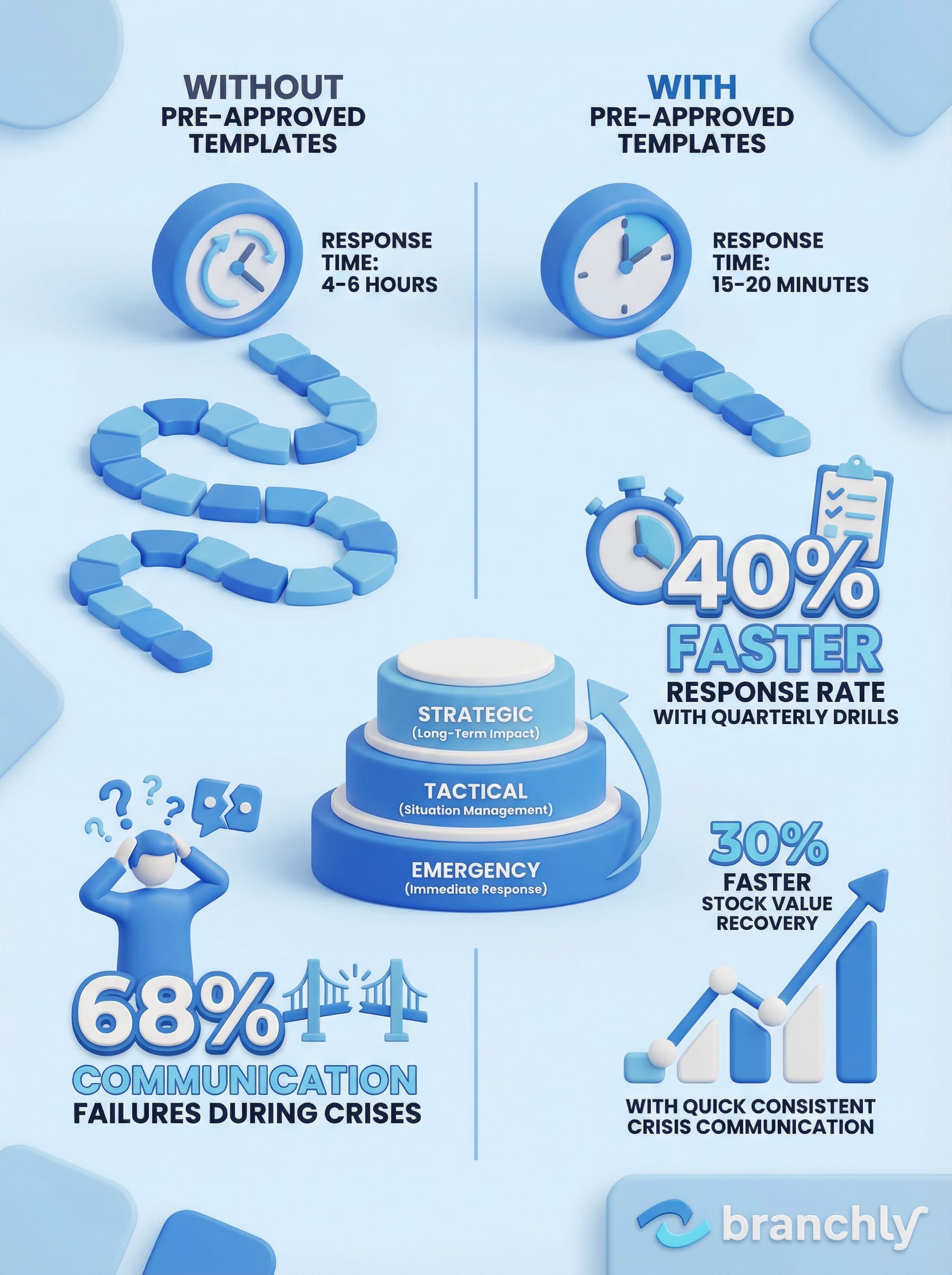
This isn't rare. Up to 68% of organizations face significant communication breakdowns during crises, often because approval chains turn what should take 15 minutes into a multi-hour ordeal. The fix isn't faster lawyers or looser controls. It's pre-approved messaging templates that get vetted long before the emergency hits. Here's why they matter and how to build them right.
The Real Cost of Delayed Crisis Communication
Speed isn't just about looking responsive. It's about controlling the narrative before someone else does. In 2025, misinformation spreads faster than your legal team can schedule a review meeting. Social media turns speculation into accepted fact within hours.
Most organizations face three bottlenecks when a crisis hits: hierarchical approval structures requiring sign-off from multiple departments, legal reviews that prioritize liability reduction over timely disclosure, and decentralized stakeholder contact systems where nobody's sure who should hear what first. Each delay compounds. Employees hear about the crisis on Twitter before getting internal communication. Customers call support lines that have no talking points. Regulators read about your breach in the news.
The 15-Minute Window
Organizations with pre-approved templates can issue holding statements within 15-20 minutes of a crisis emerging, even before full details are known. Those without? Average 4-6 hours for first external communication.
The financial impact is measurable. Companies that communicate quickly and consistently during crises recover stock value 30% faster than those that fumble messaging. Robinhood's $57 million FINRA fine came partly from communication failures during trading outages. When you can't tell customers what's happening, regulators assume you can't control what's happening.
What Makes a Good Pre-Approved Template
Templates aren't Mad Libs where you fill in the blanks. Good ones provide structure while allowing customization for specific incidents. They should cover press releases, social media posts, internal memos, customer emails, and regulatory notifications. Each needs placeholders for incident-specific details but pre-approved language for everything else.
Use frameworks like CAPS: Concern (acknowledge the issue), Action (what you're doing now), Plan (what happens next), and Support (resources available). This structure works whether you're announcing a data breach or explaining why 12 branches lost power. It's empathetic without admitting liability, transparent without speculation, and actionable without overpromising.
Template Categories to Build First
Start with your most likely scenarios: system outages, weather closures, security incidents, regulatory inquiries, and HR emergencies. These five categories cover 80% of crisis communications for most multi-location operations.
Templates should also specify tone and reading level. Your external crisis communication needs to match your brand voice, but simplified. Aim for 8th-grade reading level for customer-facing messages, even if your normal marketing skews more sophisticated. People under stress can't parse complex sentences. They need clear facts and next steps.
Legal review happens once, before the crisis. Get your templates through legal, compliance, PR, and executive leadership during calm periods when they can debate nuances without time pressure. Once approved, these become your playbook. When the incident hits, you're customizing pre-vetted language, not starting from scratch.
The Three-Tier Messaging System
Not every message needs the CEO's approval. A three-tier classification system defines who can deploy which communications based on urgency and impact: emergency response messages (life-safety issues, immediate threats), tactical messages (operational updates, customer service responses), and strategic messages (media statements, investor communications, regulatory filings).
Emergency messages get deployed by security or facilities teams without waiting for executive approval. If there's an active shooter or gas leak, your head of security can trigger the pre-approved evacuation message immediately. Tactical messages might need a crisis manager or communications director to review and send. Strategic messages still go through senior leadership, but they're choosing from pre-approved options rather than writing from scratch.
Who Approves What
Emergency: Security/Facilities (life-safety). Tactical: Crisis Manager/Comms Director (operations updates). Strategic: C-Suite/Legal (media, investors, regulators). Define this before the crisis, not during.
This tiered system prevents two common mistakes: bottlenecking urgent safety messages behind executive calendars, and having mid-level managers make public statements that expose the company to legal risk. Clear lanes keep things moving without creating chaos.
Tailoring Messages by Stakeholder Group
Your employees, customers, regulators, and media need different information at different times. Templates should account for this. The internal memo explaining a data breach includes technical details and action items for staff. The customer email focuses on what data was exposed and what protections you've put in place. The regulatory filing provides timeline documentation and compliance evidence.
Build a communication matrix that maps each stakeholder group to message owners, preferred channels, and escalation protocols. Employees should always hear first. Nothing destroys trust faster than staff learning about layoffs or security breaches from news alerts. Brief your internal teams before going public, even if it's just 30 minutes ahead.
Sequence Matters
Standard order: 1) Crisis team, 2) All employees, 3) Directly affected customers, 4) Broader customer base, 5) Media/public, 6) Regulators (if not already notified). Adjust based on legal obligations - some breaches require regulator notification before public disclosure.
For multi-location organizations, geography matters too. If a storm takes out six branches in one region, those branch managers need detailed operational guidance while headquarters sends simplified updates to unaffected locations. Templates should have regional customization fields so local teams can add specifics without rewriting core messaging.
Testing Templates Before You Need Them
Templates that look good in a binder often fail in actual use. The language is too stiff. The placeholders are ambiguous. The approval workflow made sense on paper but doesn't reflect how your organization actually operates. You won't find these problems by reading the document. You find them by running drills.
Run tabletop exercises where your crisis team responds to realistic scenarios using the templates. Give them 15 minutes to customize and deploy messages for a simulated data breach or facility fire. Watch where they struggle. Do people understand which template to use? Can they fill in the blanks without legal guidance? Does the approval workflow actually work under time pressure?
Test the technology too. Pre-approved templates are useless if they live in a shared drive that crashes when 50 people try to access it simultaneously. Use tools with read receipts and audit trails so you can confirm who received messages and when. This documentation becomes critical during post-incident reviews and regulatory audits.
What Good Testing Reveals
Real drills expose gaps in authority (who can actually approve messages?), technical failures (can't access templates during outage), and language problems (jargon nobody understands). Fix these during practice, not during actual emergencies.
Schedule these drills quarterly. Treat them like fire drills, not optional training. Build muscle memory so your team can execute under stress. Organizations that practice regularly respond 40% faster when real incidents hit because people aren't learning the process for the first time under crisis conditions.
Keeping Templates Current
Pre-approved templates expire. Your company gets acquired and the brand voice changes. New regulations require different disclosure language. Leadership turns over and the new CEO wants different messaging tone. Templates from two years ago might be legally outdated or tonally wrong.
Set annual review cycles where legal, PR, and compliance teams revisit all templates. Check for regulatory changes that affect required disclosures. Update contact information and escalation procedures. Retire templates for scenarios that are no longer relevant and create new ones for emerging risks.
Post-Incident Template Reviews
After every real crisis, review the messages you actually sent. What worked? What felt off? Where did you have to improvise because the template didn't fit? Use these lessons to refine templates while the experience is fresh.
Also track how often each template gets used. If your data breach templates never get deployed but weather-related closures happen monthly, invest more time refining the messages you actually need. Templates should reflect your real risk profile, not theoretical worst-case scenarios that never materialize.
The Compliance and Audit Angle
For regulated industries, pre-approved templates aren't just about speed. They're about compliance. FINRA Rule 4370 requires broker-dealers to have business continuity plans including emergency contact information and customer communication strategies. NCUA and FFIEC expect credit unions and banks to have documented crisis communication procedures. Generic plans don't satisfy auditors. You need evidence that messages were pre-vetted and properly deployed.
This means keeping audit trails. Document when templates were created, who approved them, when they were last reviewed, and how they were used during incidents. Auditors want to see the decision process, not just the final message. Time-stamped approval workflows prove you followed procedures rather than improvising during chaos.
Pre-approved templates also protect against regulatory penalties for inadequate disclosure. If you've already had legal review language about system outages, you're less likely to accidentally omit required notifications or use phrasing that creates liability. This matters when regulators review your incident response months later. Documented pre-approval shows due diligence.

Pre-Approved Messaging Workflow
From incident to coordinated stakeholder communication in under 20 minutes
Common Mistakes to Avoid
The biggest mistake is treating templates as fill-in-the-blank forms with no room for adaptation. Real incidents rarely fit cleanly into predetermined categories. Your cyberattack template might not account for a ransomware situation where attackers are actively leaking data. Build flexibility into templates so users can adapt without starting over.
Another mistake is making templates too legally defensive. Yes, you need to limit liability. But overly cautious language that admits nothing and promises nothing makes you look evasive. People can tell when you're hiding behind lawyers. Balance legal protection with genuine transparency about what you know, what you're doing, and what comes next.
The Holding Statement
Can't get full details in 15 minutes? Deploy a holding statement: acknowledge the incident, confirm you're investigating, provide next update timeline. Better than silence while you gather facts.
Don't create so many templates that nobody can find the right one. Start with 10-15 core scenarios covering your most likely risks. You can always build more as patterns emerge. But a crisis isn't the time for your team to be choosing between 47 different messaging options.
Finally, don't assume templates eliminate the need for real-time decision making. They provide structure and pre-approved language, but humans still need to judge which template fits, what customization is needed, and when to escalate. Templates support good judgment. They don't replace it.
Summary
Pre-approved messaging templates turn crisis communication from a bottleneck into a competitive advantage. They cut response times from hours to minutes, satisfy regulatory requirements for documented procedures, and protect your reputation when consistency matters most. But only if you build them right, test them regularly, and keep them current. The work happens before the crisis. The payoff comes when your team can respond decisively while competitors are still scheduling legal review meetings.
Key Things to Remember
- ✓Organizations with pre-approved templates respond 40% faster during crises and issue holding statements within 15-20 minutes instead of 4-6 hours
- ✓Use a three-tier messaging system (emergency, tactical, strategic) to define who can approve and deploy different communications without bottlenecking urgent safety messages
- ✓Test templates quarterly through realistic tabletop exercises to identify gaps in authority, technology failures, and unclear language before actual incidents
- ✓Tailor messages by stakeholder group and always brief employees first - staff learning about crises from external sources destroys internal trust
- ✓For regulated industries, documented pre-approval and audit trails prove compliance with FINRA, NCUA, and FFIEC requirements for crisis communication procedures
How Branchly Can Help
Branchly's Phase 4 Pre-Approved Communication engine eliminates the panic-writing that slows crisis response. The platform maintains templated, pre-vetted messages for employees, customers, vendors, and regulators, each customized to match your brand voice and reading level. Messages route through legal and compliance for pre-approval during calm periods, then deploy with one click when incidents hit. Tone Guard ensures consistency across all communications, while automatic audit trails document every message, timestamp, and approval for regulatory compliance. Your team moves from crisis detection to coordinated stakeholder communication in minutes, not hours.
Citations & References
- [1]
- [2]
- [3]
- [4]
- [5]
- [6]
- [7]everbridge.com View source ↗
- [8]caljac.org View source ↗
- [9]Crisis Communication: From Principles to Actionable Tips | DeskAlerts alert-software.com View source ↗
- [10]
- [11]
- [12]
- [13]What Most Organizations Get Wrong About Crisis Communication and How to Fix It dialmycalls.com View source ↗
- [14]How DeskAlerts Improves Crisis Communication with Real-Time Emergency Alerts alert-software.com View source ↗
- [15]