
Introduction
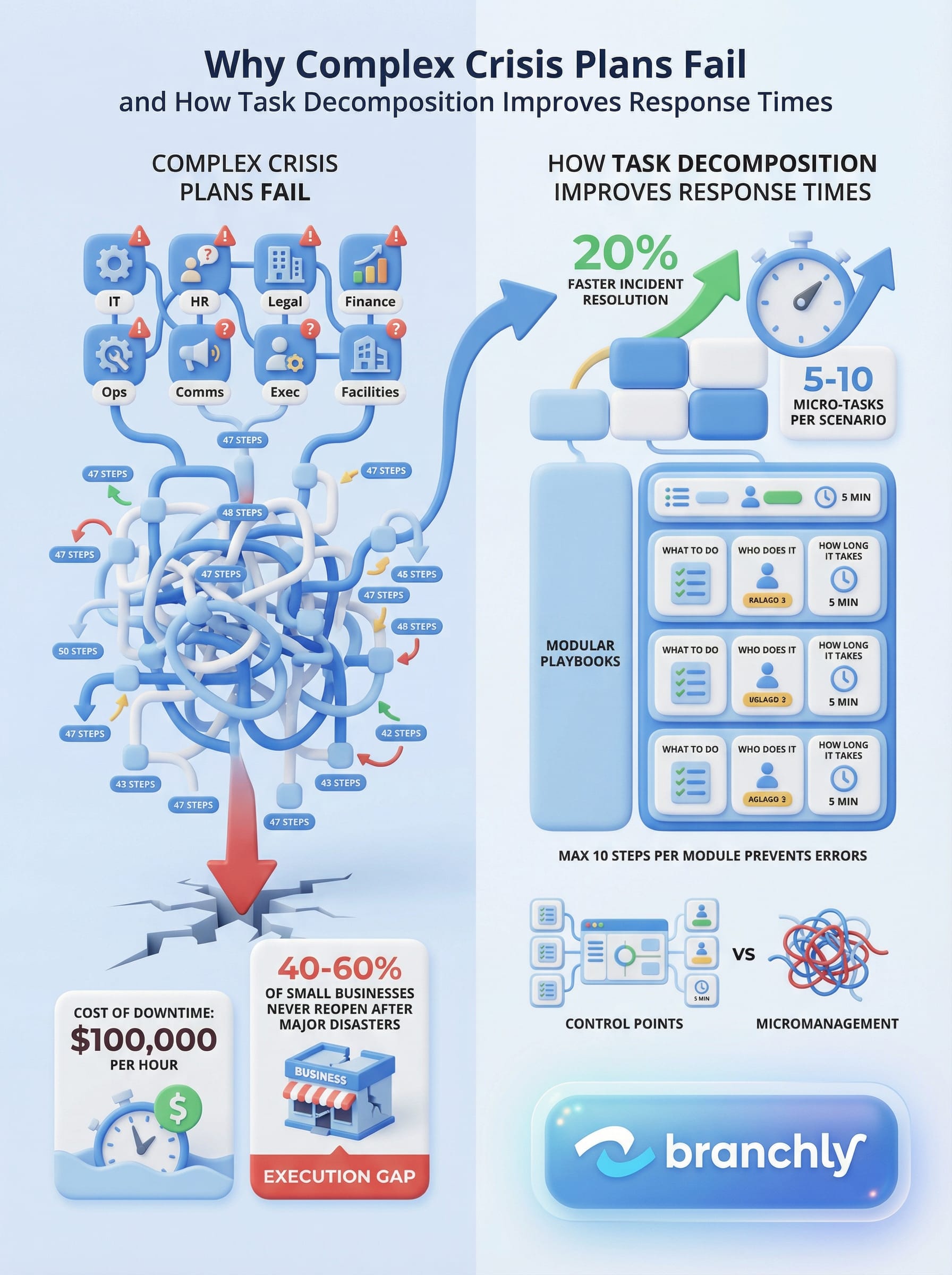
When a bank's primary power system failed during peak hours, the crisis plan called for 47 distinct steps across 8 departments. Staff scrambled through the manual. The result? A hasty restoration attempt that triggered hardware surges, damaging critical systems and forcing complex workarounds for days. The plan existed, but its complexity made it useless under pressure.
Studies show that 40 to 60% of small businesses never reopen after a major disaster. While many factors contribute to this, one stands out: the gap between having a plan and being able to execute it. The Three Mile Island incident demonstrated how minimal planning and unfamiliar procedures lead to catastrophic outcomes. Your team doesn't need a 200-page manual. They need clear, actionable steps they can execute without thinking.
The Hidden Cost of Complexity
Crisis management plans often fail not because they lack detail, but because they contain too much of it. When your data center goes offline or a cyberattack locks you out, staff don't have time to parse through dense procedures, navigate approval chains, or decipher ambiguous responsibilities.
Companies lose roughly $100,000 per hour during unplanned downtime. Every minute spent hunting for the right procedure or waiting for clarification multiplies that loss. Worse, cognitive overload under stress leads to errors that compound the original problem. The bank example above shows how complexity creates cascading failures: aging infrastructure, discontinued parts, and staff unfamiliar with protocols turned a power failure into a multi-day crisis.
Research on emergency response reliability reveals that systems perform well up to a certain capacity, then struggle dramatically near maximum load. Complex procedures accelerate this breakdown. When your crisis plan requires cross-referencing multiple documents, coordinating across departments without clear handoffs, or making judgment calls on vague criteria, you've built a system designed to fail under pressure.
Test Under Realistic Conditions
Run drills that simulate actual stress: limited information, time pressure, key personnel unavailable. If your team can't execute the plan during a controlled exercise, they won't during a real crisis.
How Task Decomposition Changes Crisis Response
Breaking complex emergencies into manageable, well-defined components addresses the core problem. Task decomposition treats crisis response as a series of specific actions with clear ownership, sequencing, and completion criteria. Instead of "restore critical systems," you get: check backup power status (Facilities, 2 minutes), notify IT leadership (Operations Manager, immediate), activate failover protocols (IT Lead, 5 minutes).
This approach applies targeted control at critical decision points without micromanaging execution. During the prodromal and acute phases of a crisis, when damage containment matters most, close oversight of specific tasks prevents errors while preserving team autonomy for tactical decisions. A credit union dealing with a core banking outage doesn't need executives approving every step. They need predefined modules for member communication, transaction logging, and manual processing that activate with one click.
Platforms like Trello, Asana, and specialized crisis tools automate task assignment and track progress in real time. These systems reduce cognitive load, minimize human error, and improve incident resolution times by up to 20%. When your restaurant chain faces a food safety recall, your regional managers see exactly which locations need inspections, who's responsible, and what communication templates to use. No hunting through email threads or waiting for direction from corporate.
20% Faster Resolution
Organizations using workflow management systems for crisis response resolve incidents 20% faster than those relying on manual coordination and ad-hoc communication.
Building Modular Response Playbooks
Predefined response modules linked to specific scenarios enable fast activation while maintaining flexibility. A modular playbook for a retail network might include separate modules for: point-of-sale system failure, severe weather closure, workplace injury, supply chain disruption, and customer data incident. Each module contains the minimum viable steps to stabilize the situation.
The power lies in combination. When a hurricane knocks out power at multiple locations, you activate both the weather closure module and the utility failure module. Each contains 5 to 8 micro-tasks with clear owners and time estimates. Store managers aren't paralyzed wondering what to do. They execute their assigned tasks while the operations center tracks completion and identifies bottlenecks.
This approach aligns with established frameworks like Fink's Four-Phase Model and Mitroff's Crisis Management Model, which emphasize structured intervention across distinct stages. By assigning clear roles and escalation protocols to each micro-task, you establish a coherent chain of command without bogging down in bureaucracy. The branch manager handles immediate safety concerns. The regional director coordinates with vendors. The communications team manages customer notifications. Everyone knows their lane.
Keep Modules Under 10 Steps
If a single response module requires more than 10 distinct tasks, split it into sub-modules or simplify the workflow. Longer checklists increase the likelihood of skipped steps and execution errors.
Control Points vs. Micromanagement
Task decomposition succeeds when it identifies control points where oversight matters most, not by requiring approval for every action. Control points are moments where a wrong decision creates disproportionate risk: activating emergency generators, authorizing public statements, shutting down production lines, or evacuating facilities.
At these junctures, your playbook should mandate specific approvals or verifications. A hotel dealing with a potential Legionella outbreak needs the facilities director and legal counsel to sign off before notifying guests. But the engineering team doesn't need permission to test water samples or shut off affected systems. They execute their micro-tasks while leadership focuses on high-stakes decisions.
This balance preserves team morale and agility. Staff feel trusted to handle their responsibilities rather than monitored for compliance. Leaders maintain strategic oversight without drowning in operational details. When your franchise network experiences a product recall, franchisees follow their removal and notification checklists independently. Corporate tracks completion rates in real time and intervenes only where problems surface.
The Implementation Fallacy
Having a formal crisis plan doesn't guarantee effective performance. Organizations often discover that documented procedures don't translate into coordinated action under pressure without regular practice and refinement.
Communication Clarity in Micro-Tasks
Every micro-task needs three elements: what to do, who does it, and how long it should take. Vague assignments like "coordinate with vendors" create confusion. Better: "Contact backup internet provider using pre-negotiated emergency contract (IT Manager, 10 minutes)." The specificity eliminates ambiguity and enables meaningful progress tracking.
Pre-approved communication templates extend this principle to messaging. During a crisis, staff shouldn't compose emails from scratch. They select the appropriate template, customize location-specific details, and send. A credit union experiencing online banking downtime pulls the "system outage - member notification" template, adjusts the expected restoration time, and pushes it through established channels. No waiting for marketing approval or legal review because that happened during preparation.
Real-time collaboration tools centralize this communication. When multiple agencies or departments must coordinate, shared dashboards ensure everyone sees the same information simultaneously. No telephone trees, no forwarded email chains, no wondering if the night shift received critical updates. The system logs every action and timestamp automatically, creating audit trails that satisfy regulatory requirements without additional documentation burden.
Template Every Recurring Communication
Map your most common crisis scenarios and build pre-approved message templates for employees, customers, vendors, and regulators. Include variable fields for customization but lock down tone, legal language, and core messaging.
Learning From Each Incident
Task-based response systems generate actionable data after every incident and drill. You see which tasks took longer than expected, which got skipped, where bottlenecks formed, and which role assignments proved unrealistic. This feedback loop transforms crisis response from static planning into continuous improvement.
A hotel chain might discover that their "guest relocation" module consistently exceeds time estimates because it assigns too many tasks to front desk staff already handling guest inquiries. The solution: split responsibilities with housekeeping or add temporary staffing triggers when occupancy exceeds 75%. Without granular task tracking, this inefficiency remains invisible until it causes a real failure.
Methods like Failure Mode, Effects, and Criticality Analysis help identify where your response system might break down before it happens. You model each task, assess failure likelihood and impact, then prioritize improvements. Maybe your backup generator test happens quarterly but should be monthly. Perhaps your vendor notification list includes contacts who left two years ago. Small fixes to individual micro-tasks compound into significantly better overall resilience.
The key is treating every drill and real incident as a learning opportunity. After-action reviews focus on execution gaps, not blame. Did the playbook reflect reality? Were role assignments realistic? Did communication templates work? Use the answers to refine your micro-tasks continuously. A living system that improves with each use beats a perfect plan that never changes.
Test Your Tests
Regular drills help staff become familiar with procedures, but only if those drills simulate realistic conditions. Tabletop exercises in conference rooms don't prepare teams for 3 AM phone calls and incomplete information.
Making the Transition
Moving from complex procedures to task-based response doesn't require starting over. Begin by mapping your three most likely crisis scenarios. For each, identify the critical first 90 minutes: what must happen to contain damage and stabilize operations. Break those requirements into 5 to 10 micro-tasks with clear owners and time estimates.
Test these simplified playbooks through drills, then expand to additional scenarios based on your risk assessment. Don't try to document every possible situation. Build flexible modules that combine for varied circumstances. A regional bank might start with: core system outage, branch closure, data security incident. Each module contains 6 to 8 tasks. Combined, they handle dozens of specific scenarios without requiring dozens of separate plans.
Invest in tools that support real-time coordination and automatic logging. Spreadsheets and PDF manuals can't keep pace with multi-location incidents. You need systems that push updates to all stakeholders simultaneously, track task completion automatically, and generate audit documentation without manual effort. The upfront cost pays for itself the first time you cut response time in half and prevent a small problem from becoming a catastrophic one.
Summary
Complex crisis plans fail because they overwhelm teams when clarity matters most. Task decomposition and micro-tasking transform response from chaotic coordination into structured execution. By breaking emergencies into specific, manageable actions with clear ownership and time estimates, organizations reduce errors, accelerate resolution, and build systems that improve with each use. The goal isn't perfection. It's having plans your team can actually execute under pressure.
Key Things to Remember
- ✓Complexity kills crisis response. Plans with dozens of steps across multiple departments create cognitive overload and execution failures when time is critical.
- ✓Task decomposition breaks emergencies into 5-10 micro-tasks per scenario with clear owners, time estimates, and completion criteria.
- ✓Modular playbooks allow flexible combinations for varied scenarios without requiring separate plans for every possible incident.
- ✓Control points identify high-stakes decisions requiring oversight while preserving team autonomy for tactical execution.
- ✓Real-time tracking tools and pre-approved templates reduce response times by 20% while automatically generating compliance documentation.
How Branchly Can Help
Branchly automates task decomposition by generating location-specific playbooks with clear micro-tasks, role assignments, and time estimates. When you activate a response scenario, the Command Center displays exactly what each person needs to do and tracks completion in real time. Pre-approved communication templates eliminate panic-writing during crises, while automatic logging creates audit trails without manual documentation. The Intelligence Layer analyzes every incident and drill to identify bottlenecks and suggest workflow improvements, turning your crisis response into a system that gets better with each use.
Citations & References
- [1]dpublication.com View source ↗
- [2]
- [3]
- [4]
- [5]
- [6]
- [7]Demystifying Crisis Leadership: What’s involved in strategic decision making | BCI thebci.org View source ↗
- [8]
- [9]5 Most Common Gaps in Crisis Management That Could Cripple Your Response - Expert Crisis Management and Disaster Preparedness | Early Alert earlyalert.com View source ↗
- [10]Public health response to disasters and crises: setting the agenda for effective action | International Journal of Emergency Medicine biomedcentral.com View source ↗
- [11]
- [12]“Leading through Crisis”: A Systematic Review of Institutional Decision-Makers in Emergency Contexts - PMC nih.gov View source ↗
- [13]Evaluating the Reliability of Emergency Response Systems for Large-Scale Incident Operations - PMC nih.gov View source ↗