
Introduction
When Ethiopian health officials responded to COVID-19, three separate agencies mobilized resources for the same cities. Each thought they were filling a gap. None knew the others had already dispatched teams. The result wasn't just wasted resources. It was fragmented donor engagement, incomplete data sharing, and slower response times across the entire country.
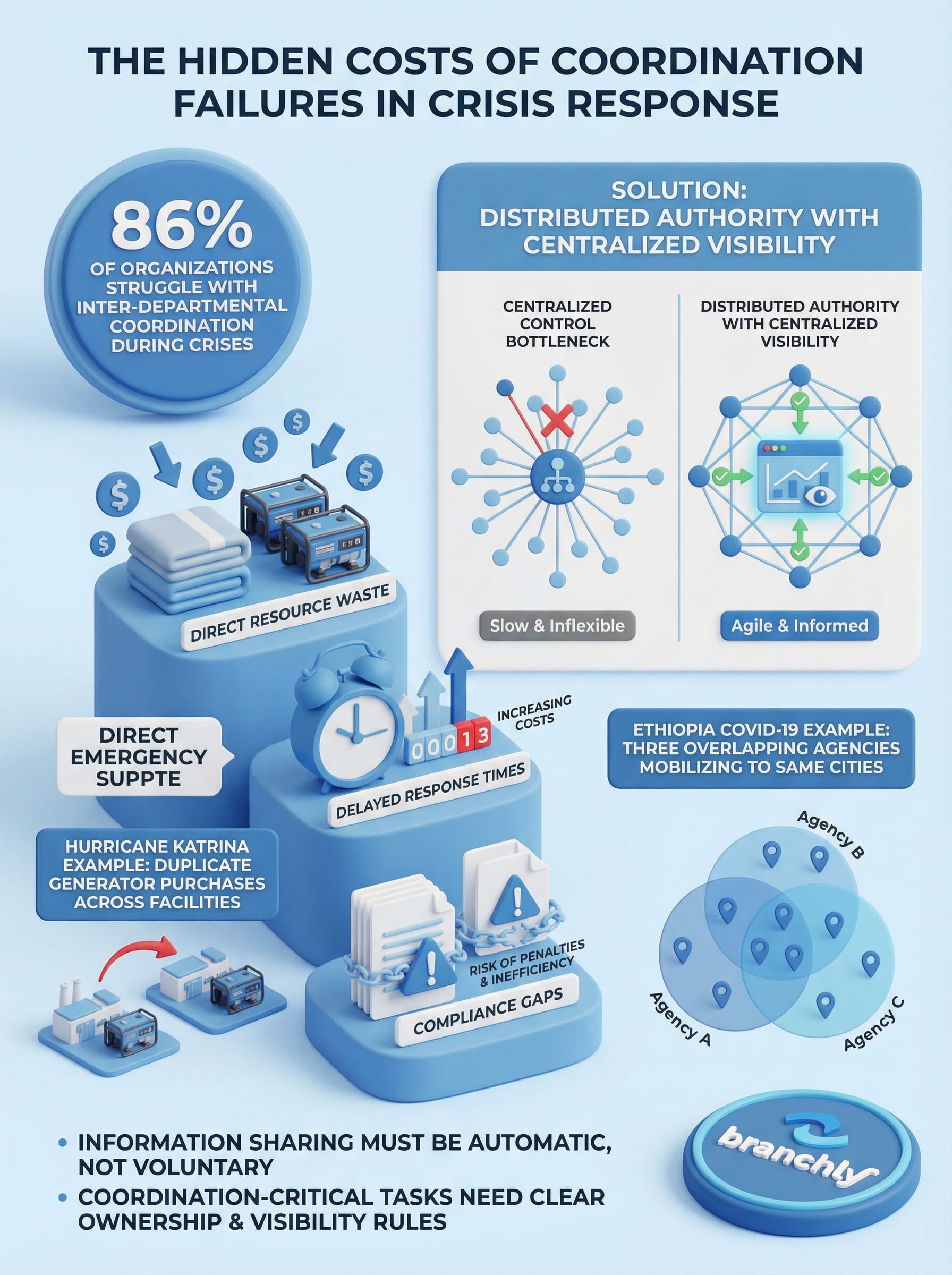
This pattern repeats in every multi-location organization facing a crisis. The failure point isn't usually the plan itself. It's that nobody can see what everyone else is doing until it's too late. Research shows 86% of organizations report struggles with inter-departmental coordination during major incidents. The crisis becomes manageable. The chaos becomes catastrophic.
The Three Hidden Costs of Poor Coordination
Coordination failures don't show up in your crisis plan. They show up in your bank account, your audit reports, and your customer reviews. The actual damage compounds in ways most organizations only discover after the fact.
First, there's direct resource waste. During Hurricane Katrina, federal agencies submitted duplicate resource requests to the same suppliers because no shared system tracked who ordered what. Multiple teams purchased generators for the same facilities. Equipment sat unused in one county while neighboring areas ran short. This wasn't incompetence. It was structural invisibility.
Second, delayed response kills efficiency. In Pakistan, NGOs coordinated directly with provincial authorities without consulting other organizations. Result? Some flood zones received three water deliveries in one day. Others waited four days. The resources existed. The visibility didn't.
Quick Check
Can your regional managers see in real time what other regions are doing during an active incident? If the answer is no, you're operating blind.
Third, compliance gaps emerge from inconsistent documentation. When South Africa rolled out COVID vaccines, government and development agencies duplicated roles because no unified coordination forum existed. Incompatible monitoring systems meant no one could prove who did what. Audit trails had holes. Regulators asked uncomfortable questions.
Why Smart Teams Still Work Against Each Other
The problem isn't that your people don't care. It's that crisis response creates structural conditions where well-intentioned teams accidentally undermine each other.
Role ambiguity sits at the top of the list. When Ethiopia's Ministry of Health, Public Health Institute, and Disaster Management Commission all mobilized for nutrition emergencies, each agency had overlapping mandates. Nobody intentionally stepped on toes. The organizational chart just made toe-stepping inevitable.
The Visibility Problem
Relief workers prioritize receiving information over sharing it. Without forcing mechanisms, information flows one direction until it's too late.
Communication breakdowns happen even with good technology. During Katrina, the National Response Plan required formal Mission Assignments with paperwork and approvals. Agencies facing urgent needs bypassed the system and acted independently. The result? Duplicate efforts nobody discovered until after-action reviews months later.
Separate command structures guarantee coordination failures at scale. During the same hurricane, federal active-duty military operated under one command while state National Guard units reported through different chains. U.S. Northern Command didn't know what Guard units were deployed where. Tasks got assigned to teams already committed elsewhere.
What Task Visibility Actually Means
Task visibility sounds simple. It's not about fancy dashboards. It's about answering three questions in real time: Who is doing what? Where are they doing it? What's the current status?
Organizations without task visibility operate in a fog. Your district manager in Phoenix orders backup servers for a system outage. Your IT director in Dallas orders the same servers for the same outage 20 minutes later. Both thought they were being proactive. Neither knew the other had already acted.
Mass casualty incidents show this problem in stark terms. Studies of traffic accidents found incomplete scene information led responders to arrive under-equipped. Delays in rescue operations increased fatalities. The information existed. Someone at the scene knew how many victims needed help. But that information never reached the teams en route.
The Five-Minute Test
If an executive asks what's happening right now across all affected locations, how long until you can answer with confidence? If it's more than five minutes, your coordination system has failed.
Real visibility means everyone with response responsibility can see task status without asking. Not summaries. Not updates when someone remembers to send them. Live status that updates as teams complete work.
The Subnational Coordination Gap
Most coordination failures happen below the executive level. Your crisis plan looks great from headquarters. But what about the 47 franchise locations that need to execute it simultaneously?
Kenya's pandemic response suffered because county-level priorities didn't integrate into national plans. Communication on funding and procurement broke down between levels. Local teams delayed responses waiting for clarity that never came. The national plan existed. The local execution failed because nobody connected the two.
This mirrors what happens in franchise systems. Corporate sends the crisis playbook. Local owners receive it. But without clear coordination on who does what steps, franchise locations improvise. Some overreact. Others underreact. The brand experience fragments across locations.
The Regional Blind Spot
Ethiopia's regions lacked zonal emergency operations centers. Information couldn't flow between national and local levels. Duplication increased. Response gaps widened.
Subnational gaps get worse when local teams can't see each other's actions. Your credit union branches all follow the same continuity plan. But when a regional internet outage hits, can Branch 12 see that Branch 8 already ordered mobile hotspots? Or does Branch 12 order another set because nobody told them?
Why Centralized Control Makes Coordination Worse
The instinct during a crisis is to centralize decision-making. Get everyone on the same conference call. Route everything through one command center. Make sure headquarters approves each action.
This approach backfires in multi-team systems. Research shows that when decision-making centralizes and inter-team communication limits, coordination gets worse. Component teams develop conflicting priorities. Local knowledge gets ignored. Bottlenecks form around the central authority.
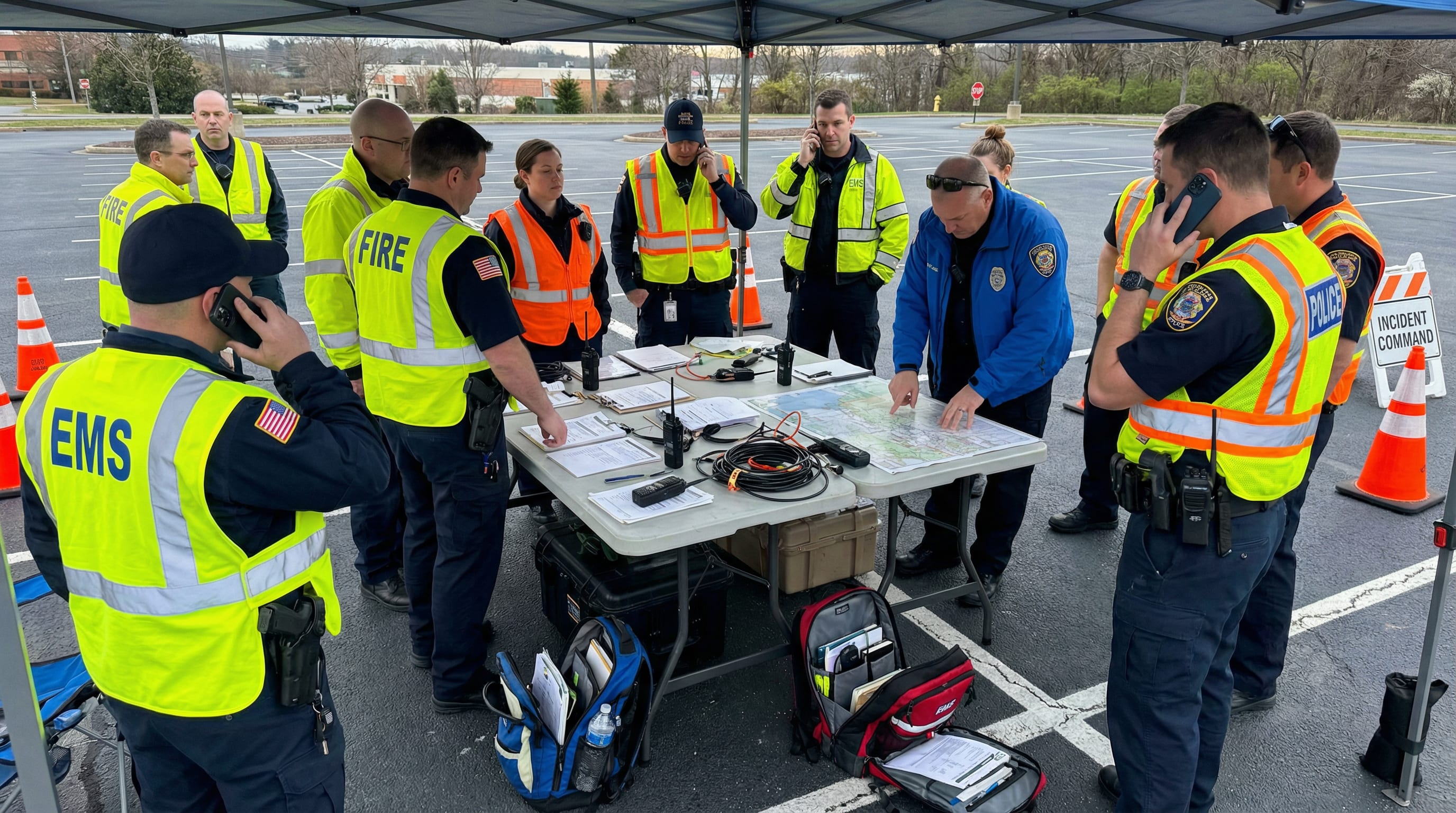
Better coordination requires distributed authority with centralized visibility. Local teams need power to act on ground-truth information. But everyone needs to see what actions others are taking in real time. You want fast local response with system-wide awareness.
The Coordination Model That Actually Works
Local authority to act. Central visibility of all actions. No bottlenecks.
This model requires technology that most organizations lack. Your district managers need ability to execute playbook steps without approval. But your executives need a live dashboard showing every step being taken across all locations. The technology creates accountability without creating delays.
The Information Sharing Paradox
People hoard information during crises. Not because they're selfish. Because sharing takes time they don't have and offers no immediate benefit to their specific situation.
Your branch manager dealing with a power outage wants to know: When will power return? Where can we get a generator? Can we reroute customers? They don't naturally think to broadcast: We've secured a generator, don't order another one. That update helps the system. It doesn't help them right now.
Force the Share
Information sharing can't be optional. Your system must auto-broadcast task completion to everyone who might duplicate that work.
Without forcing mechanisms, information flows stay one-directional. Field teams want information from headquarters. Headquarters wants information from the field. But lateral information between peer locations never flows unless you build systems that share automatically.
The solution isn't asking people to share more. It's building systems where sharing happens as a byproduct of doing the work. When someone checks off a task in your response platform, that completion instantly becomes visible to everyone else working related tasks. No extra effort required.
What Good Coordination Looks Like in Practice
Organizations with working coordination systems share specific characteristics. These aren't aspirational. They're observable behaviors you can measure.
First, role clarity exists before the crisis. Everyone knows their specific responsibilities and can see exactly where their role ends and someone else's begins. No overlap. No gaps. When ambiguity exists, escalation paths are pre-defined and fast.
Second, task status updates automatically. Nobody sends status reports. The system captures completion as work happens. If your facilities manager marks a generator delivered, every other facilities manager sees that update within seconds.
Coordination Metric
Track duplicate resource purchases. If the number isn't zero, your coordination has failed.
Third, bottlenecks become visible immediately. When five locations all wait on the same approval, your dashboard shows that pile-up. Leadership can intervene before delay cascades. Most organizations only discover bottlenecks during post-incident reviews when it's too late to matter.
Fourth, compliance documentation happens automatically. Every task completion, every approval, every decision gets timestamped and logged without manual effort. Your audit trail builds itself because the system captures actions as they occur.
Building Coordination Into Your Playbooks
Most crisis playbooks tell people what to do. They don't tell people how to avoid duplicating what others are already doing. That's the missing piece.
Start by identifying coordination-critical tasks. These are actions where duplication wastes significant resources or where multiple teams might reasonably attempt the same solution. Equipment purchases. Vendor notifications. Customer communications. Regulatory filings.
For each coordination-critical task, your playbook needs three elements. First, clear ownership. One role claims this task. Everyone else can see it's claimed. Second, visibility rules. Who needs to see when this task starts and completes? Third, dependency mapping. What other tasks can't proceed until this one finishes?
Test for Duplication
Run a tabletop exercise where two teams both think they own the same task. See how long it takes to discover the conflict. If it's more than 60 seconds, your system needs work.
Then build forcing mechanisms into task execution. When someone claims a coordination-critical task, the system should auto-notify anyone else who might duplicate that work. When they complete it, that completion should trigger next-step tasks for dependent teams.
The ROI of Coordination
Organizations struggle to justify investment in coordination systems because the ROI appears intangible. But the math is straightforward once you measure the right things.
Calculate your duplicate resource costs. During your last three incidents, how many times did multiple locations order the same equipment or service? What did those duplicates cost? Most organizations discover this number is higher than expected because nobody was tracking it.
Measure coordination delays. How many hours did teams spend in status meetings trying to figure out who was doing what? How many decisions got delayed because information sat with one person who wasn't available? Time waste compounds across dozens of people during every incident.
Hidden Waste
One mid-size retail chain found they'd purchased 14 backup generators across 8 locations during a regional outage. They needed 8. Coordination failure cost $47,000 in one incident.
Factor in compliance risk. Incomplete documentation and inconsistent response across locations create audit exposure. One regulatory fine for inadequate continuity practices often exceeds the entire annual cost of proper coordination systems.
Then add reputational protection. When customers see professional, coordinated response across all locations, you preserve brand equity. When they see chaos and inconsistency, you lose trust that takes years to rebuild.
Summary
Coordination failures during crisis response cost more than most organizations realize. The pattern repeats across industries and incident types: smart people working hard but unable to see what their colleagues are doing until duplication and delays compound the original problem. The solution isn't trying harder. It's building systems where task visibility, role clarity, and information sharing happen automatically as teams execute response plans. Organizations that solve coordination don't just respond faster. They respond at lower cost with better documentation and more consistent outcomes across all locations.
Key Things to Remember
- ✓86% of organizations struggle with inter-departmental coordination during crises, turning manageable incidents into catastrophic failures through duplicate efforts and communication breakdowns.
- ✓Task visibility requires answering three questions in real time: who is doing what, where are they doing it, and what's the current status. Without live answers, duplication is inevitable.
- ✓Centralized control worsens coordination in multi-team systems. Better approach: distributed authority to act with centralized visibility of all actions.
- ✓Information sharing won't happen voluntarily during crises. Systems must auto-broadcast task completion to everyone who might duplicate that work.
- ✓Coordination failures create measurable costs: duplicate resource purchases, compliance gaps from inconsistent documentation, and reputational damage from inconsistent response across locations.
How Branchly Can Help
Branchly's Command Center solves coordination failures by giving every team member live visibility into what's happening across all locations. When one location claims a task, everyone else sees it immediately. When they complete it, that status broadcasts automatically. Role assignments are pre-defined in playbooks so there's never ambiguity about who owns what. Dependent tasks trigger automatically when prerequisites complete. Every action, approval, and decision gets timestamped in tamper-resistant audit logs. You get distributed execution with centralized visibility, eliminating duplication without creating bottlenecks. The system forces information sharing as a byproduct of doing the work, so coordination happens without extra effort from teams already under pressure.
Citations & References
- [1]
- [2]How can we strengthen partnership and coordination for health system emergency preparedness and response? Findings from a synthesis of experience across countries facing shocks | BMC Health Services Research springer.com View source ↗
- [3]Challenges and obstacles in sharing and coordinating information during multi-agency disaster response: Propositions from field exercises | Information Systems Frontiers springer.com View source ↗
- [4]How can we strengthen partnership and coordination for health system emergency preparedness and response? Findings from a synthesis of experience across countries facing shocks - PMC nih.gov View source ↗
- [5]Exploring Barriers and Facilitators of Inter-Organizational Management in Response to Mass Casualty Traffic Incidents: A Qualitative Study - PMC nih.gov View source ↗
- [6]Challenges and obstacles in sharing and coordinating information during multi-agency disaster response: Propositions from field exercises | Information Systems Frontiers springer.com View source ↗