
Introduction
The call came in at 9:02 AM: the core banking system was down across 47 branches. By 9:08, frontline staff were still waiting to hear whether they should close, switch to manual processes, or tell customers to come back later. The regional manager was waiting for the VP to approve the communications plan. The VP was in a meeting. By the time someone made a decision at 9:31, customers had already started posting angry reviews online.
This delay didn't happen because people were incompetent. It happened because the organization lacked conditional decision logic, clear escalation criteria that tell responders exactly when to act, who to notify, and what authority they have without waiting for permission. When your response plan assumes every decision flows through a central authority, you build in delays that can turn manageable incidents into full-blown crises.
What Happens When Escalation Criteria Are Missing
Organizations without structured escalation frameworks default to ad hoc decision-making. Someone has to make a judgment call about whether an incident is serious enough to escalate, and that judgment varies wildly depending on who's on duty, their experience level, and how much they want to bother their boss.
The result is inconsistency. A network outage affecting 1,000 customers might get escalated immediately on Monday morning when the IT director is available, but the same issue on Friday evening gets handled by a junior technician who doesn't want to interrupt anyone's weekend. Meanwhile, response times stretch and customers suffer because no one defined the threshold that demands immediate action regardless of convenience.
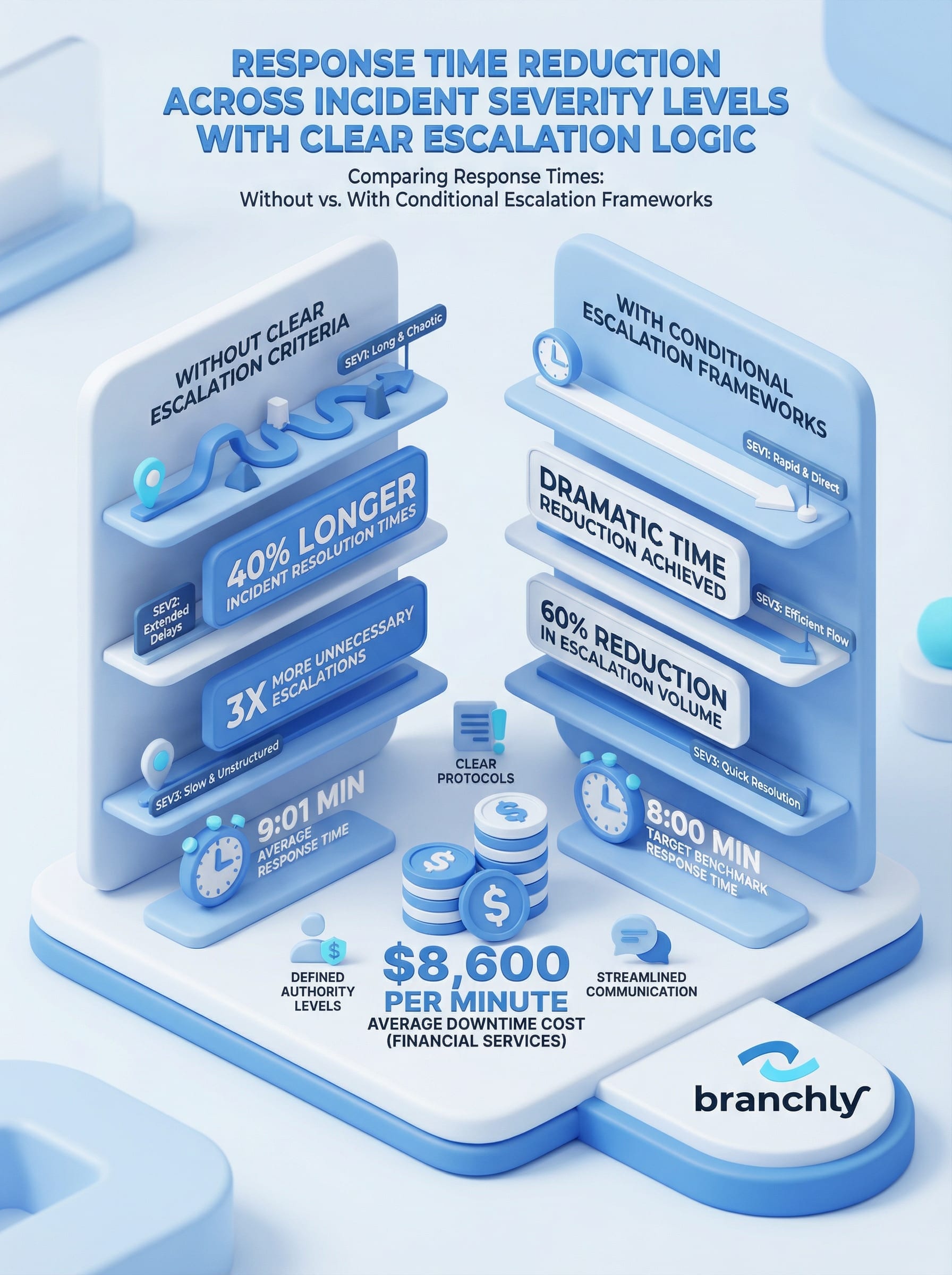
Research on prehospital emergency services in Mashhad, Iran found that mean response times exceeded international benchmarks by more than one minute, reaching 9:01 minutes when the target was under 8:00. That gap matters enormously in cardiovascular emergencies where every second counts. Nearly 60% of delays stemmed from operational issues like territory confusion and traffic, but systemic deficiencies in decision protocols made everything worse.
Define Severity Before the Crisis
Create a severity matrix before incidents happen. SEV1 (complete system outage), SEV2 (partial degradation), SEV3 (minor issue) with specific customer impact thresholds for each level. Everyone should know these definitions by heart.
Decision paralysis also shows up when roles aren't clearly defined. If your crisis plan says contact the incident commander but doesn't specify who that person is by time of day or incident type, responders waste precious minutes tracking someone down. In one study of emergency management challenges, poor coordination and unclear roles showed up as the most frequent problem, cited in 28.6% of cases.
The Cost of Ambiguity in High-Stakes Moments
Vague escalation policies create hesitation. When frontline staff don't have clear thresholds, they second-guess themselves. Should I escalate this now, or wait to see if it resolves on its own? Is this serious enough to wake up the VP at 2 AM? That internal debate burns time while the problem gets worse.
Consider a cybersecurity incident. If your playbook says notify IT leadership for potential breaches, you've left room for interpretation. Potential is a weasel word. Does a single failed login attempt count? What about ten? A hundred? Without numeric triggers like five failed administrative login attempts from the same IP within 10 minutes, your security team will either over-escalate everything (creating alert fatigue) or under-escalate serious threats (creating exposure).
Real Cost of Delayed Escalation
Organizations with unclear escalation criteria experience 40% longer incident resolution times and handle 3x more unnecessary escalations due to over-cautious staff compensating for ambiguity.
The financial impact is measurable. Every minute of unplanned downtime costs money. For financial services organizations, that number averages $8,600 per minute according to industry benchmarks. If ambiguous escalation procedures add 20 minutes to your response time, you've just added $172,000 to the cost of a single incident. Multiply that across multiple incidents per year and the expense becomes staggering.
Reputation damage compounds the problem. Customers don't care about your internal coordination challenges. They see a business that can't get its act together. During the Texas floods, the absence of a designated warning coordination role disrupted the flow of critical weather alerts to emergency managers and the public, slowing both decision-making and public notification. The result was confusion, delayed evacuations, and preventable harm.
Building Conditional Logic Into Your Response Framework
Conditional decision frameworks work by pre-defining the circumstances that trigger specific actions. Instead of saying escalate if serious, you say if more than 500 customers are affected OR if the outage exceeds 30 minutes OR if regulated systems are impacted, escalate immediately to the Incident Commander and notify the executive team within 15 minutes.
This kind of specificity removes judgment calls during high-pressure moments. Your response team doesn't need to debate whether something is serious enough. They check the criteria. If the conditions are met, they escalate. Period.
Effective escalation frameworks typically include several types of triggers working in parallel. Severity levels (SEV1 through SEV3) define the scope of impact. Time-based thresholds create urgency, automatically escalating issues that aren't resolved within defined windows. Impact thresholds quantify customer or operational effects. Customer-initiated escalations provide a safety valve when someone affected demands higher-level attention.
Build in Time-Based Auto-Escalation
If an incident isn't acknowledged within 15 minutes, auto-escalate to the next tier. If it's not resolved within 60 minutes, notify executive leadership. Time limits prevent incidents from falling through the cracks.
The SPAR(CD) framework (Situation, Context, Decision, Plan, Act, Review) emerged from systematic analysis of over 10,000 studies across fire, police, military, and ambulance services. It represents how experienced responders actually make decisions under pressure: assess the situation, understand the context, decide on a course of action, plan the steps, act, then review what worked. This framework supports conditional adaptation by building in complexity analysis and contextual factors, making it applicable across different types of emergencies.
Tiered Support Structures That Actually Work
Multi-tier support structures break response into layers, each with defined authority and escalation triggers. Tier 1 handles routine issues and follows predefined procedures. Tier 2 steps in when Tier 1 hits their authority limit or time threshold. Tier 3 handles complex, multi-system problems. Tier 4 consists of executive leadership who make strategic decisions during major crises.
The key is defining exactly when each tier gets involved. Tier 1 might have authority to shut down a single compromised workstation but must escalate to Tier 2 if they detect network-wide suspicious activity. Tier 2 can authorize emergency maintenance windows up to 2 hours but must escalate to Tier 3 for longer outages. Tier 3 can approve emergency spending up to $50,000 and make operational decisions affecting multiple locations, escalating to Tier 4 only for issues with regulatory implications or potential media exposure.
This structure prevents bottlenecks. Lower tiers handle what they can without waiting for permission. Higher tiers focus on genuinely complex decisions that require their expertise and authority. Everyone knows exactly where their responsibility ends and the next tier begins.
Authority Levels Prevent Delays
Define dollar limits, customer impact thresholds, and decision types each tier can handle independently. Pre-approved authority reduces escalation volume by 60% while speeding resolution.
The Joint Decision Model (JDM), developed for police operations and adapted for multi-agency coordination, promotes collaboration through a five-step process that aligns objectives and risk assessments among fire services, environmental agencies, and private organizations during crises. Its emphasis on shared situational awareness addresses one of the biggest coordination challenges: ensuring everyone is working from the same understanding of what's happening and what needs to happen next.
For multi-location organizations, this means building a common operational picture that updates in real time. Each location reports status. The command center aggregates that information. Everyone sees the same dashboard showing which locations are affected, what actions are in progress, and where bottlenecks exist. No one is making decisions based on stale information or conflicting reports.
How to Test Whether Your Escalation Logic Works
Writing escalation criteria into a document doesn't mean they'll work under pressure. You need to test them. Run tabletop exercises where you present scenarios and ask participants to walk through their response, paying particular attention to decision points. Who makes which calls? When do they escalate? What information do they need?
Watch for ambiguity. If participants debate whether something meets the escalation criteria, your criteria aren't clear enough. If they can't identify who has authority to make a particular decision, you haven't defined roles adequately. If they have to look up contact information or dig through documentation to figure out next steps, your reference materials aren't accessible enough.
Red Team Your Escalation Process
Have someone unfamiliar with your procedures try to follow them during a drill. Their confusion will reveal gaps and assumptions that aren't obvious to people who wrote the plans.
Time your exercises. If it takes 20 minutes to escalate a SEV1 incident during a low-stress drill, it'll take 30+ minutes during an actual crisis when everyone is fielding calls and dealing with urgent issues simultaneously. Your escalation process should be fast enough that timing doesn't become the primary bottleneck.
After each real incident, review what actually happened versus what was supposed to happen. Did people follow the escalation procedures? If not, why not? Was the procedure impractical? Was the situation different from what the procedure anticipated? Were people unaware of the procedure? Each deviation is either a training opportunity or a sign that your procedures need adjustment.
The feedback loop matters. Phase 6 of an effective response system analyzes response times, skipped steps, and bottlenecks after every incident or drill, then automatically suggests removing ineffective steps, reordering tasks, or refining timing for future playbooks. This continuous improvement prevents your procedures from becoming static documents that drift further from reality over time.
Common Escalation Mistakes to Avoid
The most common mistake is making escalation criteria too broad. When everything is high priority, nothing is. If your criteria result in 80% of incidents being classified as SEV1, you've lost the ability to distinguish genuinely critical situations from routine problems. Tighten your definitions so that only true emergencies trigger the highest response level.
Another mistake is creating escalation paths that depend on a single person. If your procedure says notify the IT Director and that person is on vacation, in a meeting, or dealing with another crisis, your entire response stalls. Build in alternates and automatic failover. If the primary contact doesn't acknowledge within 10 minutes, the system automatically notifies their backup.
Single Points of Failure Kill Response Time
Every critical role needs a designated backup with the same authority and access. Document the backup chain clearly and test it quarterly.
Organizations also fail by not automating notification routing. Manual escalation (someone has to remember to call or email the next tier) introduces delay and human error. Automated systems that trigger notifications based on defined criteria remove that failure point. When a SEV1 incident is logged, the system immediately pages the Incident Commander, notifies the executive team via SMS, and logs the escalation with a timestamp.
Don't ignore the human factors. Stress, lack of training, and low confidence impair real-time judgment. Research shows that up to 80% of decisions in emergency settings are made in under one minute using intuitive, recognition-based strategies rather than careful comparison of alternatives. That's why your escalation criteria need to be simple enough to apply under pressure. If someone has to read three pages of procedures to figure out whether to escalate, they won't.
Finally, don't create escalation theater where procedures exist on paper but everyone knows to bypass them in practice. If your official process is so cumbersome that experienced staff routinely ignore it and call their boss directly, you have a process problem. Either simplify the official process or acknowledge that your real process is different and document that instead.
Making Escalation Part of Your Culture
Clear escalation logic isn't just a technical requirement. It's a cultural statement about how your organization handles uncertainty and pressure. When you define escalation criteria clearly and empower people to act within those boundaries, you're saying we trust you to make the right call when it matters.
That trust has to go both ways. Leadership needs to support decisions made according to the escalation framework, even when those decisions turn out to be overly cautious. If someone escalates an incident that turns out to be minor, and they get criticized for wasting leadership's time, they'll hesitate to escalate next time. That hesitation can be fatal when the next incident is genuinely serious.
Reward Appropriate Escalation
Publicly acknowledge when someone made a good escalation call, even if the incident turned out to be less severe than initially thought. You want people erring on the side of safety.
Train new hires on escalation procedures as part of onboarding. Don't wait until they're six months into the job and encounter their first crisis. They should know from day one what constitutes a SEV1 incident in your organization, who the Incident Commander is, and how to activate the response plan.
Make escalation criteria visible. Post severity definitions in common areas. Include quick reference cards in onboarding packets. Build the criteria into your incident management software so people see them every time they log an issue. Repetition builds familiarity, and familiarity enables fast, confident action under pressure.
Impact of Clear Escalation Logic
Response Time Reduction Across Incident Severity Levels
Review and update your escalation criteria annually, or sooner if your organization changes significantly. Mergers, new technology, regulatory changes, and shifts in operational structure can all make existing escalation procedures obsolete. Don't wait for a crisis to discover that the Incident Commander role is now held by someone in a different department who wasn't informed.
Summary
Conditional decision frameworks eliminate the ambiguity that causes response delays during crises. By defining specific severity levels, time-based triggers, impact thresholds, and authority boundaries before incidents occur, organizations remove the need for judgment calls under pressure. Clear escalation logic means faster response, more consistent execution, and better outcomes when seconds matter. The organizations that respond fastest aren't lucky or better staffed. They've simply done the work upfront to define exactly what should happen when things go wrong.
Key Things to Remember
- ✓Vague escalation criteria cause decision paralysis and inconsistent response across incidents and personnel
- ✓Effective frameworks combine severity levels, time thresholds, impact metrics, and pre-defined authority boundaries
- ✓Tiered support structures with clear handoff triggers prevent bottlenecks and reduce unnecessary escalations by 60%
- ✓Testing escalation procedures through drills reveals ambiguity and timing problems before real crises expose them
- ✓Automated notification routing and backup roles eliminate single points of failure that delay response
How Branchly Can Help
Branchly embeds conditional escalation logic directly into every playbook. Severity-based branching routes incidents to the appropriate response tier automatically, with time-based triggers that escalate if issues aren't acknowledged or resolved within defined windows. Role assignments adapt based on availability, automatically notifying backups when primary contacts are unavailable. Real-time dashboards give command teams visibility into which locations need attention and where response is stalled, eliminating the coordination gaps that cause delays. Automated audit trails document every decision and escalation with timestamps, supporting both operational improvement and regulatory compliance. Instead of relying on people to remember escalation procedures under pressure, Branchly makes the right action the default action.
Citations & References
- [1]
- [2]The Competitive Advantage of a Strong Crisis Emergency Management Program earlyalert.com View source ↗
- [3]
- [4]Decision Support Frameworks in Public Health Emergencies: A Systematic Review of Dynamic Models in Complex Contexts - PMC nih.gov View source ↗
- [5]Application of Multiple-Criteria Decision-Making Technology in Emergency Decision-Making: Uncertainty, Heterogeneity, Dynamicity, and Interaction | MDPI mdpi.com View source ↗
- [6]“Leading through Crisis”: A Systematic Review of Institutional Decision-Makers in Emergency Contexts - PMC nih.gov View source ↗
- [7]Enhancing scientific response in a crisis: evidence-based approaches from emergency management in New Zealand | Journal of Applied Volcanology biomedcentral.com View source ↗
- [8]Response Time and Causes of Delay in Prehospital Emergency Missions in Mashhad, 2015 - PMC nih.gov View source ↗
- [9]
- [10]Proven escalation policy framework (w/ templates & checklists) | Hyperping Blog hyperping.com View source ↗
- [11]What is Escalation Path? Complete Guide to Issue Resolution, Support Hierarchy & Crisis Management Workflows | PostNext postnext.io View source ↗
- [12]Identifying challenges to critical incident decision-making through a macro-, meso-, and micro- lens: A systematic synthesis and holistic narrative analysis - PMC nih.gov View source ↗
- [13]The Challenges to a Modern Approach to Leadership, Management, Critical Thinking, and Decision Making Within an Emergency Management Environment – Current and Emerging Trends in the Management of International Disasters pressbooks.pub View source ↗
- [14]“Leading through Crisis”: A Systematic Review of Institutional Decision-Makers in Emergency Contexts - PMC nih.gov View source ↗
- [15]
- [16]A Framework for Response Escalation and Emergency Response Asset Management - PMC nih.gov View source ↗