Introduction
Picture this: an alarm sounds, employees file outside, someone checks names off a clipboard, and fifteen minutes later everyone returns to their desks. Compliance achieved. But what happens when the real emergency is a ransomware attack that locks every system? Or a staffing crisis that leaves three locations without managers? Or a winter storm that cuts power to half your branches for a week?
The uncomfortable truth is that annual fire drills train people for one specific scenario they'll probably never face. Meanwhile, roughly 50% of businesses remain unprepared for actual emergencies, according to SHRM research. The problem isn't a lack of good intentions. It's that once-a-year training doesn't stick, doesn't cover enough ground, and doesn't build the muscle memory teams need when chaos arrives.
The Science of Forgetting: Why Annual Training Fails
In the 1880s, German psychologist Hermann Ebbinghaus discovered something that should concern every organization with annual-only training: humans forget approximately 70% of new information within 24 hours. Within a week, retention drops to roughly 25%. This pattern, called the forgetting curve, has been replicated in studies for over a century. It means that by the time your next annual drill comes around, employees have retained almost nothing from the previous one.
Research from Deloitte's 2024 Global Human Capital Trends survey found that 82% of employees report standardized training programs fail to address their specific learning needs and work contexts. When training happens once a year with generic content, it becomes a checkbox exercise rather than genuine preparation. Employees go through the motions, knowing they won't need this information until the same time next year. The brain files it under 'not immediately relevant' and moves on.
The consequences of this forgetting aren't abstract. Insurance brokerage Gallagher estimates that more than 70% of companies without a comprehensive business continuity plan fail to recover from a significant business interruption. And having a plan on paper isn't the same as having a team that can execute it under pressure. The plan needs to live in people's heads, not just a shared drive.
Moving From Compliance to Competence
The goal of crisis training shouldn't be to satisfy auditors. It should be to build teams capable of coordinated, confident response when something goes wrong. That requires rethinking both frequency and format. A study published in the Journal of Educational Psychology found that spaced repetition improved long-term retention by 200% compared to single-session learning. In practical terms: four quarterly exercises will produce dramatically better results than one annual drill, even if the total training time is identical.
Quick Win: Monthly Micro-Drills
You don't need full-scale exercises every month. Try 15-minute tabletop discussions during regular team meetings. Present a brief scenario and ask: Who calls whom? What's the first action? Where do you find the checklist? These micro-drills keep crisis response top of mind without major time investment.
Scenario diversity matters just as much as frequency. Fire drills prepare people for fires. But according to Agility Recovery's research, organizations should be testing response to cyberattacks, natural disasters, communication system failures, staffing emergencies, and utility outages. Each scenario exercises different decision-making pathways and reveals different gaps in preparedness. An organization that only drills evacuations is essentially practicing for one play while ignoring the rest of the playbook.
The Four Pillars of Effective Crisis Training
Effective crisis training programs share four characteristics that distinguish them from compliance-focused approaches. First, they use varied exercise types. The Federal Financial Institutions Examination Council (FFIEC) recommends multiple testing methods: tabletop exercises for strategic discussion, walk-through drills for practical process validation, simulation tests for realistic response practice, and full interruption tests for comprehensive capability verification. Each type serves a different purpose, and organizations need a mix.
Second, they involve cross-functional teams. Crisis doesn't respect departmental boundaries. When a payment system goes down, IT, operations, customer service, and communications all need to coordinate. Training that happens in silos produces siloed responses. The organizations with the smoothest crisis response are those where marketing knows what IT is doing, branch managers understand the communication chain, and everyone knows who makes which decisions.
The 30-Day Retention Problem
A 2023 study published in Human Resource Development Quarterly found that without systematic reinforcement, 79% of employees cannot recall critical training information after just 30 days. This means even quarterly training has gaps. The solution is embedding crisis awareness into regular operations through brief refreshers, quick reference materials, and ongoing scenario discussions.
Third, effective programs document and analyze results. Every exercise should generate findings: what worked, what didn't, what needs updating in the plan. Without this analysis, organizations keep making the same mistakes. SBS Cybersecurity recommends maintaining a testing schedule that documents plans and allows for strategic improvement over time. The debrief after an exercise often provides more value than the exercise itself.
Fourth, they make training realistic and role-specific. Generic all-hands presentations don't stick because they aren't relevant to specific job functions. A branch manager needs different crisis knowledge than a call center representative. Contextual learning that presents information in job-relevant scenarios increases knowledge transfer by 67%, according to Harvard Business Review research. When employees can see exactly how training applies to their daily work, retention improves.
Building Your Training Calendar
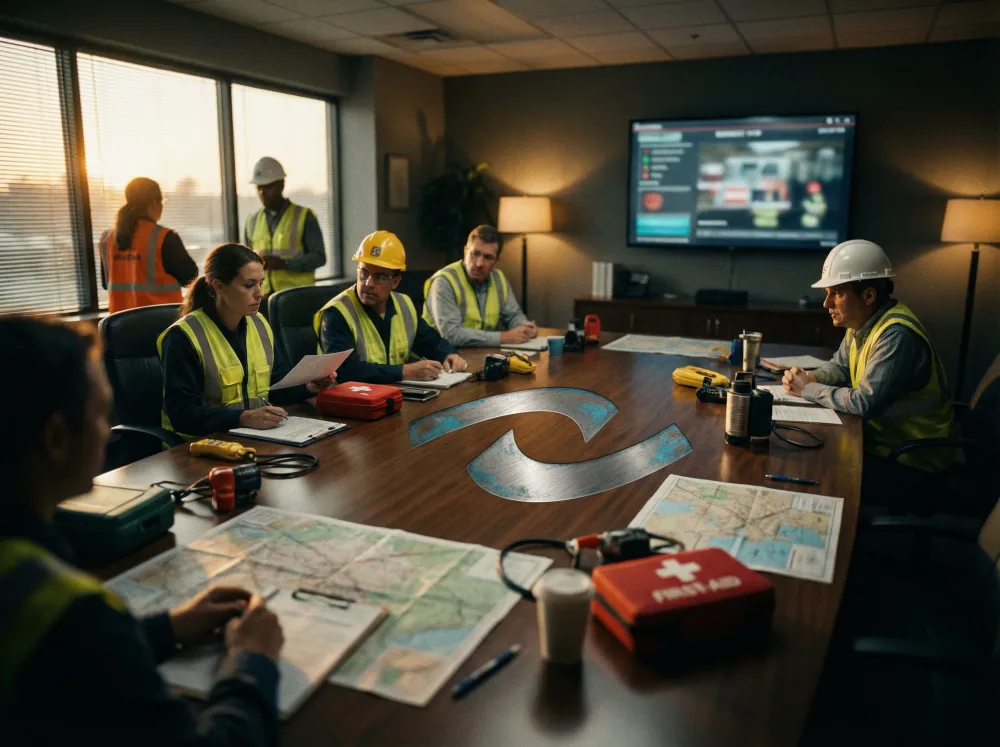
A practical training program doesn't require unlimited time or budget. Start with quarterly tabletop exercises. These are low-cost, low-disruption discussions where leadership teams walk through their response to a hypothetical scenario. Each quarter, rotate through different crisis types: Q1 might address a cyber incident, Q2 a severe weather event, Q3 a staffing emergency, Q4 a communication system failure. This approach ensures variety while keeping preparation manageable.
Layer in monthly micro-learning moments. These can be as simple as a five-minute discussion at the start of a team meeting, a short quiz in an internal newsletter, or a brief scenario posed in Slack. The goal isn't comprehensive training. It's keeping crisis awareness present in organizational consciousness. Research on active recall shows that simply asking employees to remember training information resets the forgetting curve and strengthens retention.
Annual full-scale drills still have their place. They test coordination across the entire organization and reveal gaps that smaller exercises might miss. But they should be the capstone of a year-round program, not the entirety of it. Think of the annual drill as the final exam and the quarterly and monthly activities as the coursework that prepares people to pass it.
Making Training Stick: Practical Techniques
Beyond frequency and variety, the format of training significantly impacts retention. Microlearning, which delivers content in focused segments of ten minutes or less, compensates for short attention spans and competing priorities. According to a 2023 study in the Journal of Applied Psychology, microlearning improves knowledge retention by up to 60% compared to traditional methods. Break complex crisis procedures into digestible chunks and deliver them over time rather than in a single overwhelming session.
Active participation dramatically outperforms passive information consumption. The Learning Pyramid model shows that people retain roughly 10% of what they read, 20% of what they hear, but 75% of what they practice doing and 90% of what they teach others. Design exercises that require employees to make decisions, communicate with teammates, and explain procedures to colleagues. When someone has to articulate why a step matters, they're far more likely to remember it.

Real Preparation Beats Rehearsed Performance
Teams that practice diverse scenarios quarterly respond faster and more effectively than those who drill once annually
Finally, make resources accessible at the point of need. The best training in the world won't help if employees can't find the relevant playbook when an incident occurs. Quick-reference guides posted in break rooms, mobile-accessible checklists, and clearly organized digital resources turn training into action. When information is available in the moment of crisis, employees can execute procedures even if they don't have perfect recall of every detail.
Measuring What Matters
How do you know if your training program is working? Move beyond participation metrics. Tracking that 100% of employees attended the annual drill tells you nothing about preparedness. Instead, measure response time during exercises, decision quality under simulated pressure, and accuracy of communication during drills. Post-exercise surveys can assess employee confidence in their ability to handle various scenarios.
Delayed assessments provide particularly valuable insight. Test employees on crisis procedures 30, 60, and 90 days after training to measure actual retention. If scores drop significantly, the training format needs adjustment. If certain topics consistently score lower, those areas need more reinforcement. This data-driven approach transforms training from an administrative obligation into a genuine capability-building investment.
Summary
Annual fire drills check a regulatory box, but they don't build organizational resilience. The science of memory shows that infrequent training fades quickly, leaving teams unprepared when real crises strike. Effective crisis training requires quarterly exercises at minimum, diverse scenario coverage, cross-functional participation, and continuous reinforcement between formal drills. The organizations that respond smoothly to unexpected events aren't lucky. They're the ones that treated crisis training as an ongoing discipline rather than an annual inconvenience. Start small if needed: add a monthly five-minute scenario discussion to existing meetings, rotate tabletop topics quarterly, and measure what employees actually retain rather than just what they attended. The goal isn't perfection. It's building the muscle memory that turns panicked scrambling into coordinated action when it matters most.
Key Things to Remember
- ✓The forgetting curve means employees lose 70% of training content within 24 hours. Annual drills alone cannot build lasting crisis response capability.
- ✓Quarterly tabletop exercises across varied scenarios produce dramatically better retention than single annual drills, even with the same total training time.
- ✓Monthly micro-learning moments, such as brief scenario discussions in team meetings, keep crisis awareness present and reset the forgetting curve.
- ✓Effective training involves cross-functional teams, documents findings for improvement, and makes content role-specific rather than generic.
- ✓Measure retention through delayed assessments at 30, 60, and 90 days rather than just tracking attendance at training events.
How Branchly Can Help
Branchly transforms crisis training from an annual checkbox into continuous organizational capability. The platform generates role-specific playbooks for diverse crisis scenarios, so your teams can practice responding to cyber incidents, weather events, staffing emergencies, and system outages with structured exercises rather than generic presentations. Built-in tracking ensures exercises are scheduled regularly and documents findings for continuous improvement. When a real crisis occurs, the same playbooks guide response in real-time, turning training directly into action. Pre-approved communication templates eliminate scrambling for the right words under pressure, while centralized visibility lets leadership track response across every location. The result is teams that build genuine muscle memory through repeated practice and can execute coordinated response when it matters most.
Citations & References
- [1]
- [2]
- [3]
- [4]
- [5]