
Introduction
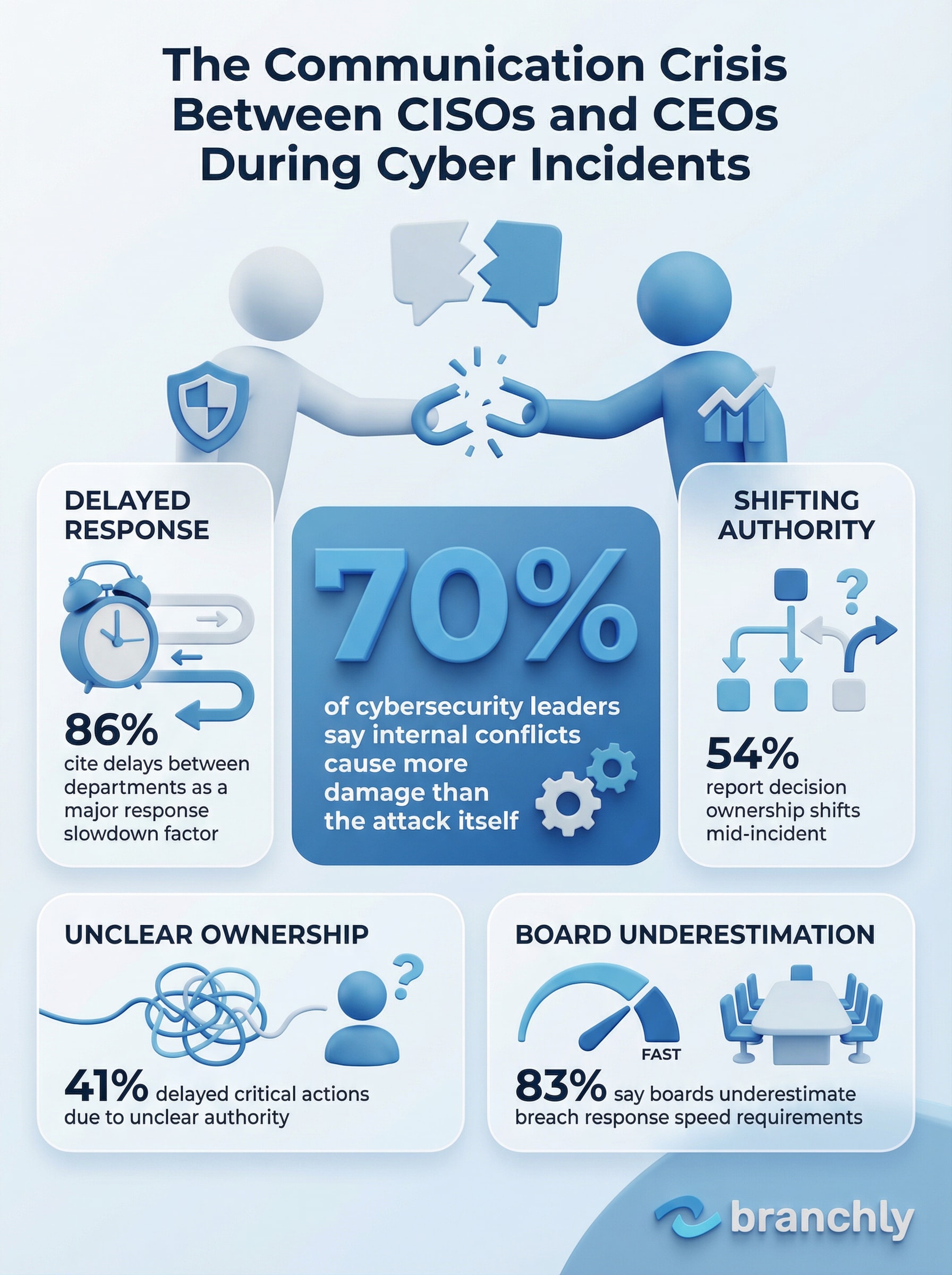
Here's a number that should worry every executive: 70% of senior cybersecurity leaders report that internal conflicts during a crisis cause more disruption than the cyberattack itself. The culprit isn't a lack of talent or tools. It's a communication breakdown between the people who need to make decisions together: CISOs and CEOs.
When a data breach hits or ransomware locks up your systems, the clock starts ticking. But if your CISO is talking about packet inspection and your CEO is asking about revenue impact, you've got a problem that no security tool can fix. Let's talk about why this gap exists and what it costs you when crisis strikes.
The Translation Problem: Why Technical and Business Leaders Miss Each Other
The disconnect starts before any crisis happens. Nearly 31% of executives admit they don't fully understand technical cybersecurity concepts. On the flip side, 58% of CISOs struggle to translate technical risks into terms that senior leaders can act on. This isn't about intelligence. It's about context and priorities.
Your CISO thinks in terms of vulnerabilities, attack vectors, and system hardening. Your CEO thinks about quarterly results, customer retention, and competitive position. Both perspectives matter. But when they don't connect, you get dangerous blind spots. The CISO can't get funding for critical upgrades because they can't articulate business impact. The CEO can't make informed risk decisions because they don't understand the real exposure.
This gap widens during a crisis. When every minute counts, you don't have time to explain what lateral movement means or why you need to isolate certain systems. Decision paralysis sets in. Teams wait for clarity that never comes.
The Cost of Misalignment
41% of cybersecurity leaders have delayed critical response actions because they weren't sure who had final decision authority during an incident.
Who's Actually in Charge During an Incident?
Authority confusion kills response time. In one recent survey, 54% of respondents said decision ownership shifted mid-incident. Think about what that means in practice: your team isolates a compromised server, then waits for approval to notify customers. But who approves? The CISO wants to contain first and communicate later. Legal wants to control the message. The CEO wants to minimize reputational damage. Meanwhile, the breach spreads.
Tim Youngblood, CISO at Astrix Security, puts it bluntly: 'The real bottleneck is often our own ability to respond quickly and decisively.' He's not talking about technical capability. He's talking about organizational clarity. When you don't establish decision rights before a crisis, people default to checking with multiple stakeholders. That's how minutes become hours.
Action Item
Map out decision authority for your top five crisis scenarios right now. Write down who can authorize system shutdowns, customer notifications, law enforcement contact, and public statements. Share it with your executive team. Update it quarterly.
The structural problem runs deeper than crisis response. About 82% of CISOs now report directly to the CEO, up from 47% in 2023. That sounds like progress. But proximity doesn't equal alignment. More than half of boards think CISOs spend most of their time aligning security with business objectives. Only 34% of CISOs say that's actually true.
What happens in that perception gap? Unmet expectations. Boards think they're funding security adequately (41% believe this). CISOs disagree (only 29% say they have adequate budget). The result: 62% of CISOs who postponed technology upgrades to cut costs later experienced breaches. The math is brutal and predictable.
Why Boards Underestimate Crisis Speed
Here's a statistic that should concern every director: 83% of cybersecurity leaders say boards underestimate the speed and intensity required during breach response. This isn't about boards being uninformed. It's about the nature of cyber incidents versus traditional business crises.
A fire spreads in hours. A breach can compromise your entire network in minutes. Ransomware operators move fast because they know your response will be slow. They count on confusion about who decides what. They bet on the time you'll spend debating whether to pay, whether to notify customers, whether to call the FBI.
Board members typically review security quarterly or annually. They see metrics, dashboards, compliance scores. What they don't see is the operational reality: the 2 a.m. Slack messages, the judgment calls about which systems to prioritize, the pressure to restore service while preserving forensic evidence. When crisis hits, that experiential gap becomes dangerous.
The Alignment Gap
61% of CISOs feel aligned with boards on strategic goals. Only 43% of board members agree. Someone's wrong about how well you're communicating.
The Translation Time Tax: When Departments Can't Talk to Each Other
Translation time is the invisible cost in every cyber incident. 86% of cybersecurity leaders cite the delay between departments as a major factor slowing response. Here's how it plays out: IT Security detects suspicious activity. They need to brief Legal about notification requirements. Legal needs to loop in Communications about messaging. Communications needs executive approval for any public statement. Each handoff takes time. Each translation introduces errors.
The problem isn't that these departments exist. It's that they operate in silos until crisis forces collaboration. Your CISO has never worked through a customer communication with your PR team. Your general counsel hasn't practiced coordinating with your operations manager. When the crisis hits, they're meeting each other for the first time under maximum pressure.
Test Your Translation Speed
Run this drill: have your CISO brief your CEO on a hypothetical breach affecting customer data. Time how long it takes to get to a go/no-go decision on customer notification. If it's more than 15 minutes, you've got translation problems to fix.
More than half of CISOs admit they lack tools to communicate risk in business terms. They can tell you the CVSS score of a vulnerability. They struggle to articulate whether that vulnerability threatens Q4 revenue or customer trust. This isn't a personal failing. It's a systemic gap in how we train and support security leaders.
What Works: Bridging the Gap Before Crisis Strikes
The organizations that respond well to cyber crises share common practices. They don't wait for an incident to figure out how leadership will communicate. They build translation capability into their normal operations.
Start with regular executive briefings that force translation practice. Your CISO should present security updates monthly, not quarterly. But here's the key: the format matters. Ban technical jargon. Require every risk to be explained in business impact terms. What revenue is at risk? Which customer segments are exposed? What's the competitive implication if this data leaks?
Joint crisis planning sessions work better than separate tabletop exercises. Get your CISO, CEO, general counsel, and head of communications in the same room. Walk through a breach scenario together. Don't just discuss the technical response. Work through the actual decisions: When do we notify customers? What do we tell employees? When do we go public? Who talks to regulators?
Document decision rights explicitly. Create a simple matrix: for each major incident type, write down who has authority to make key decisions. System shutdown? CISO with CEO notification. Customer communication? CEO with CISO and Legal input. Public statement? CEO only. The specifics matter less than having clarity before you need it.

Crisis Decision Matrix
Map authority before you need it
Change how you measure security effectiveness. Stop relying only on technical metrics (vulnerabilities patched, systems updated). Add business metrics that executives understand: mean time to detect business-critical incidents, cost of security incidents as a percentage of revenue, customer data exposure rate. This gives your CISO and CEO a shared language.
The Cost of Getting This Wrong
Robinhood paid a $57 million fine partly because of poor crisis coordination. The technical breach was bad. The organizational response made it worse. When your CISO and CEO can't communicate effectively under pressure, regulators notice. Customers notice. The market notices.
But the financial cost is just one measure. Reputation damage from a poorly handled breach lasts years. Employee morale suffers when teams watch leadership fumble under pressure. Customer trust, once broken, takes massive investment to rebuild. All of this stems from a simple failure: technical and business leaders who can't talk to each other when it matters most.
The good news? This is fixable. Unlike zero-day vulnerabilities or nation-state attackers, communication gaps are entirely within your control. You can't prevent every breach. You can absolutely prevent the organizational chaos that turns a security incident into a business catastrophe.
Start Here
Schedule a 90-minute session with your CISO, CEO, general counsel, and head of communications. Pick your most likely crisis scenario. Walk through it together. Document who decides what. That's your foundation.
Stop treating cybersecurity as a technical problem that occasionally needs executive attention. Start treating it as a business risk that requires ongoing translation and alignment. The organizations that do this well don't have fewer incidents. They just respond faster, with less internal friction, and recover better. That's the difference between a manageable crisis and a career-ending disaster.
Summary
The gap between CISOs and CEOs isn't about technical knowledge or business acumen. It's about translation, alignment, and decision clarity. When 70% of cybersecurity leaders say internal conflicts cause more damage than the actual attack, the message is clear: fix your internal communication before the next crisis tests it. Build shared language now. Define decision rights today. Practice coordination regularly. Your next incident will happen. Whether it becomes a contained event or an organizational crisis depends largely on whether your leaders can talk to each other under pressure.
Key Things to Remember
- ✓70% of cybersecurity leaders report internal conflicts during crises cause more disruption than the attacks themselves, primarily due to CISO-CEO communication gaps.
- ✓41% of security leaders have delayed critical response actions due to unclear decision authority, and 54% report decision ownership shifts mid-incident.
- ✓Despite 82% of CISOs now reporting directly to CEOs, perception gaps persist: 61% of CISOs feel aligned with boards on strategy, but only 43% of board members agree.
- ✓Translation time between departments delays response in 86% of incidents, with teams struggling to convert technical risks into business impact language executives understand.
- ✓Organizations that conduct joint crisis planning sessions with CISOs, CEOs, legal, and communications teams before incidents occur respond faster and with less internal friction when real crises hit.
How Branchly Can Help
Branchly eliminates translation time by giving every stakeholder a shared operational picture during cyber incidents. Pre-approved communications templates let your CISO, legal team, and CEO align on messaging before crisis hits. Clear role assignments and approval workflows remove decision ambiguity. Your Command Center provides real-time visibility so technical teams, executives, and board members see the same information in their own context. When your next incident happens, Branchly ensures your internal coordination is faster than the threat.
Citations & References
- [1]Crisis preparedness as a tool to build trust between the C-Suite and cybersecurity leaders - FTI Strategic Communications fticommunications.com View source ↗
- [2]
- [3]Effective Communications between CISOs and Key Stakeholders thecybersecurityreview.com View source ↗
- [4]70% of CISOs say internal conflicts more damaging than cyberattacks | CSO Online csoonline.com View source ↗
- [5]5 Key Questions CISOs Must Ask Themselves About Their Cybersecurity Strategy thehackernews.com View source ↗
- [6]
- [7]70% of Security Leaders Say Internal Misalignment Creates More Chaos Than Threat Actors: Cytactic's 2025 State of Cybersecurity Incident Response Management (CIRM) Report prnewswire.com View source ↗
- [8]70% of CISOs say internal conflicts more damaging than cyberattacks | CSO Online csoonline.com View source ↗
- [9]