Introduction
In February 2024, Kellogg's CEO Gary Pilnick suggested families eat cereal for dinner to save money during an earnings call. Within hours, #BoycottKelloggs was trending on TikTok. The company stayed silent for three days while the backlash grew. By the time they responded, the damage was done. Brand sentiment had cratered, and major retail partners were fielding angry customer calls.
This wasn't an isolated incident. The pattern repeats across industries: a tone-deaf comment, delayed response, and millions lost. But here's what makes social media crises different from traditional reputation threats. You don't have days or even hours to craft the perfect statement. You have minutes to prevent a containable problem from becoming a brand-defining disaster.
The New Math of Reputation Damage
Social media crises don't follow the old rules of crisis management. Traditional PR crises gave you time to assemble stakeholders, draft statements, and coordinate with legal. Now, a single customer complaint can reach millions before your crisis team even knows there's a problem.
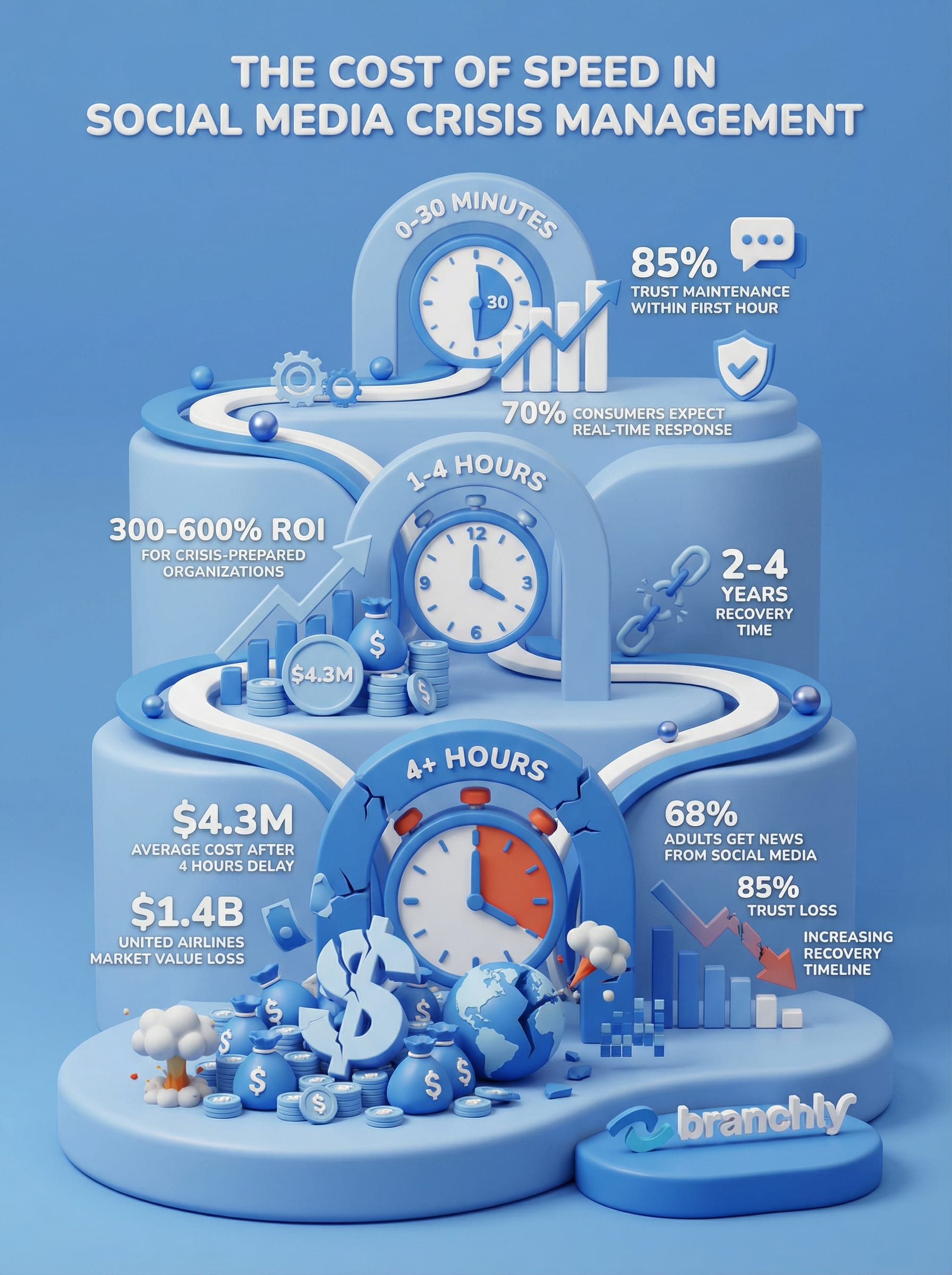
The numbers tell the story. Brands that respond within the first hour of a crisis are 85% more likely to maintain public trust. Wait longer than four hours, and you're looking at an average loss of $4.3 million. That's not counting the hidden costs: eroded brand equity, increased customer acquisition expenses, and recovery timelines that stretch 2-4 years for major incidents.
United Airlines learned this the hard way. When video of a passenger being forcibly removed from a flight went viral in 2017, the company's initial response was defensive and slow. The result? $1.4 billion in lost market value. The incident is still referenced in business schools as a textbook example of how not to handle a crisis.
The First Hour Window
Set up automated alerts for unusual mention spikes. Five negative posts within an hour signals an emerging issue. Ten or more means you're already in crisis mode and need immediate response.
Why Pre-Approved Messages Save Brands
The Patiswiss case study shows what happens when you wing it. After a customer posted a photo of moldy chocolate on LinkedIn, CEO Elif Asli Yildiz Tunaoglu responded personally. But instead of empathy, she delivered a defensive message accusing the customer of defamation and threatening legal action. The response went viral for all the wrong reasons.
Major retailer Migros temporarily pulled Patiswiss products from shelves. The company's reputation took a hit that no amount of advertising could quickly repair. All because there was no pre-vetted response framework in place.
This is where pre-approved communication templates become critical. You can't draft empathetic, legally sound responses while your brand is being torn apart online. The pressure is too high, emotions run too hot, and mistakes compound quickly.
Customer Expectations Are Brutal
70% of consumers expect real-time communication during crises. On social media specifically, many expect replies within 30 minutes or less. Your crisis plan needs to match that reality.
Smart organizations build a library of templated responses before anything goes wrong. These aren't canned corporate-speak. They're frameworks that acknowledge the issue, express genuine concern, and outline next steps without admitting liability or making promises you can't keep.
The templates get routed through legal and compliance during calm times, not during the crisis. When something breaks, your social media team can customize the pre-approved message for the specific situation and respond in minutes, not hours.
What Early Detection Actually Looks Like
68% of American adults get their news from social media. That means your crisis isn't just spreading among customers. It's reaching journalists, investors, and regulators simultaneously. By the time your CEO hears about it through normal channels, you're already behind.
Real-time monitoring isn't optional anymore. You need systems that track mention volume, sentiment shifts, engagement rates, and trending hashtags. These metrics tell you not just that something is happening, but how fast it's spreading and whether it's crossing into mainstream attention.
The benchmarks matter. A normal day might see 50-100 brand mentions with 60-70% positive sentiment. When mentions spike to 500 in an hour and sentiment drops below 40%, you've got an emerging crisis. At 1,000+ mentions with negative sentiment dominating, you're in full crisis mode.
Crisis Detection Thresholds
Monitor these metrics to catch issues before they explode
But detection is worthless without the ability to act fast. That's where most organizations fail. They have monitoring tools but lack clear escalation protocols. Someone sees the spike, but doesn't know who to alert or what threshold triggers a response.
Your monitoring system needs to automatically notify the right people based on severity. Minor issues go to your social media manager. Major spikes trigger alerts to PR, legal, and executive leadership simultaneously. Every minute you save in the notification chain is a minute you gain in response time.
The Real Cost of Getting It Wrong
Let's talk about what happens when you don't have systems in place. H&M published an image of a Black child wearing a hoodie labeled "Coolest Monkey in the Jungle" in 2018. The backlash was immediate and global. Celebrities called for boycotts. The company eventually pulled the image and apologized, but the incident follows the brand to this day.
The direct costs are measurable: lost sales, marketing spend to rebuild reputation, potential legal fees. But the indirect costs hurt more. Customer lifetime value drops. Acquisition costs rise because trust is harder to rebuild than establish. Talented employees question whether they want to work for a company with reputation problems.
Recovery timelines stretch years, not months. Even with perfect execution after a crisis, you're looking at 2-4 years to fully recover brand sentiment and customer trust. That's 2-4 years of suppressed growth, defensive marketing spend, and explaining the incident to every new customer and employee.
Post-Crisis Analysis
After every incident or drill, compare baseline performance with crisis-period data. Track sentiment recovery rate, audience retention, and time to normal mention volume. These metrics tell you if your response actually worked.
Compare that to organizations with crisis management programs in place. They typically see a 300-600% return on investment by avoiding costs and accelerating recovery. When you can respond in minutes with pre-approved messages, contain the damage before it goes viral, and show stakeholders you're in control, the crisis becomes a manageable incident instead of a brand-defining disaster.
Building a Response Framework That Works Under Pressure
Your crisis communication plan needs to work when your brain doesn't. That's the test. When you're getting tagged in hundreds of posts, your phone won't stop buzzing, and your CEO is asking for updates, you need a system that removes decisions, not adds them.
Start with your message library. You need pre-approved templates for your most likely scenarios: product defects, service failures, employee misconduct, data breaches, and offensive content. Each template should have three versions: initial acknowledgment, detailed explanation, and resolution update.
The initial acknowledgment goes out within 30 minutes. It doesn't need all the answers. It needs to show you're aware, you care, and you're working on it. Something like: "We're aware of the reports about [issue]. We take this seriously and are investigating. We'll share more information within [timeframe]."
Your detailed explanation comes within 2-4 hours. This is where you explain what happened, what you're doing about it, and what affected customers should do. You've had time to gather facts, coordinate with legal, and get executive approval.
Tone Matters More Than Perfection
Audiences forgive honest mistakes if you respond with genuine empathy. They don't forgive defensive, corporate-speak, or tone-deaf responses, even if technically accurate.
The resolution update closes the loop. Once you've fixed the problem, tell people. Explain what you learned and what you're changing to prevent recurrence. This is how you rebuild trust.
But templates are just part of it. You need clear approval workflows that balance speed with oversight. Junior social media managers can deploy initial acknowledgments immediately. Detailed explanations require PR director approval. Statements about legal or financial matters need general counsel sign-off.
Document everything. Every post, every decision, every approval, with timestamps. If the crisis escalates to regulatory scrutiny or litigation, you need to show you followed proper procedures and acted in good faith.
Testing Before the Crisis Hits
Nobody believes their crisis plan will fail until it does. The problem is, by then it's too late. You can't discover that your social media manager doesn't have access to the pre-approved templates or that legal takes three hours to respond to urgent requests during an actual crisis.
Run tabletop exercises quarterly. Give your team realistic scenarios: a customer posts video of a food safety issue, an employee makes a controversial statement that gets attributed to the company, or a major service outage affects thousands of customers. Then watch what happens.
Time everything. How long to detect the issue? How long to notify stakeholders? How long to get approval for your response? How long before your message is live? If any of these steps take longer than your benchmarks, you've found your bottleneck.
Test your monitoring systems too. Have someone from outside your team post a fake negative review or complaint using a test account. Does your monitoring catch it? Do the right people get notified? Can they access the response templates?
Practice Makes Permanent
Run exercises when your team is tired or distracted. Friday afternoon, right before a holiday, or during busy season. If your process works under those conditions, it'll work during a real crisis.
After each exercise, do a debrief. What worked? What didn't? What took longer than expected? Update your templates, adjust your workflows, and fix your technology gaps. Then test again in three months.
The organizations that handle social media crises well aren't lucky. They've practiced the scenario a dozen times before it happened for real.
Summary
Social media has changed crisis management permanently. The old rules about taking time to craft perfect responses don't apply when a single post can reach millions in minutes. Organizations that survive reputation crises have three things in common: real-time monitoring that catches issues early, pre-approved message templates that enable fast responses, and regular testing that reveals gaps before they matter. The average social media crisis costs $4.3 million, but organizations with crisis management programs see 300-600% ROI by avoiding that damage. Speed isn't just important. It's the difference between a manageable incident and a brand-defining disaster.
Key Things to Remember
- ✓Brands that respond within the first hour of a crisis are 85% more likely to maintain public trust, while delays beyond four hours cost an average of $4.3 million
- ✓Pre-approved communication templates enable minutes-fast responses without sacrificing legal review or brand consistency
- ✓Real-time monitoring with clear escalation thresholds catches issues before they explode: five negative posts per hour signals emerging crisis, ten or more means full response needed
- ✓70% of consumers expect real-time communication during crises, with many expecting social media responses within 30 minutes
- ✓Recovery from major reputation crises takes 2-4 years even with perfect execution, making prevention and early response critical
How Branchly Can Help
Branchly's pre-approved communication templates eliminate the panic-writing that turns incidents into disasters. Our system stores legal-vetted, brand-aligned messages for your most likely crisis scenarios, ready to customize and deploy in minutes. Real-time monitoring integration detects reputation threats early, while automated escalation protocols ensure the right stakeholders get notified based on severity. Every response, approval, and modification is automatically logged for compliance and post-crisis analysis. When your brand is trending for the wrong reasons, Branchly gives you the tools to respond fast, respond right, and maintain stakeholder trust.
Citations & References
- [1]
- [2]Corporate Reputation and Crisis Management in Social Media: The Patiswiss Case Study - International Journal of Research and Innovation in Social Science rsisinternational.org View source ↗
- [3]
- [4]
- [5](PDF) Social media crisis management: Aligning corporate response strategies with stakeholders’ emotions online academia.edu View source ↗
- [6]6 Social Media Crisis Management Strategies for 2025| Sprinklr | Sprinklr sprinklr.com View source ↗
- [7]
- [8]
- [9]This One Mistake Cost Brands Billions - How to Avoid a Social Media crisis surveysparrow.com View source ↗
- [10]
- [11]
- [12]
- [13]How to Build a Social Media Crisis Management Strategy | Sprout Social sproutsocial.com View source ↗