
Introduction
When Hurricane Helene made landfall in September 2024, it didn't just bring devastating winds and flooding. It brought something equally dangerous for organizations trying to protect their people: silence. In western North Carolina, 74% of cell sites went offline. Entire counties had what officials described as "basically nonexistent" cellular service. Nearly 600 people remained unaccounted for in Asheville because families simply couldn't reach them.
For multi-location organizations, that scenario exposes a critical vulnerability. Your crisis notification system probably relies on cellular networks. Your employee check-ins depend on smartphones. Your coordination between locations assumes everyone can receive a text or email. But what happens when the infrastructure those systems depend on is the first casualty of the disaster you're trying to manage?
The Scale of the Problem: Why Cell Networks Fail When You Need Them Most
Cell towers are engineered to withstand high winds, typically up to 110 mph. But hurricanes, wildfires, and floods attack the network at multiple points. It's not always the tower itself that fails. Power outages take down cell sites that lack backup generators. Flooding destroys ground-based equipment that routes data across the network. A communications center miles away can fail, and your local tower suddenly can't transmit anything.
The FCC's data tells the story. Hurricane Helene caused 4,562 cell site outages at its peak, more than any hurricane in recorded history. For comparison, Category 5 Hurricane Ian in 2022 knocked out 747 sites. Hurricane Harvey in 2017 took down 365. We're seeing network failures of unprecedented scale, and the trend isn't improving. Cell towers only have batteries required to power first responder communications for 12 hours. If commercial power doesn't return and no generator is available, the site goes dark.
The 12-Hour Rule
Cell towers are only required to have battery backup for 12 hours of first responder communications. If power isn't restored and no generator is deployed, the tower goes offline. Plan your backup systems to kick in before that window closes.
The PACE Framework: Military-Grade Communication Planning
The U.S. military developed the PACE framework for exactly this problem. PACE stands for Primary, Alternate, Contingency, and Emergency. It's a structured approach to communication redundancy that ensures you have multiple independent paths to reach your people. Hospitals, government agencies, and critical infrastructure operators have adopted it. Multi-location businesses should too.
Your Primary channel is your everyday system, likely a mass notification platform that sends texts, emails, and push notifications. Your Alternate kicks in when primary fails, perhaps mobile hotspots or a backup internet connection. Your Contingency is more robust, designed for extended outages, such as satellite phones or dedicated radio networks. Your Emergency channel is the last resort when everything else is down, potentially including physical runners or preset meeting points.
The key principle is that each level should be independent of the others. If your alternate still depends on cellular networks, it's not truly redundant. If your contingency requires the same power source as your primary, a single outage takes both down.
Satellite: The Technology That Bypasses Ground Infrastructure
Satellite communication works by bouncing signals off orbiting satellites rather than routing through ground-based towers and cables. When Hurricane Milton hit Florida in October 2024, T-Mobile and SpaceX activated their satellite-to-cell system early, allowing smartphones to receive emergency alerts and send texts without any terrestrial infrastructure. This was originally scheduled for later commercial launch, but the FCC granted emergency authorization because the need was that acute.
For organizations, dedicated satellite phones remain the gold standard for backup communication. Unlike consumer satellite features built into some smartphones, dedicated satphones can make voice calls and provide data connectivity anywhere on Earth with a clear view of the sky. They're not cheap, with devices running several hundred to over a thousand dollars and airtime adding to ongoing costs. But for location managers who need reliable communication during the worst scenarios, they provide something cellular networks can't guarantee: independence from local infrastructure.
74% Offline
During Hurricane Helene, 74% of cell sites in affected North Carolina counties went down, the highest outage rate ever recorded during a U.S. hurricane. Traditional notification systems that rely solely on cellular networks would have failed to reach the majority of employees in those areas.
Two-Way Radios: The Underrated Workhorse
Two-way radios operate on radio frequencies that don't require cell towers or internet connections. Within their range, typically several miles for consumer models and much farther for commercial systems with repeaters, they provide instant push-to-talk communication. For a retail chain, franchise network, or credit union with multiple branches in a geographic area, radios can keep location managers connected to each other and to a central coordinator when everything else fails.
The limitation is range. Standard two-way radios won't connect your Florida locations to your Georgia headquarters. But for coordinating staff within a location, communicating between nearby branches, or maintaining contact with a regional command post, they're simple, reliable, and don't depend on infrastructure that hurricanes love to destroy. Many emergency management consultants recommend keeping charged radios at each location with preset channels and clear protocols for when to use them.
Building Your Multi-Channel Communication Plan
Start by mapping your current dependencies. What systems does your primary notification platform rely on? Cellular data, WiFi, landline internet? What happens to each dependency in a power outage lasting 12 hours? 48 hours? A week? Walk through your employee check-in process and identify every point where cellular or internet service is assumed. That map shows you where redundancy is needed.
Next, designate communication hierarchy for each level of outage. Who needs to be reachable no matter what? For most organizations, that's location managers and key decision-makers. Those individuals might warrant satellite phone access. For broader staff, what's the fallback when they can't receive texts? Predetermined check-in locations, posted schedules, or cascade calling trees where people who can be reached contact others who can't.
Don't forget power. Your backup communication equipment is useless if it's dead. Portable power stations, solar charging capability, and spare batteries should be part of any backup communication kit. During Hurricane Helene, many people had working phones but no way to charge them after days without power.
Testing Your Backup Before You Need It
Equipment that sits in a drawer for years often doesn't work when you finally need it. Batteries die, software becomes outdated, and people forget how to use devices they've never practiced with. Schedule regular tests of your backup communication channels. Verify that satellite phones still activate and have current airtime. Confirm that radio frequencies are programmed correctly and that batteries hold charge. Run tabletop exercises where you simulate a cellular outage and walk through how you'd actually reach each location.
The FCC now requires wireless carriers to participate in the Mandatory Disaster Response Initiative, which includes roaming across networks during emergencies. But policy requirements don't guarantee your specific location will have service. The only way to know your backup plan works is to test it. As one emergency management professor put it, every disaster reveals that communications are the first to go. The organizations that maintain contact are the ones that practiced before the crisis hit.
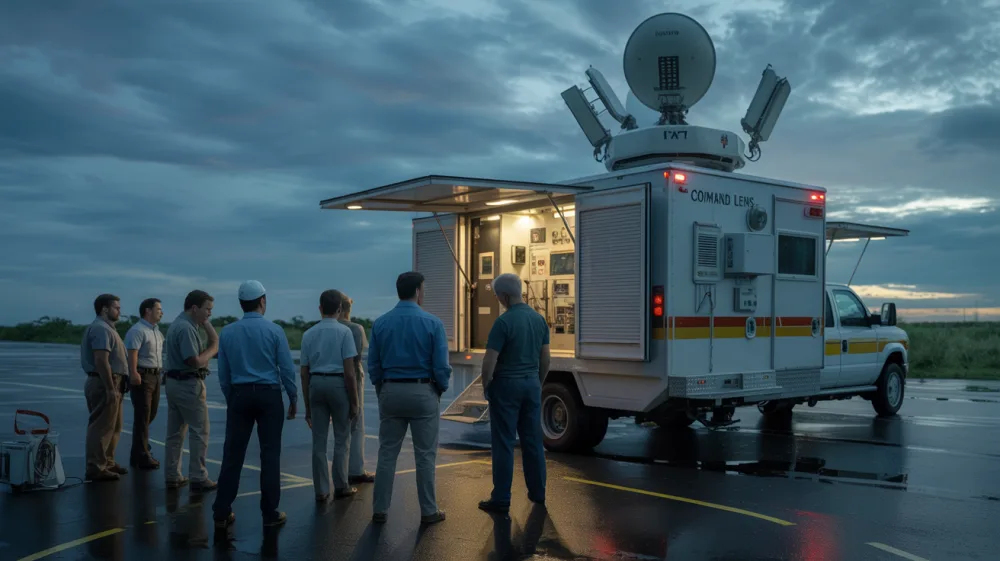
Communication is the Lifeline
When cell towers fail, prepared organizations have already tested their backup channels
Summary
The hurricanes of 2024 proved that cellular network failures aren't edge cases anymore. They're predictable consequences of severe weather that multi-location organizations must plan for. Building communication redundancy using the PACE framework, investing in satellite and radio backup options, and testing those systems before disaster strikes can mean the difference between coordinated response and dangerous silence. Your crisis management platform is only as reliable as the communication channels it depends on. Make sure you have options when the primary one fails.
Key Things to Remember
- ✓Hurricane Helene caused 4,562 cell site outages at its peak, with 74% of sites down in some North Carolina counties, proving that cellular-dependent notification systems have a critical single point of failure.
- ✓The PACE framework (Primary, Alternate, Contingency, Emergency) provides a structured approach to communication redundancy where each level operates independently of the others.
- ✓Satellite phones and two-way radios bypass ground infrastructure entirely, making them essential backup options for location managers who must stay reachable during extended outages.
- ✓Cell towers typically have only 12 hours of battery backup for first responder communications, so backup communication plans should activate before that window closes.
- ✓Regular testing of backup communication equipment and protocols is essential since untested systems often fail when finally needed due to dead batteries, outdated software, or forgotten procedures.
How Branchly Can Help
Branchly helps multi-location organizations prepare for communication infrastructure failures before they happen. Our platform generates pre-approved communication templates that can be deployed through multiple channels, so your messaging is ready regardless of which systems remain operational. Role-specific playbooks ensure location managers know exactly what backup protocols to follow when primary notification channels fail. And our centralized command center tracks location status in real-time, giving you visibility into which branches can be reached and which need alternative contact methods. When cell towers go down, the organizations that respond effectively are the ones that planned for it.
Citations & References
- [1]Communications Status Report for Areas Impacted by Hurricane Helene Federal Communications Commission View source ↗
- [2]Unprecedented outage: No hurricane has knocked out more cell sites than Category 4 Helene Wireless Estimator View source ↗
- [3]How Fires, Floods and Hurricanes Create Deadly Pockets of Information Isolation Scientific American View source ↗
- [4]With towers destroyed, Hurricane Milton is a real-time test for satellite cell service The Boston Globe View source ↗
- [5]