
Introduction
The lights flicker. HVAC systems go silent. Water pressure drops to nothing. For multi-location businesses, utility failures strike without warning and rarely at convenient times. A restaurant chain faces spoiled inventory during a Friday dinner rush. A credit union branch loses access to critical systems mid-transaction. A hotel scrambles to relocate guests when cooling fails during a summer heat wave.
These scenarios play out daily across the country. According to J.D. Power's 2025 Electric Utility Business Customer Satisfaction Study, 74% of business customers experienced a power outage this year, up from 73% in 2024. One-fourth of those businesses reported financial losses directly tied to those outages. The stakes keep rising while the frequency of disruptions shows no signs of slowing.
For organizations operating dozens or hundreds of locations, utility failures create coordination nightmares. Each site has different infrastructure, different backup capabilities, and different vulnerabilities. Without a structured approach to utility contingency planning, every outage becomes a fresh crisis.
The True Cost of Going Dark
Utility failures hit harder than most business leaders expect. ITIC's 2024 Hourly Cost of Downtime survey found that a single hour of server downtime costs $300,000 or more for 90% of mid-sized and large enterprises. The U.S. Department of Energy estimates power outages cost the American economy approximately $150 billion annually. These numbers reflect direct losses only. They do not capture the cascading effects: damaged customer relationships, regulatory scrutiny, employee overtime, and recovery expenses that accumulate long after the lights come back on.
A Nature Communications study published in April 2025 examined the economic impacts of widespread, long-duration power interruptions in a major utility service area. The findings were stark: a single-day interruption reduced the three-month regional GDP by $1.8 billion (1.3%). A three-day outage pushed losses to $3.7 billion (2.6%). A fourteen-day interruption, the kind caused by major hurricanes, reduced GDP by $15.2 billion (10.4%). These losses were driven overwhelmingly by supply chain disruptions and business continuity failures rather than price signals alone.
For multi-location businesses, the math compounds quickly. A regional restaurant group with 40 locations facing a 6-hour power outage across a metro area might lose $50,000 in spoiled inventory, $30,000 in lost revenue, and face weeks of insurance paperwork. The 2024 impacts of extreme heat on restaurant operations cost some operators hundreds of thousands in sales losses during single weather events.
Calculate Your Exposure
Map each location's critical systems and estimate hourly downtime costs. Include inventory loss, labor costs, lost transactions, and recovery time. Most organizations underestimate their exposure by 40% or more.
Power: The Foundation Everything Else Depends On
Backup power planning starts with understanding what actually needs protection. The National Fire Protection Association (NFPA) distinguishes between emergency power systems (legally required for life safety), legally required standby systems (mandated for specific functions like emergency lighting), and optional standby systems (protecting business-critical equipment). Most multi-location businesses need all three categories addressed, but few have systematically evaluated which systems fall into each bucket at every site.
Commercial generators represent the most common backup power solution. Sizing them correctly matters enormously. An undersized generator can fail to keep critical systems running or damage itself through overheating. An oversized generator wastes fuel, requires unnecessary maintenance, and delivers unreliable power output. The calculation requires totaling the load of all systems that must stay powered, including HVAC, lighting, motors, compressors, and IT systems, while accounting for startup surge requirements that can exceed normal operating loads by 200% or more.
Installation requirements add complexity. Commercial generators need proper foundation engineering, fuel storage that complies with local fire and environmental regulations, automatic transfer switches to connect to main electrical panels, and adequate ventilation. Generators weighing more than 600 pounds require structural calculations. Monthly load tests, visual inspections, and maintenance checks are standard requirements. The 2003 Northeast Blackout demonstrated what happens when backup systems receive insufficient attention: despite having generators and UPS systems in place, approximately half of New York City's 58 hospital backup systems experienced failures due to improper maintenance, incorrect load ratios, transfer switch failures, or failed startup batteries.
Water: The Overlooked Utility Vulnerability
Water system failures create immediate operational crises for restaurants, hotels, healthcare facilities, and any business requiring sanitation. When Atlanta's Adamsville Pumping Station failed in September 2024, it triggered boil water advisories across parts of the city and multiple surrounding municipalities. Residents and businesses had to boil all water for drinking, cooking, or brushing teeth. The advisory affected critical facilities including schools, nursing homes, and commercial operations until water quality testing confirmed safety.
For restaurants, a boil water advisory can mean immediate closure. Health codes require safe water for food preparation, dishwashing, and handwashing. Bottled water and boiled water workarounds exist, but they add significant operational burden and risk compliance issues. Hotels face similar constraints plus the challenge of communicating with guests and managing expectations around showers, pools, and food service. A July 2024 boil water advisory in Washington D.C. affected customers throughout the District, including the Pentagon, Arlington National Cemetery, and Reagan National Airport.
Water System Failure Causes
The most common triggers include main breaks and distribution system repairs, power outages affecting pumping stations, equipment failures, and inadequate system operator training. Periods of low pressure can introduce bacteria into distribution systems, requiring precautionary advisories even when no contamination is confirmed.
Water contingency planning requires identifying alternative water sources, establishing relationships with bottled water suppliers, understanding local utility notification systems, and training staff on boil water protocols. Multi-location businesses should map which locations share water infrastructure and could be affected by a single failure point.
HVAC: Where Comfort Meets Compliance
HVAC failures hit restaurants particularly hard. A failed exhaust fan or air conditioning unit can push kitchen temperatures past safe limits, creating risks for heat exhaustion, accidents, and employee turnover. Ventilation failure traps smoke and grease particles, compromising air quality and increasing fire risk. The guest-facing impact is equally severe: uncomfortable conditions drive customers out early, generate negative reviews, and damage brand reputation. One industry expert described HVAC breakdowns as a restaurant's worst-case scenario because they threaten food safety, staff wellbeing, and customer experience simultaneously.
The Federation of American Scientists reported that the economic impacts of extreme heat cost the nation an estimated $162 billion in 2024, equivalent to nearly 1% of U.S. GDP. Restaurants and hotels bore significant portions of this burden. During a Los Angeles heatwave in October 2024, McDonald's employees staged a walkout to protest extreme working conditions, compromising operating hours. Arkansas restaurants scaled back hours during summer heatwaves. Triple-digit temperatures combined with HVAC system strain created compounding operational failures.
HVAC contingency planning requires preventive maintenance schedules that account for peak demand seasons, relationships with 24/7 emergency service providers, protocols for operating with degraded cooling capacity, and clear decision frameworks for temporary closures when conditions become unsafe. Temperature monitoring systems can provide early warning of problems before full system failure.
Building a Multi-Location Utility Contingency Plan
Effective utility contingency planning for multi-location organizations requires standardized assessment across all sites. Each location needs an inventory of critical systems, their power requirements, backup capabilities, and recovery time objectives. This assessment should identify which locations have generators, their capacity and fuel type, when they were last tested, and who is responsible for maintenance. The same systematic approach applies to water supply dependencies and HVAC systems.
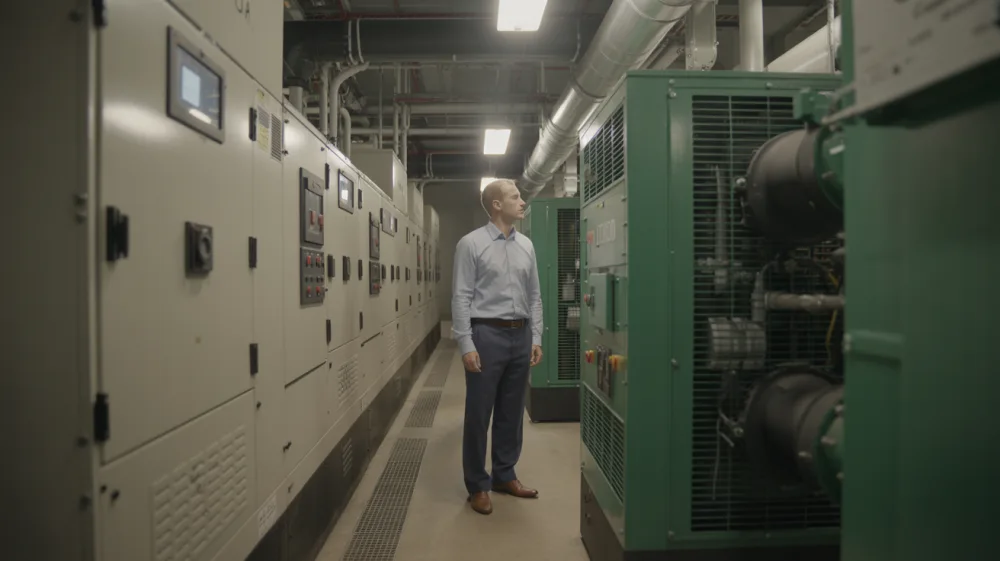
Backup Power Inspection
Regular testing prevents failures when you need backup systems most
Communication protocols matter as much as equipment. Staff need to know who to contact when utilities fail, what immediate actions to take, how to assess whether the location can continue operating safely, and when to escalate decisions to regional or corporate leadership. Pre-approved messaging for customers, employees, and vendors eliminates the scramble for words during active incidents.
Testing separates planning from reality. The Nature Communications study found that doubling backup power penetration moderated GDP losses by 11-14% during extended outages, but only if those backup systems actually functioned when needed. Monthly generator tests under load, annual water contingency drills, and seasonal HVAC stress testing identify problems before they become crises. Documentation of tests, results, and corrective actions creates the audit trail regulators and insurers expect.
Moving from Reactive to Prepared
The gap between knowing utility failures will happen and being ready for them remains wide at most organizations. J.D. Power found that utilities providing frequent and proactive communication during outages see stronger customer satisfaction results despite the disruption. The same principle applies to multi-location businesses: customers and employees respond better to organizations that demonstrate preparation, communicate clearly, and recover quickly.
Investing in utility resilience pays returns beyond avoided losses. Organizations with documented business continuity programs demonstrate measurably faster recovery times than unprepared competitors. Insurance claims process more smoothly when documentation exists. Regulatory examinations reveal fewer findings when contingency plans are tested and current. Employee confidence improves when they know what to do rather than improvising under pressure.
The utilities will fail again. Summer heat will strain HVAC systems. Water mains will break. Storms will knock out power. The question is not whether these events will happen but whether your organization will respond with confidence or chaos.
Summary
Utility failures create cascading operational crises for multi-location businesses, with power outages alone costing the U.S. economy $150 billion annually. Effective contingency planning requires systematic assessment of backup power, water, and HVAC capabilities across all locations, combined with documented protocols, pre-approved communications, and regular testing. Organizations that invest in utility resilience recover faster, maintain customer confidence, and avoid the costly scramble that defines unprepared responses.
Key Things to Remember
- ✓74% of businesses experienced power outages in 2025, with one-fourth reporting direct financial losses from those disruptions.
- ✓A single hour of downtime costs $300,000 or more for 90% of mid-sized and large enterprises according to ITIC research.
- ✓Water system failures trigger boil water advisories that can force immediate restaurant closures and hotel operational disruptions.
- ✓HVAC failures during extreme heat create compounding risks: employee safety hazards, food safety violations, and customer experience failures.
- ✓Doubling backup power penetration moderates economic losses by 11-14% during extended outages, but only if systems are tested and maintained.
How Branchly Can Help
Branchly transforms utility failure response from reactive scrambling into coordinated action. The platform automatically generates location-specific playbooks for power outages, water system failures, and HVAC emergencies, with role assignments and step-by-step protocols tailored to each site's infrastructure. Pre-approved communication templates eliminate the search for words during active incidents, while real-time tracking keeps regional and corporate teams informed as locations work through response procedures. When utilities fail at multiple sites simultaneously, Branchly's command center provides the visibility needed to prioritize resources and coordinate recovery across your entire organization.
Citations & References
- [1]
- [2]A Method to Estimate the Economy-wide Consequences of Widespread, Long Duration Electric Power Interruptions Nature Communications View source ↗
- [3]
- [4]
- [5]