Introduction
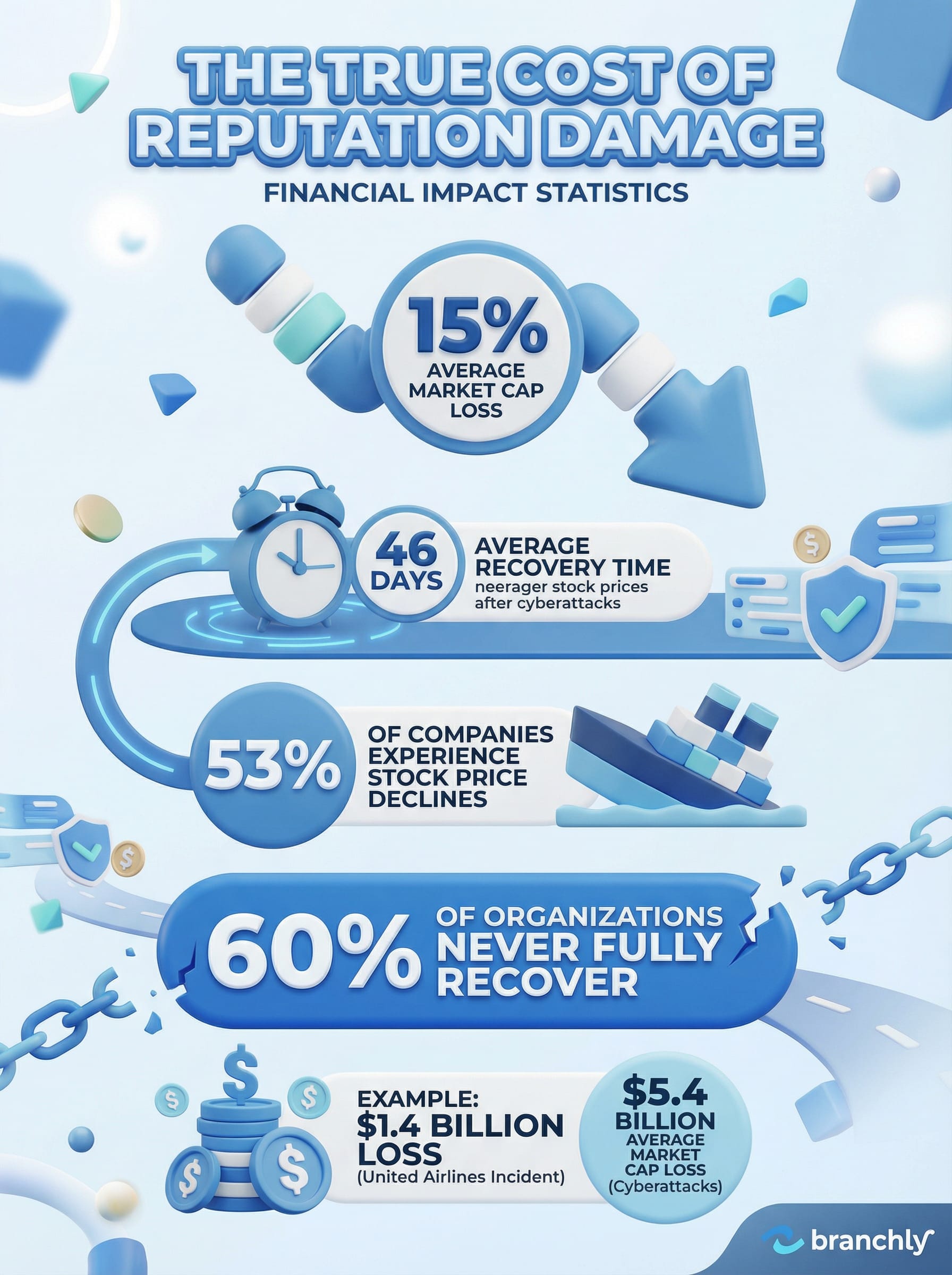
When United Airlines forcibly removed a passenger in 2017, the airline lost $1.4 billion in market value within days. That's a 4% drop in share price from a single crisis event. The story made headlines, but the financial damage was far from unique.
Research shows that 53% of companies experience stock price declines after reputation crises, with an average loss of 15% in market capitalization. More troubling: nearly 60% of organizations hit by major reputation events never fully recover. For multi-location operations, where a crisis at one branch can ripple across the entire brand, understanding how to measure and prevent reputation damage isn't optional anymore.
How Organizations Measure Reputation Damage
Most organizations rely on reactive metrics: they wait for a crisis to hit, then scramble to understand the damage. That approach misses the early warning signals and makes recovery harder.
The most effective measurement strategies combine real-time monitoring with quantitative and qualitative analysis across multiple dimensions. Customer sentiment tracking through surveys and social media analytics provides immediate insight into public perception and emotional response. Media monitoring tools track both traditional and digital coverage, measuring changes in tone and volume that can amplify or contain damage. Financial indicators like sales trends, stock price movements, and market share shifts quantify the tangible economic impact.
Recovery Timeline Reality
Stock prices typically take 46 days to recover after cyberattacks. Second breaches cause greater damage than first incidents, especially when financial data is compromised.
Brand tracking platforms like YouGov offer continuous data on loyalty, awareness, and preference, helping organizations detect emerging crises before they explode. Employee engagement surveys reveal internal morale issues that often precede external reputation problems. Search audits across Google, social platforms, and review sites identify how far negative content has spread and where to focus reputation repair efforts.
But raw metrics don't tell the full story without context. That's where structured assessment frameworks come in.
The Frameworks That Predict Reputation Impact
Situational Crisis Communication Theory (SCCT) provides an evidence-based method for evaluating reputational threat before, during, and after crisis events. The framework analyzes three key factors: initial crisis responsibility (whether stakeholders believe the organization had control), crisis history (past incidents that intensify blame), and prior relational reputation (how the organization has treated stakeholders historically).
SCCT Crisis Categories
Victim cluster: organization is a victim too (natural disasters). Accidental cluster: unintentional events (equipment failure). Intentional cluster: knowable, preventable actions (fraud, misconduct). Each carries different levels of attributed responsibility.
SCCT categorizes crises into victim, accidental, and intentional clusters. Victim crises (like natural disasters) generate the least blame. Accidental crises (equipment failures, unintentional errors) generate moderate blame. Intentional crises (fraud, preventable misconduct) generate severe blame and the deepest reputation damage. Each category requires different response strategies to protect reputation.
Risk scoring models offer another structured approach. These systems assign weighted values to compliance breaches, customer complaints, cybersecurity incidents, and operational failures based on their potential reputational impact. The scoring reveals which risks demand immediate attention and which can be monitored over time.
Scenario planning and predictive analytics take measurement a step further. AI and machine learning tools simulate crisis scenarios, identify vulnerabilities, and detect early sentiment shifts before they become full-blown reputation disasters. Comprehensive monitoring dashboards integrate live data from social listening, threat intelligence, and financial metrics to provide a real-time view of reputational health.
What the Numbers Actually Show
The financial consequences of reputation damage are measurable and severe. For publicly traded companies, cyberattacks trigger an average 7.5% drop in stock value and a loss of $5.4 billion in market capitalization. Recovery takes an average of 46 days for stock prices to return to pre-breach levels. But that's just the immediate hit.
The Compounding Effect
Second-time breaches cause significantly greater damage than first incidents. Organizations with crisis history face intensified stakeholder blame and longer recovery periods.
Recovery timelines vary widely based on response quality. Some companies restore their reputation within six months if they respond quickly and transparently. But a Deloitte survey found that while 30% of board members reported recovery in under a year, 16% said it took four years or longer. The difference comes down to preparation and response speed.
The most sobering statistic: nearly 60% of organizations that experience major reputation crises never fully recover. Stock prices may stabilize, but customer trust, brand value, and market position suffer permanent erosion. For multi-location businesses like credit unions, franchises, and retail chains, one poorly managed incident at a single branch can trigger system-wide damage.

Reputation Damage Timeline
From crisis trigger to full recovery: key phases and decision points
Why Multi-Location Organizations Face Unique Risks
A data breach at one credit union branch doesn't stay local. A health code violation at one franchise location doesn't just hurt that owner. In multi-location operations, reputation damage spreads fast because customers, regulators, and media treat your brand as a single entity.
The challenge gets worse when each location has different leadership, varying levels of preparedness, and inconsistent crisis response capabilities. Franchisees operate with more autonomy than corporate locations, but they're still bound to the parent brand's reputation. One poorly handled incident undermines trust across the entire network.
The Visibility Problem
Corporate teams often learn about branch-level crises from media reports or customer complaints, not from location managers. By then, the reputation damage is already spreading.
Static crisis plans don't scale across diverse locations. A PDF playbook written for one scenario doesn't adapt when crisis details change. Manual call trees fail when key people aren't available. Pre-written messages don't account for local context or severity levels. The result is inconsistent responses, delayed communications, and preventable reputation damage.
Organizations that recover fastest from reputation crises share common characteristics: they had pre-approved communication templates ready, they activated coordinated responses across all locations simultaneously, and they maintained complete documentation for regulatory review and stakeholder transparency.
Building Reputation Protection Into Operations
Reputation protection starts before crises happen. Organizations that treat reputation as an operational priority, not just a PR concern, build resilience into daily operations.
First, establish continuous monitoring systems that track the metrics and signals discussed earlier. Customer sentiment, media tone, employee engagement, and financial indicators should feed into regular reviews, not just crisis assessments. Early detection allows intervention before problems escalate.
Second, develop location-specific playbooks that adapt to each branch's unique context while maintaining brand consistency. Every location should have clear escalation paths, pre-approved messaging, and defined roles so response is immediate and coordinated when crises hit.
The Pre-Approval Advantage
Organizations with pre-vetted crisis communications respond 3-5x faster than those drafting messages during active incidents. Speed directly impacts reputation damage severity.
Third, run regular drills that test both your measurement systems and response capabilities. Tabletop exercises reveal gaps in monitoring, coordination, and communication before real crises expose them. Track response times, identify bottlenecks, and refine processes based on what you learn.
Fourth, integrate reputation impact into your risk scoring methodology. When evaluating potential crises, weigh reputational consequences alongside operational, financial, and compliance factors. This ensures you're not just reacting to immediate problems while missing slower-moving reputation threats.
Finally, maintain detailed documentation of every incident, response action, and outcome. Audit trails serve two purposes: they demonstrate due diligence to regulators and stakeholders, and they create institutional memory that improves future crisis response.
The Difference Between Recovery and Prevention
Recovery strategies focus on damage control after reputation harm occurs. Prevention strategies stop that harm from happening in the first place. The data makes clear which approach costs less.
When you're spending four years and millions in market value trying to rebuild trust, you're competing at a disadvantage against organizations that never lost that trust. When 60% of companies never fully recover, prevention becomes the only viable strategy.
The Board Question
Ask your board: If we experienced a reputation crisis tomorrow, how long would recovery take? If the answer is 'we don't know,' you don't have a prevention strategy.
For multi-location organizations, prevention means building systems that work at scale. Individual branch managers can't be expected to craft perfect crisis responses under pressure. Corporate teams can't manually coordinate across hundreds of locations in real time. The gap between what's needed and what's possible with manual processes is where reputation damage happens.
The organizations that protect their reputations most effectively don't rely on heroic individual effort during crises. They build systems that make coordinated, brand-consistent responses automatic. They measure reputation health continuously, not just during incidents. They treat reputation protection as operational discipline, not crisis firefighting.
Summary
Reputation damage costs are measurable, severe, and often permanent. Organizations that combine continuous monitoring, structured assessment frameworks, pre-approved communications, and location-specific playbooks recover faster when crises occur. But the real goal isn't faster recovery. It's preventing the damage in the first place through operational systems that work at scale across every location in your network.
Key Things to Remember
- ✓53% of companies experience stock price declines after reputation crises, with average losses of 15% in market cap. Nearly 60% never fully recover.
- ✓Situational Crisis Communication Theory (SCCT) helps predict reputation impact by analyzing crisis responsibility, organizational history, and prior stakeholder relationships.
- ✓Multi-location organizations face amplified reputation risk because incidents at single branches spread across the entire brand within hours.
- ✓Organizations with pre-approved communications and coordinated response systems recover 3-5x faster than those drafting messages during active crises.
- ✓Reputation protection requires continuous monitoring, location-specific playbooks, regular testing, and detailed documentation built into daily operations.
How Branchly Can Help
Branchly helps multi-location organizations prevent reputation damage before it starts. Our AI-powered platform generates location-specific playbooks with pre-approved communications, coordinates real-time responses across all branches simultaneously, and maintains complete audit trails for regulatory transparency. When incidents occur, you respond in seconds with brand-consistent messaging instead of scrambling for hours while reputation damage spreads. Risk scoring includes reputation impact as a core factor, and continuous monitoring helps detect emerging threats before they become crises. Request a demo to see how Branchly transforms reputation protection from reactive firefighting into proactive operational discipline.
Citations & References
- [1]
- [2]
- [3]
- [4]
- [5]Damage to Reputation or Brand: A Critical Risk | Global Risk Management Survey aon.com View source ↗
- [6]Protecting Organization Reputations During a Crisis: The Development and Application of Situational Crisis Communication Theory | Corporate Reputation Review springer.com View source ↗
- [7](PDF) Protecting Organization Reputations During a Crisis: The Development and Application of Situational Crisis Communication Theory academia.edu View source ↗
- [8]
- [9]
- [10]
- [11]
- [12]
- [13]
- [14]Company Reputation Damage Examples: How Major Crises Hurt Brands and What You Can Learn - NewswireJet newswirejet.com View source ↗