
Introduction
Your power's out. Your POS system is down. And there's a line of frustrated customers at the door. Who do they talk to? Not your crisis management team or your corporate communications department. They talk to the person at the counter.
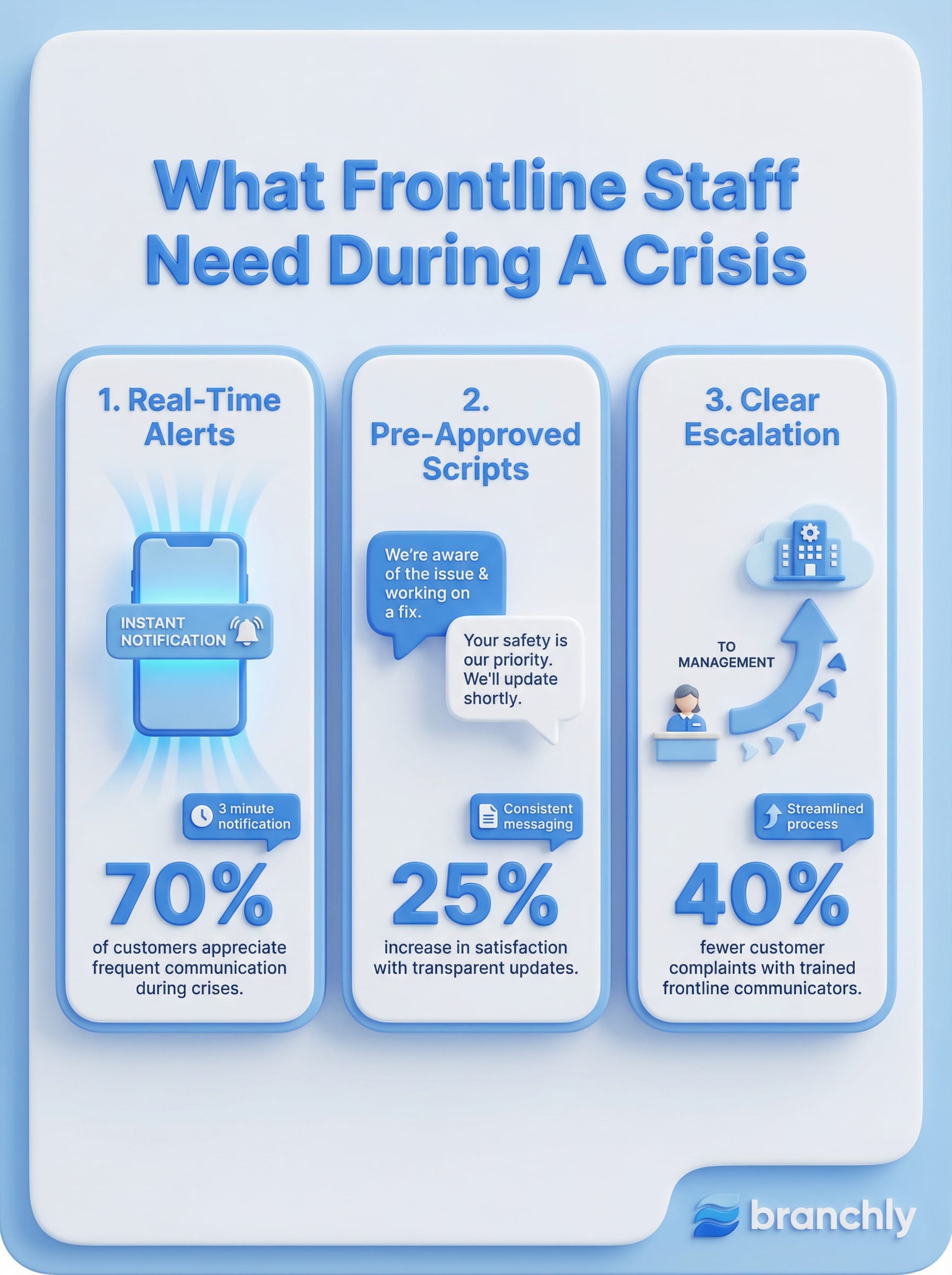
That frontline employee becomes the face of your organization in its most vulnerable moment. If they fumble, you lose trust. If they handle it well, you build loyalty. Research shows that 70% of customers appreciate frequent communication during crises, and organizations that maintain transparent updates see a 25% increase in satisfaction. But here's the problem: most frontline workers have never been trained to handle these moments. They don't have email access, they've never seen your crisis plan, and they're expected to improvise professional responses under pressure.
Why Frontline Communication Training Gets Ignored
Most crisis communication plans are written for people who sit at desks. They assume recipients have company email, access to an intranet, and time to read multi-page documents. That describes nobody working a register, manning a hotel front desk, or serving tables.
The communication gap is structural. When a system outage hits, corporate sends an email at 9:47 AM. The store manager sees it at 10:15 AM after helping three customers. The shift supervisor hears about it secondhand at 10:45 AM. The cashier who started at 11:00 AM? They find out when a customer asks why their card won't work.
This isn't a training problem. It's an infrastructure problem. You can't train people to respond to information they never receive. Before you can teach frontline staff what to say, you need to give them a way to hear what's happening in real time.
What Frontline Staff Actually Need During a Crisis
Frontline employees need three things during a disruption: they need to know what's happening, what to tell customers, and who to escalate to when the situation exceeds their script. That's it. Everything else is noise.
Start with situational awareness. Your staff should receive instant notifications through SMS or a mobile app the moment something goes wrong. Not a detailed incident report. Not a formal memo. A single message: "Card processing is down company-wide. Estimated fix: 2 hours. Cash and checks only. More info coming."
Then give them language. Pre-approved talking points that match your brand voice and cover the scenarios they'll actually face. Not corporate jargon. Real sentences a real person would say. For a payment outage: "Our card system is down right now, but we can take cash or checks. We're working to fix it and expect to be back up in about two hours. I can hold your items if you'd like to come back, or we can process this manually." That's professional, empathetic, and actionable.
Finally, give them an escalation path. They need to know when to stop talking and get help. If a customer is angry about a refund policy, that's not a frontline decision. If someone asks about data security after a breach, that needs to go to management. Train staff to recognize the boundary and give them a simple way to escalate: a phone number, a manager on duty, a clear handoff protocol.
Building Pre-Approved Message Templates That Work
Pre-approved messaging solves the panic-writing problem. When something breaks, nobody should be composing customer-facing language from scratch. That's when you get tone-deaf apologies, overpromises you can't keep, or worse, contradictory statements across different locations.
Build templates for your most common disruptions: system outages, weather closures, equipment failures, staffing shortages, and supply chain issues. Each template should include variations for severity (minor delay vs. full closure) and audience (walk-in customers vs. scheduled appointments vs. online orders).
Write at a 6th to 8th grade reading level. Use short sentences. Avoid industry jargon. Don't say "We're experiencing technical difficulties with our point-of-sale infrastructure." Say "Our cash registers aren't working right now." Clarity beats polish when people are frustrated.
Run every template past your legal and compliance teams before a crisis hits. That pre-approval saves hours when you're under pressure. You don't want to discover at 2 PM on a Friday that your attorney needs to review customer messaging while fifty people are waiting for answers.
Training Methods That Actually Stick
Reading a crisis manual doesn't prepare anyone for a crisis. You need practice under pressure. Run drills that put employees in realistic scenarios where they have to communicate with actual or simulated customers.
Start simple. Give staff a scenario card: "The credit card system is down. A customer just loaded $200 of groceries onto the belt. What do you say?" Have them practice the response out loud. Then add complications: "The customer doesn't have cash." Then: "They're getting angry." Then: "Other customers are listening." Each layer tests whether they can maintain composure and stick to approved language.
Role-playing feels awkward, but it works. Pair employees and rotate scenarios. Manager plays angry customer. New hire practices de-escalation. Then swap roles. The repetition builds muscle memory. When a real crisis hits, they won't freeze because they've already said the words a dozen times.
Record training sessions or real incidents (with permission) and review them as a team. What worked? What made things worse? Where did the script break down? This feedback loop turns every disruption into a training opportunity for the next one.
The Feedback Loop: Learning from Every Crisis
After every incident, ask your frontline staff what happened. They saw things you didn't. They know which messages confused customers, which questions they couldn't answer, and where the process fell apart.
Create a simple debrief process. Within 48 hours of any disruption, gather the team and ask three questions: What information did you need but didn't have? What did customers ask that you couldn't answer? What would you do differently next time? Keep it short. Fifteen minutes. Write down the answers.
Then act on what you learn. If three people say they didn't know how long the outage would last, that's a communication gap. If five people got asked about refunds and didn't know the policy, that's a training gap. If someone invented a workaround that helped customers, that's intelligence you need to share with every location.
This feedback loop turns reactive employees into proactive problem-solvers. They stop waiting for instructions and start thinking ahead. Because they know their input matters and their experience improves the system.
What Good Crisis Communication Looks Like in Practice
A regional bank's core system went down on a Monday morning. Within three minutes, every branch employee received a text: "Core banking offline. Cannot process transactions. Cash withdrawals and deposits paused. Estimated fix: 90 minutes. Tell customers we'll extend hours if needed."
Tellers had pre-printed cards to hand to customers explaining the situation. Branch managers had talking points for local business clients who needed same-day transactions. The contact center had a script that matched what branches were saying. Everyone was working from the same playbook.
The system came back online in 75 minutes. The bank sent a second text confirming normal operations and thanking staff. Customer complaints were minimal. No social media crisis. No regulatory questions. Because the frontline communicated with confidence and consistency.
Compare that to a restaurant chain where an equipment failure shut down half their kitchens. No staff notification went out. Employees learned about it when delivery orders started backing up. Some locations told customers 20 minutes. Others said an hour. One manager offered refunds. Another didn't. By evening, social media was full of complaints about inconsistent service and poor communication.
Same type of disruption. Totally different outcomes. The difference was preparation.
Common Mistakes That Make Things Worse
The first mistake is giving frontline staff too much information. They don't need to understand the technical details of why the server crashed. They need to know it's down, when it'll be fixed, and what to tell customers. Extra context just creates confusion.
The second mistake is giving them too little authority. If you require manager approval for every deviation from the script, you create bottlenecks. Empower staff to make small judgment calls: offering to hold items, suggesting alternative solutions, or calling for backup when needed. Trust them to handle routine situations.
The third mistake is forgetting to update them when things change. You sent a message at 10 AM saying the system would be down for two hours. It's now 1 PM and still broken. If you don't send an update, employees are giving customers outdated information and looking incompetent. Send status updates every 30 to 60 minutes during extended incidents.
The fourth mistake is using defensive language. Don't train staff to say "It's not our fault" or "This never happens." Customers don't care whose fault it is. They care about solutions. Train staff to acknowledge the inconvenience, explain what's being done, and offer options.
Building a Sustainable Training Program
One training session doesn't cut it. Crisis communication skills degrade without practice, especially in industries with high turnover. You need ongoing reinforcement.
Include crisis communication in new hire onboarding. Show them where to find message templates. Walk them through a sample scenario. Have them practice one response before they ever interact with a customer. It takes 15 minutes and prevents hours of confusion later.
Run quarterly refresher drills. Pick a random Tuesday morning and simulate an outage. Send the alert. See how staff respond. Time how long it takes them to access templates. Check if they remember the escalation protocol. Treat it like a fire drill: short, focused, and repeated until it's automatic.
Recognize and reward good crisis communication. When an employee handles a difficult situation well, call it out publicly. Share the story in team meetings. Make it clear that calm, professional customer communication during disruptions is valued and noticed.
Summary
Frontline employees carry your reputation in their hands every time they interact with customers during a crisis. If you train them well, they become your strongest asset, delivering consistent, empathetic messaging that builds trust and loyalty. If you don't, they become a liability, spreading confusion and damaging your brand with every improvised response. The difference comes down to infrastructure, preparation, and practice. Give your frontline staff real-time information through accessible channels. Provide pre-approved message templates that sound human. Train them with realistic drills that build confidence. Then create a feedback loop that turns every crisis into a learning opportunity. Organizations that invest in frontline communication training don't just survive disruptions better. They come out stronger because their customers see professionalism under pressure instead of panic.
Key Things to Remember
- ✓Frontline employees need three things during a crisis: real-time situational awareness, pre-approved talking points, and clear escalation protocols.
- ✓Pre-approved message templates prevent panic-writing during disruptions and ensure consistency across all locations.
- ✓Role-playing drills and scenario-based training build muscle memory so staff can respond confidently under pressure.
- ✓Post-crisis debriefs with frontline staff reveal communication gaps and training needs that improve future responses.
- ✓Organizations with trained frontline communicators see 40% fewer customer complaints and 25% higher loyalty during crises.
How Branchly Can Help
Branchly gives frontline employees the tools they need to communicate confidently during any disruption. Our platform delivers instant SMS and mobile app notifications the moment a crisis begins, ensuring every employee across all locations receives the same accurate information simultaneously. Pre-approved message templates are built into every playbook, giving staff professional, empathetic language they can use immediately with customers. Role-specific guidance ensures frontline workers see only the information they need, while managers get additional context and escalation protocols. Real-time updates keep everyone informed as situations evolve, and automatic logging creates a complete record of what was communicated, when, and by whom. After each incident, Branchly's intelligence layer analyzes response patterns and identifies training gaps, helping you improve frontline communication with every crisis you face.
Citations & References
- [1]
- [2]Crisis communication best practices: the only 4 you need to remember | Blink joinblink.com View source ↗
- [3]
- [4]
- [5]
- [6]Customer Experience (CX) and Crisis Management: 25 Best Practices for 2025 renascence.io View source ↗
- [7]Crisis Management in Customer Relationships: Building Trust in Times of Trouble earlyalert.com View source ↗
- [8]A comprehensive guide to crisis communication for protecting your brand reputation - Agility PR Solutions agilitypr.com View source ↗
- [9]Exploring corporate reputation and crisis communication | Journal of Marketing Analytics springer.com View source ↗
- [10]Crisis Communication Plan: Lessons from Brands Who Got It Right - CTO Magazine ctomagazine.com View source ↗