Introduction
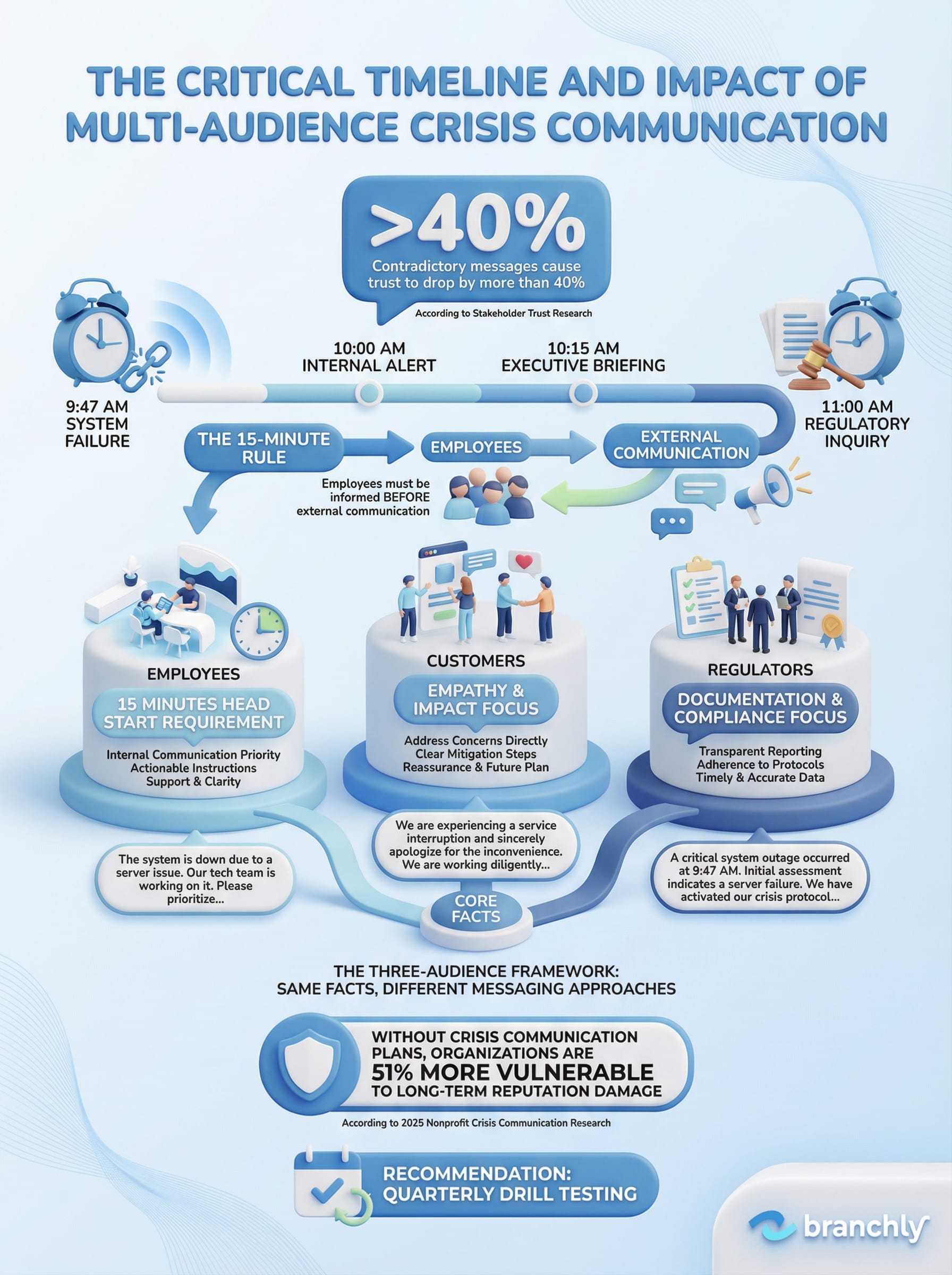
At 9:47 AM, your core banking system goes down. By 9:52 AM, branch managers are calling. By 10:15 AM, customers are posting complaints on social media. By 11:00 AM, your compliance officer is asking what documentation you have for regulators. You need to say something to all of them, but you can't say the same thing to all of them.
This is the multi-audience communication trap. What reassures a customer can confuse an employee. What satisfies a regulator can sound cold to the public. And if your messages contradict each other, research shows stakeholder trust can drop by more than 40%. The organizations that maintain confidence during crisis aren't the ones with perfect PR teams. They're the ones who planned their messaging before the emergency started.
Why Contradictory Messages Destroy Trust Faster Than Silence
The Facebook-Cambridge Analytica crisis offers a textbook case in what not to do. When the data breach first surfaced, different Facebook executives offered vague, conflicting timelines about what happened and when they knew about it. Mark Zuckerberg waited days to respond, and when he did, the scripted statement felt disconnected from the magnitude of the problem. Public trust collapsed before the company could regain control of the story.
The pattern repeats across industries. BP initially downplayed the Deepwater Horizon spill, with executives offering optimistic assessments that conflicted with what cameras on the ocean floor were showing. OpenAI's board experienced backlash when inconsistent statements about leadership changes left employees, investors, and the public confused about what actually happened and why. In each case, the problem wasn't just the crisis itself. It was that stakeholders heard different versions of reality depending on which channel they were listening to.
Here's what makes contradictory messaging so damaging: it forces your audiences to choose which version to believe. That decision tree introduces doubt into every subsequent message you send. If your COO tells employees the system will be back online in two hours, but your customer service team is telling callers it might be tomorrow, both groups will assume the next thing you tell them might also be wrong. Once that doubt takes root, even accurate updates get questioned.
The Trust Tax
Organizations without crisis communication plans are 51% more vulnerable to long-term reputation damage, according to 2025 nonprofit crisis communication research.
Research on COVID-19 crisis communication found that denial strategies produced the lowest trust ratings in local officials, while taking responsibility and committing to relationship rebuilding supported higher confidence. But even responsibility-taking only works when the message stays consistent across channels. If your CEO apologizes on LinkedIn while your PR team minimizes the issue on Twitter, you've just created two competing narratives.
The Three-Audience Framework: Different Messages, Same Facts
The solution isn't to send identical messages to everyone. Different audiences need different information at different speeds. Your framework should start with a single source of truth about what happened, what's being done, and what's expected next. Then you adapt the message for each audience without changing the underlying facts.
Employees need operational clarity first. Tell them what happened, how it affects their specific role, and what they should do right now. If your POS system is down, branch staff need to know whether to process transactions manually, send customers away, or switch to a backup system. They need this information before customers start asking questions. Internal communication should always run ahead of external messaging because your employees become your front-line communicators whether you plan for it or not.
Zoom's response to privacy concerns in 2021 shows this framework in practice. When security vulnerabilities surfaced, the company announced a 90-day feature freeze to address the issues. Employees got detailed technical briefings about what was changing and why. Customers got clear, jargon-free updates about new security features being rolled out. Investors and regulators got documentation of the systematic review process and compliance measures. Same situation, three different emphasis points, zero contradictions.
The 15-Minute Rule
Employees should hear about a crisis from their leadership within 15 minutes of external communication going out. Hearing it from customers or social media first destroys credibility and creates confusion when they're trying to help.
Customers need empathy and clear impact information. They don't care about your internal recovery procedures. They want to know what services are affected, how long the disruption will last, and what alternatives you're offering. When you don't know the timeline, say that and commit to update frequency instead. Telling customers you'll provide updates every two hours is more confidence-building than promising a fix time you might miss.
Regulators need documentation, specifics, and compliance confirmation. This audience wants timestamps, affected systems, remediation steps, and evidence that you're following required protocols. This is where having pre-approved templates becomes critical. You can't afford to be drafting regulatory notifications from scratch while managing an active crisis. Your legal and compliance teams should have reviewed the framework before you need it.
Pre-Approved Templates: The Tool That Saves Hours When You Have Minutes
Writing crisis messages during an emergency is like trying to assemble furniture while your house is flooding. You can do it, but the results won't be good and you're wasting time you don't have. Pre-approved templates solve three problems at once: they're faster, they're legally vetted, and they prevent the tone inconsistencies that happen when different people are writing under pressure.
Your template library should cover your most likely scenarios: system outages, data breaches, physical security incidents, severe weather closures, and regulatory inquiries. Each scenario needs employee, customer, and regulator versions. The templates should have clear fill-in-the-blank sections for specifics like affected locations, estimated restoration times, and contact information. But the tone, legal language, and core messaging should be locked in before the crisis hits.
Template Testing Matters
Run quarterly drills where you activate your templates with fake scenarios. You'll discover gaps in approval workflows, outdated contact lists, and tone problems before they matter.
Apple's response to backlash over planned child safety features demonstrates the value of being able to pause and reassess messaging. When privacy advocates raised concerns, Apple didn't double down on its initial explanation. The company paused the rollout, revised its communication strategy, and came back with clearer messaging that addressed the specific privacy concerns. That kind of adaptive response only works when you have communication frameworks flexible enough to adjust without contradicting what you said earlier.
Your approval workflow needs to be part of the template system. Who reviews employee messages before they go out? Who has authority to approve customer communications? Which scenarios require legal review, and what's the escalation path if your general counsel isn't available? Meta's slow response to whistleblower allegations in 2021 came partly from unclear approval chains. By the time leadership aligned on messaging, the narrative had moved on without them.
The Coordination Problem: Getting Everyone to Say the Same Thing Simultaneously
You've got good templates. Your facts are straight. Your approval chain is clear. Now you need to get messages to 47 branch managers, 200 employees, 15,000 customers, your board of directors, and your primary regulator before someone posts speculation on social media. This coordination problem is where most multi-location organizations fail, even when their messaging is solid.
The sequence matters as much as the content. Employees first, always. They need a 15-minute head start before any public communication. Board members and key regulators should be notified simultaneously with or just after employees. Customers and the general public come next. Vendors and partners get looped in based on whether the crisis affects their operations. Get this sequence wrong and you create the contradiction problem even with perfect messaging.
Update Consistency Beats Update Speed
Set a regular update schedule and stick to it, even if the update is 'no new information.' Irregular, reactive updates train your audiences to panic-refresh and assume the worst during silence.
Mass notification systems help with the mechanical distribution, but they don't solve the customization problem. Your 23rd Street branch has different operating hours, different staff, and different customer demographics than your Airport location. If you send both the exact same message, you're missing opportunities to address location-specific concerns. But if you customize manually during a crisis, you'll introduce errors and delays. The solution is building location attributes into your template system so customization happens automatically.
Your communication plan also needs a spokesperson protocol. Who's authorized to talk to media? Who handles regulator calls? What happens if your CEO is unreachable? Organizations that haven't thought through these questions end up with department heads giving conflicting interviews or junior staff making statements they're not equipped to make. Designate primary and backup spokespersons for each audience, and make sure everyone else knows to route inquiries to those people.
The Empathy Problem: When Compliance Language Sounds Cold
Your legal team needs you to say certain things in certain ways. Your customers need to feel like you care about the disruption you've caused. These requirements conflict more often than they should, and the tension gets worse under crisis pressure. The result is usually messages that are legally defensible but emotionally tone-deaf.
Research frameworks like the 3E Crisis Communication Model emphasize that effectiveness, efficiency, and empathy need to work together. A message can be legally accurate and operationally clear, but if it lacks emotional awareness, it will fail with customer audiences. This doesn't mean adding flowery language or over-apologizing. It means acknowledging impact before jumping to solutions.
Compare two versions of the same update. Version A: 'Our mobile banking platform experienced a service disruption from 9:00 AM to 11:30 AM on March 15. The issue has been resolved and all systems are operational.' Version B: 'We know many of you couldn't access mobile banking this morning when you needed it. The issue lasted from 9:00 AM to 11:30 AM and has been fixed. All systems are working normally now.' Same facts. Very different tone. Your regulatory filing can use Version A. Your customer email should use Version B.
Voice Consistency Matters
Your crisis messages should sound like your brand. If your normal customer communication is friendly and direct, don't suddenly switch to corporate-speak during emergencies.
This is why your pre-approved templates need input from both legal and marketing during the development phase. Fight that battle when you're calm and have time to find compromise language. Don't try to negotiate tone and liability concerns while your systems are down. Get legal to approve empathetic language in advance, so you don't have to strip the humanity out of your messages during the crisis.
Post-Crisis Debrief: What Worked, What Contradicted, What Confused
Most organizations treat crisis communication as pass-fail. If you got through it without major backlash, you assume you did fine. That's a missed opportunity. Every crisis or drill should end with a structured debrief that examines what messages went out, when they went out, and how different audiences responded.
Pull transcripts of what different departments told different audiences. Look for places where the facts stayed the same but the framing created apparent contradictions. Check timestamps to see if your sequencing worked. Did employees hear from you before customers started calling? Did your board find out from your CFO or from the news? Review social media and customer service logs to see what confused people. If you're getting the same clarifying questions repeatedly, your original message wasn't clear.
Survey Your Audiences
After the crisis settles, send short surveys to employees and customers asking how clear and timely they found your communications. You'll discover gaps you didn't know existed.
Test your templates quarterly with tabletop exercises. Give your team a scenario and 20 minutes to activate the communication plan. You'll find outdated contact lists, approval bottlenecks, and message gaps when the stakes are low. Organizations that only test their crisis communication during actual crises are always fighting the last war. Your templates need to be living documents that get updated as your business changes.
Pay attention to which messages got ignored or required follow-up clarification. If nobody opened your employee email but everyone read the Slack message, you've learned something about your primary communication channel. If customers called asking for information you already posted on your website, you've learned your website isn't their first check. Adjust your distribution strategy based on what actually reaches people, not what your plan assumes will reach them.
Building Your Three-Audience Communication Plan This Quarter
Start by mapping your crisis scenarios to stakeholder impact. For each major risk you've identified, ask which audiences need to hear from you and what their primary concern will be. A data breach affects customers differently than a power outage, and your messaging should reflect those different concerns. Don't try to write universal templates that work for everything. Build scenario-specific frameworks.
Draft your employee templates first. These are your most time-sensitive messages and they need the most operational detail. Get them reviewed by HR and legal now, before you need them. Then build customer and regulator versions that maintain factual consistency with the employee message but adjust tone and detail level appropriately. Have your legal, compliance, and communications teams review all three versions together to catch contradictions before they get locked in.
Document your approval workflows with specific names and backup contacts. Who approves employee messages? Who approves customer communications? What level of incident requires CEO involvement? What if your primary approver is unreachable? Map out the decision tree now, when you have time to think through the edge cases. Include your approval workflows in your quarterly drills so everyone knows their role.
Set up your distribution channels and test them. Make sure you can reach all employees quickly through multiple channels. Verify that your customer communication lists are current and segmented appropriately. Confirm your regulatory notification procedures meet compliance requirements. Then run a drill where you activate everything with a fake scenario and see what breaks.
The first version of your plan won't be perfect. That's fine. The goal is to have something documented and tested that you can improve after each drill and each real incident. Organizations with tested, imperfect plans perform better during crises than organizations with perfect plans that exist only in theory. Start where you are, test what you build, and refine based on what you learn.
Summary
Multi-audience crisis communication is not about crafting perfect prose under pressure. It's about building frameworks before the emergency that let you adapt messaging for different stakeholders without contradicting yourself. Employees need operational clarity first. Customers need empathy and impact information. Regulators need documentation and compliance confirmation. The facts stay consistent across all three, but the tone and detail level shift to match each audience's needs. Pre-approved templates that have been vetted by legal, tested in drills, and updated quarterly give you the speed and consistency that manual message-writing can't deliver. The organizations that maintain trust through crisis aren't the ones with the best PR instincts. They're the ones who planned their communication strategy when they had time to think clearly.
Key Things to Remember
- ✓Contradictory messaging destroys stakeholder trust faster than delayed communication, with research showing trust can drop more than 40% when organizations send inconsistent messages across channels.
- ✓Employees must receive crisis information 15 minutes before external communication, preventing the credibility damage that occurs when staff learn about incidents from customers or social media.
- ✓Pre-approved message templates reviewed by legal, compliance, and communications teams eliminate the tone inconsistencies and approval delays that occur when drafting under crisis pressure.
- ✓Customer communications require empathy and impact clarity, not operational details, while regulator messages demand documentation and compliance confirmation with minimal emotional language.
- ✓Quarterly communication drills reveal approval bottlenecks, outdated contact lists, and message gaps when stakes are low, rather than discovering these failures during actual emergencies.
How Branchly Can Help
Branchly's pre-approved communication templates are built for multi-audience coordination. The platform stores scenario-specific messages for employees, customers, and regulators that have been reviewed by your legal and compliance teams before a crisis hits. When you activate a response, the system automatically customizes messages based on location attributes and sends them through the right channels in the right sequence. Employees get operational details first, customers receive empathetic service impact updates, and regulators get documentation-ready notifications with full audit trails. Your approval workflows are built into the platform, so messages route to the right reviewers without manual coordination. Post-incident analytics show which messages were opened, which required clarification, and where timing gaps occurred, so you can refine your communication plan based on real performance data.