
Introduction
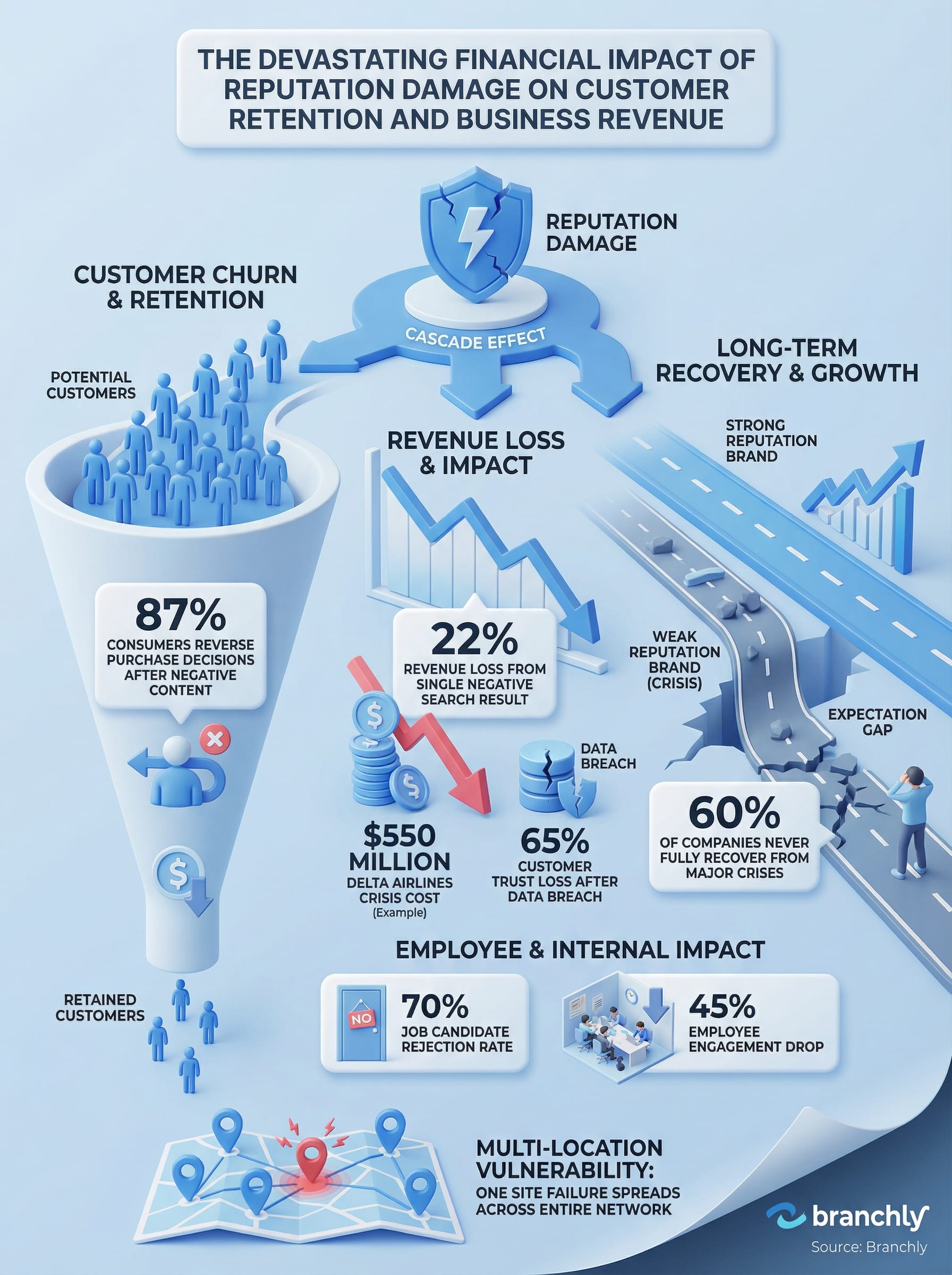
When Delta Air Lines' systems went down in July 2024, what was initially just a tech hiccup quickly spiralled out of control to cause utter chaos. Over 7,000 flights wound up being cancelled, stranding thousands of passengers and sparking a nasty backlash on social media. And then came the price tag - a whopping estimated $550 million in losses all crammed into just a single week. What started out as a cute little IT outage had by the end morphed into a full-blown reputation nightmare.
And this isn't some one-off weird incident with Delta. United Airlines nearly lost a billion dollars in market value a while back after a viral video of some rough passenger removal. And the pattern is pretty clear: when your reputation takes a hit - it hits your bottom line, your customer base, and your market position right in the gut. For companies with multiple locations - and we know how hard it is to keep everything consistent across sites even on a good day - when something goes wrong at one place, it can quickly start causing ripples across the whole operation.
The Financial Toll of Reputation Crises
The numbers are pretty sobering. Research tells us that a whopping 87% of consumers end up changing their minds about making a purchase after stumbling across negative reviews about a company. Just one article on the first page of search results with a bad rap on it can knock a company's potential business down by a whopping 22%. And it gets even uglier - a single hit on Google can tank your revenue by as much as 22%.
Things can spin out of control pretty quickly. After a data breach, 65% of customers lose their trust in the organisation hit by the breach - and over half of those people swear they'll never go back. You don't need much to scare people off for good - two nasty experiences and 70% of customers will be gone for good.
Some businesses never fully recover from a major reputation crisis. A staggering 60% of companies that get hit by one never even come close to bouncing back. The costs run way deeper than just lost revenue in the short term - it's a long-term thing, and can include a brand devaluating to a point where it's almost worthless. Volkswagen paid out a whopping $33 billion in fines and penalties after their emissions scandal broke - and Boeing's 737 Max crisis cost the company a similar amount in fines and legal fees, plus another $60 billion in lost sales.
Why Do Companies With Good Reputations Face Greater Risk
This is one thing that really doesn't seem right at first - companies with good reputations end up losing the loyalty of their customers in a lot bigger way when a crisis hits. That's because people have high expectations of companies they trust - and when that trust is betrayed, the sense of disappointment is way more intense. That's what expectancy-violation theory says. When a company you trust lets you down, the gap between what you thought they'd do and how they actually performed creates a much bigger loss of confidence. And the result is customer churn.
Monitor Your Reputation Premium
Track how your pre-crisis reputation affects customer expectations. Higher baseline trust means you need stronger crisis response protocols. Regular perception surveys help you understand the gap between customer expectations and your current preparedness.
Companies with weaker reputations see smaller drops in loyalty during crises. Customers have lower expectations so the crisis is seen as less of a departure from the norm. This doesn’t mean you should aim for a mediocre reputation. It means you gotta recognize that your strong brand comes with more vulnerability during disruptions.
How Operational Disruptions Kill Trust
Supply chain failures, service outages, system crashes, these operational disruptions directly impact your reputation and customer trust and honestly you’ll notice the difference right away if you don’t communicate properly. The key differentiator? How you talk and respond.
Transparent, timely and accountable communication across all locations helps maintain trust especially when digital platforms keep messaging consistent. Multi-location businesses benefit from centralized crisis communication strategies aligned with your overall marketing efforts. This creates a unified response that reinforces reliability rather than exposes cracks in your operation.
Your actions during a crisis matter just as much as your words. Prioritizing employee and customer safety, maintaining service where possible, avoiding exploitative practices like price gouging and showing ethical behavior all shape public perception and preserve long-term loyalty.

Real-Time Reputation Monitoring
Track customer sentiment and response effectiveness across all locations during critical incidents
The Employee Impact You Can’t Ignore
Reputation damage doesn’t just lose you customers. It loses you talent. 70% of job candidates reject offers from companies with damaged reputations even if they’re currently unemployed. That’s a big barrier to recovery.
And internal morale takes a hit too. Employee engagement drops up to 45% during a crisis. Your existing team members wonder if they want to stick around. Your best performers have options elsewhere. They leave first, taking institutional knowledge and customer relationships with them.
This creates a vicious cycle. Reputation damage leads to employee departures. Staff shortages hurt service quality. Poor service damages your reputation further. Customers notice when experienced employees disappear. They think it’s a sign of deeper problems.
Protect Internal Trust First
Your employees are your first line of defense during a crisis. Keep them informed before external stakeholders. Give them clear talking points. Show them you value their safety and wellbeing above short-term financial concerns. They'll become advocates instead of critics.
Multi-Location Businesses Face Compound Risk
When you have multiple locations, reputation damage at one site can spread across your entire network. A health code violation at one restaurant affects customer perception of all your locations. A data breach at one bank branch erodes trust in the entire institution. I’ve seen this happen time and time again and trust me, you don’t want to be in that position.
Consistency is your best defense. Customers expect the same level of service, safety protocols and ethics at every location. When one site fails, they question your entire operation. Social media makes this worse. A customer’s bad experience at one branch gets broadcast to potential customers across all your markets.
Proactive reputation management across locations means watching online sentiment at the individual site level while having centralized crisis response capabilities. You need to spot problems early before they get out of hand. You need to be able to respond quickly and consistently no matter where the incident happens.
What Recovery Actually Takes
Recovery from reputation damage is resource intensive and takes a long time. It requires ongoing monitoring of customer churn rates, regular brand perception surveys and consistent communication to rebuild trust. You can’t just issue an apology and move on.
The long tail requires sustained attention. You need to track if customers who stayed are actually engaged or just haven’t gotten around to leaving yet. You need to measure if new customer acquisition costs have increased because prospects need more convincing. You need to monitor if your best employees are updating their resumes.
Recovery Metrics That Matter
Track customer lifetime value trends, not just retention rates. Monitor employee turnover by performance level. Measure how many touches it takes to close new business compared to pre-crisis baselines. These indicators reveal whether you're truly recovering or just maintaining the appearance of stability.
Prevention is cheaper than cure. Building crisis response capabilities before you need them, training teams on communication protocols and maintaining operational standards across locations reduces your exposure. But if prevention fails, speed and transparency in your response determines whether you’re in the 60% that never fully recover or emerge with your reputation intact.
Summary
Reputation damage translates directly into customer churn and revenue loss. 90% of consumers avoid businesses with negative online reputations. The financial impact is huge: one negative search result can reduce revenue by 22%, a major crisis can cost billions in lost market value and customer defection. Companies with strong pre-crisis reputations are particularly vulnerable because customers hold them to higher standards. For multi-location businesses maintaining consistent communication, ethical conduct and service quality across all sites is key to protecting against reputation damage that can spread like wildfire across your entire network. The key to survival isn’t just handling the crisis itself but understanding that recovery requires sustained effort, transparent communication and measurable tracking of customer and employee trust over time.
Key Things to Remember
- ✓87% of consumers reverse purchase decisions after encountering negative content, and a single negative search result can reduce revenue by 22%
- ✓Companies with strong reputations face greater loyalty declines during crises because customers hold them to higher standards
- ✓Nearly 60% of companies hit by major reputation crises never fully recover, with recovery requiring sustained monitoring and communication
- ✓Reputation damage affects employee retention, with 70% of job candidates rejecting offers from companies with damaged reputations
- ✓Multi-location businesses must maintain consistent service quality and ethical conduct across all sites to prevent localized incidents from damaging the entire brand
How Branchly Can Help
We've all seen how a crisis at a single location can quickly spread to hit your entire brand reputation. That's why Branchly is here to help - with the tools you need to stop a local incident from turning into a major disaster. Our platform lets you keep tabs on what's happening at each individual site in real-time, and work with your team to come up with a unified response that will calm customers and reassure staff at the same time.
We make this process as smooth as possible by giving you a library of pre-approved messaging templates to choose from - so you can respond swiftly and sensibly to any situation. And for added peace of mind, our audit trail function keeps a record of everything that gets done during a crisis. This level of transparency and accountability not only helps keep customer trust intact, but also helps prevent even more revenue loss by getting your operation back on track fast.
Citations & References
- [1]
- [2]How does corporate reputation affect customer loyalty in a corporate crisis? - University of Arizona arizona.edu View source ↗
- [3]Exploring corporate reputation and crisis communication | Journal of Marketing Analytics springer.com View source ↗
- [4]Rebuilding Company Reputation After a Crisis | Reputation Sciences reputationsciences.com View source ↗
- [5]
- [6]
- [7]
- [8]
- [9]
- [10]