
Introduction
At 2:47 PM on a Friday, your core banking system goes down. Branches can't process transactions. Customers are lined up. Phones are ringing. Social media is lighting up. And your communications team is staring at a blank screen, trying to figure out what to say.
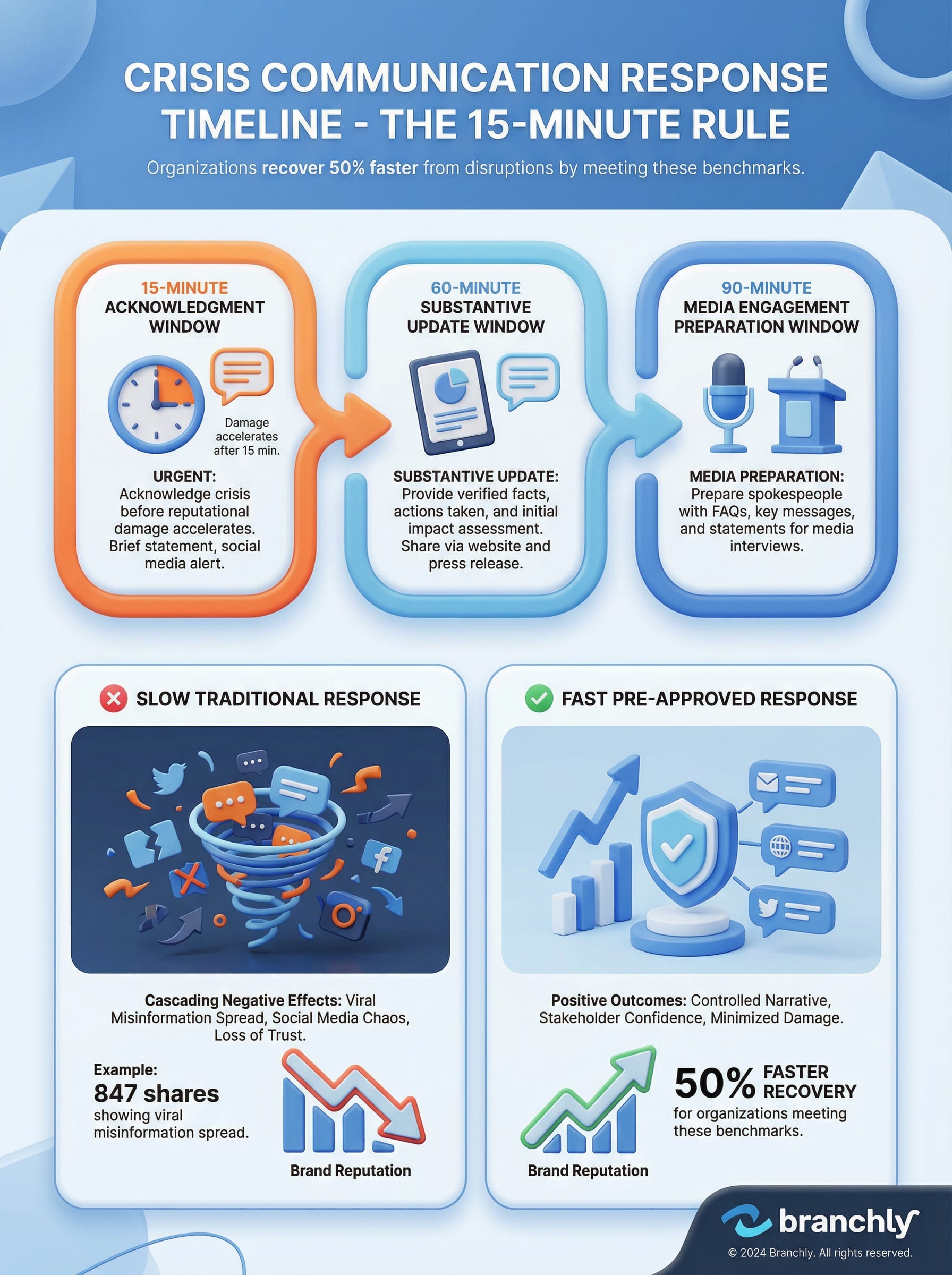
By the time legal approves your first message, it's 3:52 PM. You've missed the 15-minute window. Misinformation has already spread. A customer posted a photo of the line with the caption 'Is this bank failing?' It has 847 shares.
This is why pre-approved crisis message templates aren't a nice-to-have. They're the difference between controlling the narrative and watching it spiral out of control. Research shows organizations have as little as 15 minutes to acknowledge a crisis before reputational damage accelerates. Yet most companies still draft messages from scratch during the chaos, wasting precious minutes when speed is everything.
The 15-Minute Rule: Why Speed Trumps Perfection
When a crisis hits, the clock starts immediately. Not when you finish investigating. Not when legal signs off. Not when you have all the facts. The moment stakeholders become aware of the problem, they expect a response.
The 15-minute acknowledgment window isn't arbitrary. It's based on how fast misinformation spreads in the absence of official updates. When people don't hear from you, they fill the void with speculation, rumors, and worst-case scenarios. Social media turns every silent minute into an amplifier for anxiety.
Best practices call for acknowledging the incident within 15 minutes, issuing a substantive update within 60 minutes, and preparing for media engagement within 90 minutes. Organizations that hit these benchmarks recover 50% faster from disruptions than those relying on traditional, reactive communication methods.
The Cost of Silence
Boeing's slow, legally cautious response after the 737 MAX crashes defined their reputation for years and contributed to billions in losses. Speed matters, but so does having the right words ready.
But speed without accuracy creates a different problem. Sending incorrect information damages credibility and can worsen public safety risks. This is the paradox of crisis communication: you need to be fast and accurate, under conditions where neither comes naturally.
Pre-approved templates solve this. They give you speed because the message structure is already vetted. They give you accuracy because the core language has been reviewed by legal, compliance, and leadership when heads were cool and stakes were low.
What Makes a Crisis Message Template Actually Useful
Not all templates are created equal. A bad template is just a fill-in-the-blank form that sounds robotic and adds no value. A good template is a starting point that gets you 80% of the way there in 2 minutes instead of 45.
Good templates are scenario-specific. You can't use the same message for a data breach, a power outage, and a workplace injury. Each crisis type has different stakeholder concerns, regulatory implications, and tone requirements. Your templates should reflect that.
They also need to be audience-specific. The message you send to employees is different from what you post publicly. What you tell regulators is different from what you tell customers. What works for vendors doesn't work for media. You need multiple versions of each template, tailored to each audience's information needs and emotional state.
Template Categories You Need
Build templates for: holding statements (immediate acknowledgment), internal employee updates, customer notifications, vendor alerts, media responses, regulatory filings, and social media posts. Each should have versions for minor, moderate, and severe incidents.
Tone matters more than people think. During a 2017 flood in Texas, residents criticized emergency officials for issuing cold, technical briefings that lacked empathy. The information was accurate, but the delivery made people feel unsupported. Your templates need to match the severity of the situation. A system outage requires calm professionalism. A safety incident requires visible concern and compassion.
Include specific fill-in-the-blank sections that force you to add relevant details: time of incident, affected locations, estimated resolution time, alternative options available, and next update timing. These details transform a generic statement into something that actually helps people make decisions.
The Pre-Approval Process: Getting Legal Buy-In Before You Need It
The biggest bottleneck in crisis communication isn't writing the message. It's getting approval to send it. Legal wants to review every word. Compliance wants to check regulatory language. The CEO wants to see anything that goes to media. By the time everyone signs off, your 15-minute window is gone.
Pre-approval flips this dynamic. Instead of routing messages through legal during a crisis, you route them through legal during planning. You sit down with your general counsel, compliance officer, and communications lead, and you hash out the exact language that's acceptable for each scenario.
This conversation is easier to have when there's no active incident. Legal can think through edge cases. Compliance can reference specific regulations. Communications can push back on overly cautious language that sounds defensive. You negotiate the balance between speed and safety once, not in the middle of chaos.
The Robinhood Example
Robinhood's $57M FINRA fine stemmed partly from inadequate communication during outages. Pre-approved templates with clear regulatory language could have reduced both customer confusion and regulatory exposure.
The result is a library of messages that have blanket approval for use in specific situations. When a qualifying incident occurs, the response team can deploy the message immediately without waiting for sign-off. They fill in the blanks, do a quick sanity check, and send.
Set clear boundaries for when someone can use a pre-approved template versus when they need fresh approval. Minor incidents that fit the template criteria can go out immediately. Anything involving injuries, potential litigation, or regulatory violations needs real-time review. Document these thresholds so there's no confusion during activation.
Building Templates for Your Most Likely Scenarios
Start with the crises you've actually experienced or seen in your industry. Don't build 50 templates for every conceivable disaster. Build 8 to 12 for the scenarios that have a realistic chance of happening in the next 12 months.
For credit unions and banks, that's system outages, cybersecurity incidents, branch closures due to weather or safety concerns, ATM network failures, and potential data breaches. For franchise networks, it's supply chain disruptions, equipment failures, health inspection issues, and staff shortages. For hospitality, it's guest injuries, property damage, utility failures, and reputation incidents.
Sample Holding Statement Structure
We are aware of [issue] affecting [locations/systems] as of [time]. Our team is actively working to [action]. We expect [resolution timeframe or next update timing]. [Alternative options if applicable]. We will provide updates every [frequency].
For each scenario, build three severity levels: minor, moderate, and severe. A minor system outage affecting one branch for 30 minutes gets a different message than a regional outage lasting four hours. The template structure can be similar, but the tone, detail level, and escalation language should scale with impact.
Include version control and review dates. Templates drift out of alignment with your actual operations. The branch manager listed in your emergency contact template left six months ago. Your backup processing center moved. The regulatory language changed. Set a quarterly review cycle to keep templates current.
Store templates where people can actually find them under pressure. That means your crisis management platform, your incident response playbooks, and backed up in multiple accessible locations. A perfect template that lives in a SharePoint folder no one can access during an outage is useless.
Testing Your Templates: The Only Way to Know They Work
Templates that work in theory often fail in practice. The only way to find out is to test them during drills and simulations. Run a tabletop exercise where you trigger a scenario and require the team to deploy the appropriate template within the 15-minute window.
Watch what happens. Does someone struggle to find the right template? That's a storage or indexing problem. Does the language feel awkward when they read it out loud? That's a tone problem. Do they spend 10 minutes debating whether this situation qualifies for pre-approved use? That's a threshold clarity problem.
After every real incident, review the messages you sent. Did the template give you a good starting point? What did you have to change on the fly? Were there questions from stakeholders that the template didn't anticipate? Use these insights to refine the template for next time.
Public Perception Check
A CivicPlus survey found only 41% of residents are satisfied with emergency communication from local governments, while 78% support investment in better systems. Your messages are being judged in real-time.
Monitor public response to your crisis communications. What are people saying on social media after you send a message? Are they reassured or more confused? Are they sharing your official update or creating their own narrative? Tools that track sentiment and engagement help you understand whether your templates are landing the way you intended.
Test your distribution channels too. Templates are pointless if you can't get them to the right people. Make sure your email lists are current, your text alert system works, your social media access is set up for multiple team members, and your website can handle posting updates quickly.
The Limits of Templates: When You Need to Go Off-Script
Templates are powerful tools, not inflexible scripts. Some situations don't fit neatly into pre-built categories. Some require nuance that a template can't capture. Some demand a level of personal accountability that only a custom message can convey.
When someone gets seriously injured, when there's potential loss of life, when your actions directly caused harm, the template gives you structure but shouldn't dictate every word. Leadership needs to add genuine empathy and personal accountability. A fill-in-the-blank message about a fatality sounds callous no matter how well it's written.
Self-inflicted crises often need custom responses. If the problem was caused by negligence, poor decisions, or ethical failures, a template might sound defensive or evasive. Research shows organizational reputation rarely returns to pre-crisis levels after self-inflicted incidents. The communication strategy needs to reflect the seriousness of that reality.
When to Customize
Go off-template for: incidents involving serious injury or death, situations where your organization is clearly at fault, major reputation threats, anything likely to generate significant media attention, or crises that don't match any existing scenario.
That said, even in these situations, templates provide value. They give you a framework to start from. They remind you of the key elements every crisis message needs: acknowledgment, facts known so far, actions being taken, timeline for updates, and contact information for questions. You customize the substance while keeping the structure.
The goal isn't to remove human judgment from crisis communication. It's to remove the unnecessary friction that slows you down when every second matters. Templates handle the routine parts so you can focus mental energy on the parts that actually require thought.
Integration: Making Templates Part of Your Response Plan
Templates don't work in isolation. They need to be woven into your broader crisis response workflows. That means linking them directly to your incident playbooks so the right message surfaces automatically when you activate a specific response.
If your system outage playbook has 12 steps, step 3 should be 'Deploy pre-approved customer notification template.' Not 'Draft a message to customers.' The playbook should link directly to the template, pre-populate what it can from incident details, and route it to the designated sender for final review and distribution.
Assign clear ownership. Who is authorized to deploy each template? Who reviews it before it goes out? Who actually hits send? These roles should be documented in your crisis org chart and tested during exercises. Confusion about who does what burns time you don't have.

Integrated Communication Workflow
How pre-approved templates connect to incident response playbooks
Build in automatic logging and documentation. Every message sent during a crisis should be captured with a timestamp, recipient list, and version used. This creates your audit trail for regulatory review and gives you data for post-incident analysis. You need to know not just what you said, but when you said it and who received it.
Connect templates to your stakeholder contact lists. You've categorized your templates by audience. Make sure those audiences map to actual, maintained distribution lists. Your employee notification template is only useful if you can actually reach all employees when systems are down.
Why This Matters for Multi-Location Organizations
If you operate 50 locations, you're dealing with 50 potential incident sites. Pre-approved templates scale in ways that custom messaging can't. When three branches lose power simultaneously, you don't have time to craft individual messages. You need one template that works across locations with minor customization for specific details.
Templates also solve the consistency problem. Without them, different locations handle similar incidents differently. Branch A sends a detailed, reassuring message. Branch B sends nothing. Branch C sends something that accidentally creates legal exposure. Your brand promise falls apart because communication quality varies by whoever happens to be on duty.
For franchise networks, this is especially critical. Independent franchisees have varying experience levels. Newer owners might panic during their first real crisis. Pre-approved templates give them confidence and protect the larger brand from inconsistent messaging that erodes customer trust.
Templates also give corporate visibility. When every location uses the same communication framework, you can track incidents more easily. You know what was communicated, when, and to whom. You can spot patterns across locations and identify systemic issues that need attention.
Speed Creates Trust
Organizations with real-time communication tools recover 50% faster from disruptions. Speed isn't just about efficiency. It's about demonstrating competence when stakeholders are watching closely.
Summary
Pre-approved crisis message templates aren't about removing humanity from communication. They're about removing the barriers that prevent fast, accurate, consistent response when it matters most. The 15-minute acknowledgment window is real. The reputational damage from silence is measurable. The competitive advantage of speed is significant. Templates give you the structure to move quickly without sacrificing quality or creating legal risk. They turn the chaos of crisis communication into a repeatable process that works under pressure. Build them during calm periods. Test them during drills. Use them during real incidents. And refine them based on what you learn each time. Your reputation depends on what you say during a crisis. But it also depends on how fast you say it.
Key Things to Remember
- ✓Organizations have 15 minutes to acknowledge a crisis before misinformation takes control. Pre-approved templates enable you to meet this window while maintaining accuracy and legal compliance.
- ✓Build scenario-specific templates for your 8-12 most likely crisis types, with versions for different audiences (employees, customers, media, regulators) and severity levels.
- ✓Get legal and compliance pre-approval during planning, not during active incidents. This eliminates the biggest bottleneck in crisis communication response time.
- ✓Test templates during drills and refine them after real incidents. The only way to know they work is to use them under realistic conditions and learn from each deployment.
- ✓Integrate templates directly into your crisis playbooks and response workflows. Messages should surface automatically based on the incident type, with clear ownership and distribution processes.
How Branchly Can Help
Branchly's pre-approved communication templates are built directly into your crisis playbooks, surfacing automatically based on incident type and severity. Templates are customized for each location's specific attributes and pre-vetted by your legal and compliance teams during setup. When you activate a response, the system pre-populates incident details, routes messages through your defined approval workflow, and distributes them across multiple channels with automatic logging for audit trails. You get the speed of automation with the accuracy of human oversight, meeting the 15-minute response window without sacrificing quality or creating compliance risk.
Citations & References
- [1]
- [2]What is emergency communications plan (EC plan)? | Definition from TechTarget techtarget.com View source ↗
- [3]Effective Internal Crisis Communication Plan Templates: Your Comprehensive Guide to Navigating Challenges changeengine.com View source ↗
- [4]
- [5]
- [6]
- [7]caljac.org View source ↗
- [8]Disaster Preparedness: Crisis Communication Plan Model | Digital Preservation Management dpworkshop.org View source ↗
- [9]purdue.edu View source ↗
- [10]What Most Organizations Get Wrong About Crisis Communication and How to Fix It dialmycalls.com View source ↗
- [11]
- [12]
- [13]The Ultimate Guide to Emergency Communication Systems: Everything You Need to Know qcomm.co View source ↗
- [14]Crisis Communication: From Principles to Actionable Tips | DeskAlerts alert-software.com View source ↗
- [15]
- [16]
- [17]Mapping crisis communication in the communication research: what we know and what we don’t know | Humanities and Social Sciences Communications nature.com View source ↗
- [18]