
Introduction
Your core banking system just went down. Online banking is offline. Your phone system relies on the same network that's currently dead. And you have 15,000 members who can't access their accounts, check balances, or make transactions.
How do you tell them what's happening?
If your answer involves scrambling to export contact lists from systems you can't currently access, you've already lost hours of response time. By the time you figure out how to reach members, trust has eroded and phones are ringing off the hook—except your phones don't work either.
The gap between "we should have a backup communication plan" and "we actually tested it last month" is where credit unions fail during outages. NCUA examiners know this. In 2024 examinations, business continuity and disaster recovery emerged as major weaknesses, with credit unions struggling with outdated plans, lack of testing, and unclear roles during crises.
The Problem Most Credit Unions Don't Discover Until It's Too Late
Credit unions operate under a dangerous assumption: our systems will work when we need them.
But outages don't announce themselves politely. Ransomware attacks don't wait for convenient timing. The February 2024 Change Healthcare attack affected one in three Americans and took nearly a year to fully resolve. When systems fail, they fail completely—taking your member database, email server, and phone systems with them.
Test Before Crisis Strikes
During your next tabletop exercise, actually retrieve your backup contact lists. Can you find them? Access the encrypted files? Make test calls? If the answer is no during a drill, it will be no during a real outage.
The FFIEC's Business Continuity Management framework categorizes recovery timeframes with brutal precision. Critical processes must be recovered within minutes to hours. Not days. Not "when we figure out how to export the contact list." Minutes.
Yet 90% of businesses without disaster recovery plans fail after a major disruption. Credit unions aren't exempt from this statistic—they're particularly vulnerable given regulatory scrutiny, member trust dependencies, and the reality that financial stress makes communication failures catastrophic.
What NCUA and FFIEC Actually Require for Communication Continuity
NCUA doesn't leave business continuity planning to interpretation. Under 12 C.F.R. parts 748 and 749, federally insured credit unions must maintain comprehensive Business Continuity Plans and Disaster Recovery Plans. These aren't IT-only documents—they must address all critical resources including personnel, facilities, and communications.
The requirements start with a Business Impact Analysis identifying critical business functions and determining Maximum Allowable Downtime and Recovery Time Objectives. For member-facing services, RTOs are measured in minutes, not hours. Your communication strategy needs to match that urgency.
FFIEC Recovery Timeline
Critical processes: minutes to hours | Urgent: 24 hours | Important: 72 hours | Normal: 7 days | Nonessential: 30 days. Member communication falls squarely into "critical."
Building Backup Contact Lists That Actually Work During Outages
The most reliable backup communication method is also the oldest: a physical list of member contacts stored outside your primary systems.
Start with segmentation. Not every member needs the same information during an outage. High-value accounts, loan holders nearing payment dates, and businesses with payroll needs require different messaging than members who check balances occasionally. Build separate contact lists reflecting these priorities.
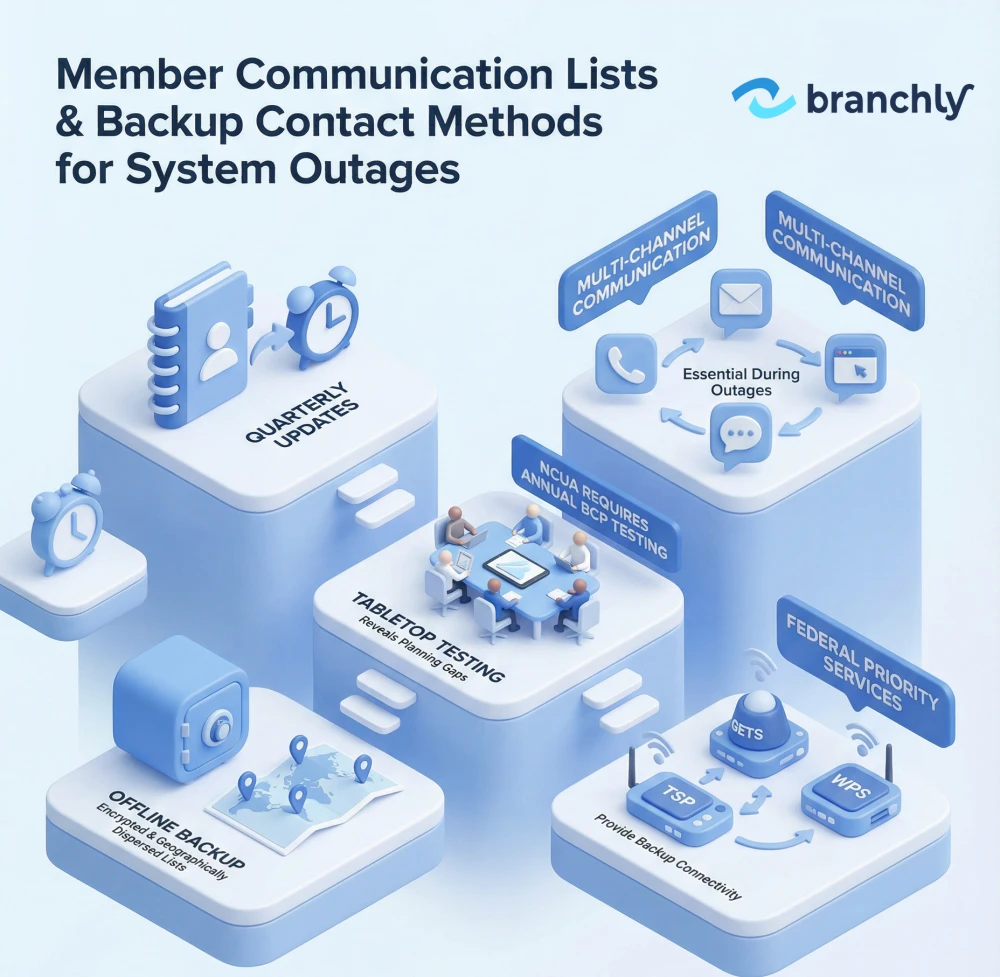
Quarterly updates are the minimum refresh cycle—monthly is better. Pull data when systems are operational, export to encrypted portable media, and store copies in geographically dispersed locations. One copy at your main office, one at your disaster recovery site, and one with a designated executive who can access it remotely.
Multi-Channel Communication Strategies for System Failures
Redundancy means using multiple independent communication channels that don't rely on the same infrastructure.
Your website might be down. Your email server might be inaccessible. Your phone system might route through the network that's currently offline. Plan for all of these failures simultaneously.

Multi-Channel Communication Strategy
Social media, SMS, status pages, and automated phone systems work when primary systems fail
Testing Your Backup Communication Systems Before You Need Them
NCUA and FFIEC recognize several testing methods, all of which should include communication plan validation.
Tabletop exercises let critical personnel walk through scenarios without disrupting operations. Present a specific outage scenario—"ransomware encrypted our core banking system, phones are down, online banking is offline"—and have the team walk through every communication step. Who contacts members? What message do they send? How do they access contact lists if the database is locked?
Data Security and Compliance for Offline Contact Lists
Offline member contact lists contain personally identifiable information subject to data protection regulations. Physical security and encryption aren't optional.
Store offline contact lists in locked locations with access logs. Not every employee should have access to comprehensive member contact data. Limit access to designated business continuity team members whose roles require it during emergencies.
Summary
Member communication lists maintained separately from primary systems transform outage response from chaos to coordinated action. When systems fail, redundant contact methods and tested communication procedures mean the difference between members receiving accurate updates within minutes versus hours of confusion and eroding trust.
NCUA and FFIEC requirements aren't abstract compliance exercises—they're frameworks proven to work during actual disruptions. Credit unions that maintain current offline contact lists, test backup communication channels quarterly, and document their procedures satisfy regulators while protecting member relationships.
Your members trust you with their financial lives. When systems fail, that trust depends entirely on your ability to communicate what's happening and when service will restore. The time to build that capability is before the outage, not during it.
Key Things to Remember
- ✓Maintain offline member contact lists with quarterly updates, encrypted storage, and geographic dispersion to ensure accessibility during complete system failures.
- ✓FFIEC categorizes member communication as a critical process requiring recovery within minutes to hours, not days—your backup systems must match this urgency.
How Branchly Can Help
Branchly's crisis management platform maintains pre-approved communication templates and automated member notification workflows that work independently of your core banking system. When an outage occurs, activate playbooks instantly to send updates through multiple channels—SMS, email, social media, and status pages—using backup contact lists automatically synced before the disruption. The platform's real-time coordination keeps every branch aligned on messaging, logs all communications for regulatory compliance, and provides the documented testing trail NCUA examiners require.
Citations & References
- [1]
- [2]FFIEC Business Continuity Management IT Booklet Federal Financial Institutions Examination Council View source ↗
- [3]
- [4]