Introduction
Your core banking system crashes at 9:47 AM. By 10:02 AM, customers are calling branches. By 10:15, they're venting on social media. By 11:00, local news picks up the story. You finally send your first communication at 11:30. That 103-minute delay just cost you customers you'll never get back.
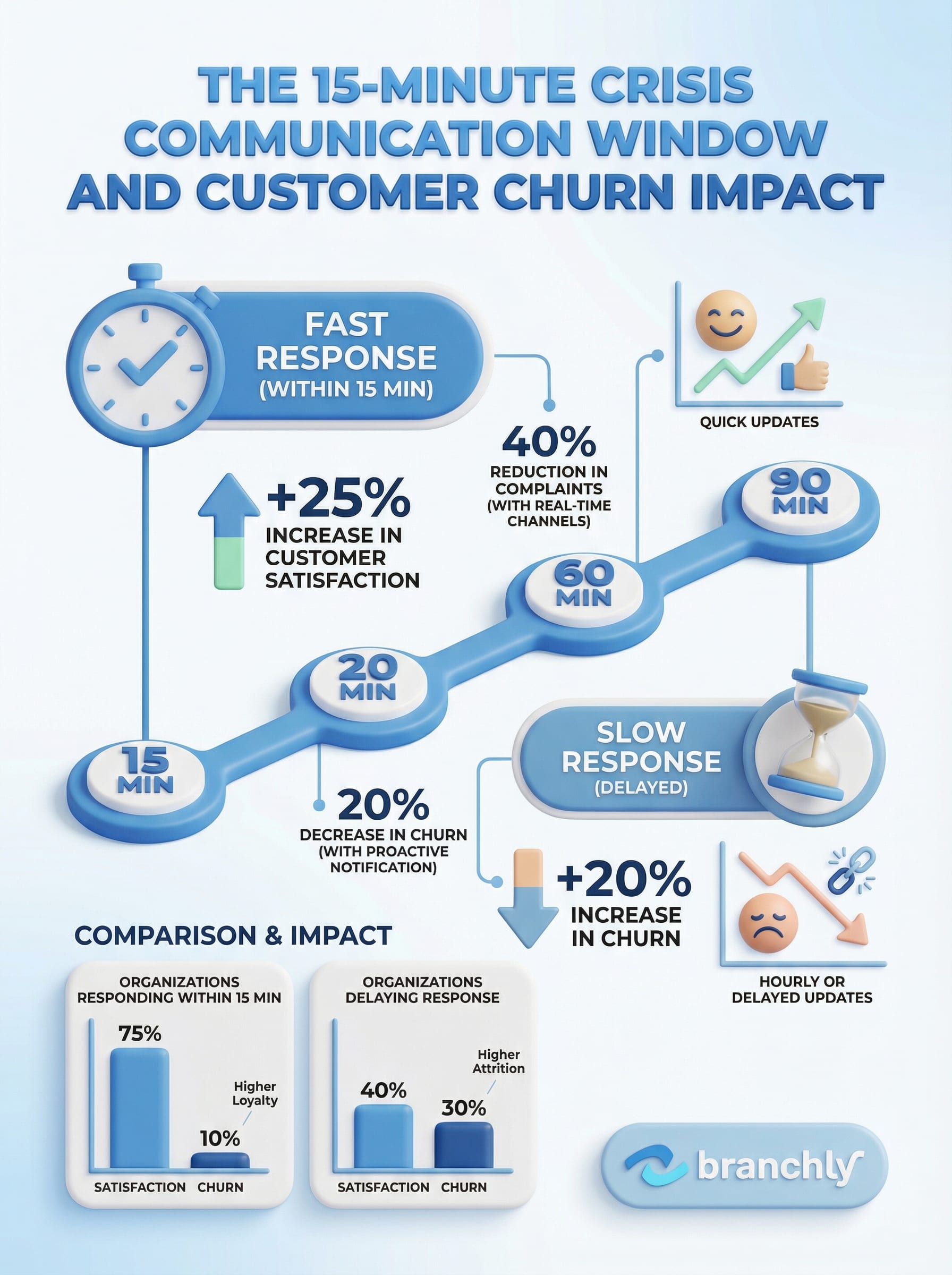
The numbers tell a stark story. Organizations that respond within 15 minutes and provide hourly updates see a 25% increase in customer satisfaction. Those that wait? They watch churn rates climb 20% and spend months rebuilding trust. The difference between retaining customers and losing them often comes down to how fast you communicate, not just how well you fix the problem.
The 15-Minute Window That Determines Customer Loyalty
Crisis communication operates on an unforgiving timeline. Research shows that acknowledging a crisis within 15 minutes prevents misinformation from taking root and demonstrates organizational preparedness. But acknowledgment alone isn't enough. The 15-20-60-90 timeline matters: 15 minutes to acknowledge, 20 minutes to assess, 60 minutes for your first substantial update, and 90 minutes for your action plan.
Customers don't expect you to have all the answers immediately. They expect you to show you're aware and working on it. Slack's 2022 outage response is a textbook example. They posted status updates every 30 minutes and used Twitter for real-time engagement. Users stayed patient because they could see progress, even when the system was still down.
Compare that to Facebook's Cambridge Analytica response. Their slow acknowledgment turned a data breach into a multi-week PR disaster. Users didn't just lose trust in Facebook's security. They lost trust in the company's willingness to be honest.
Set Your Communication Clock
Pre-write your acknowledgment template now. When a crisis hits, you should only need to fill in three blanks: what happened, what you're doing, and when you'll update next. Save those 10 minutes of panic-writing for actual problem-solving.
The Real Numbers Behind Communication Delays
Let's talk about what slow communication actually costs. Organizations using real-time communication channels report a 40% reduction in customer complaints during crises and a 25% increase in loyalty. That's not coincidence. That's customers rewarding transparency.
The inverse is equally telling. Failing to respond to customers on social media increases churn by 15%. Not responding doesn't make the problem go away. It makes customers go away. When 39% of customers who cancel cite having to repeat their issues to multiple representatives, and 47% mention needing multiple calls to resolve problems, the message is clear: communication breakdowns drive customer exits.
Proactive Communication ROI
Organizations that proactively notify affected customers before they call see a 15% increase in positive feedback and a 20% decrease in churn. The math is simple: tell them before they have to ask.
Gartner's research shows that proactive customer engagement can decrease churn rates by 20%. That means identifying who's affected and reaching out before they notice the problem. If your ATM network goes down, don't wait for customers to discover it at the machine. Send a text alert with alternative locations.
Why Multi-Channel Communication Isn't Optional Anymore
Your customers aren't all checking the same channel. Some read email. Others live on Twitter. Your oldest customers might call the branch. Your youngest expect a text message. If you're only communicating through one channel, you're only reaching part of your audience.
Cloud-based crisis communication platforms report a 50% increase in communication efficiency precisely because they let you send consistent messages across email, SMS, social media, and your website simultaneously. One update, five channels, complete coverage. But consistency is the key word. Your message needs to be identical everywhere. Nothing erodes trust faster than conflicting information across different channels.
Live chat and status pages have become table stakes. Customers want to see what's happening right now, not what you knew an hour ago. A status page that shows 'investigating' for three hours without updates generates more anxiety than helpful information. Update frequency matters as much as initial response time.
Map Your Communication Channels Now
List every way customers can reach you: phone, email, social media, website, mobile app. Now ask yourself, can you push updates through all of them simultaneously? If the answer is no, that's your next project.
The Trust Equation: Transparency Plus Speed Equals Retention
Transparency without speed frustrates customers. Speed without transparency feels like spin. You need both. Organizations that communicate transparently and frequently during crises reduce misinformation spread by 20% and see customer satisfaction climb 25%. That's because transparency demonstrates respect.
Boeing's 737 MAX crisis showed what happens when you fail at both. Slow acknowledgment of safety concerns, inconsistent messaging, and a defensive posture damaged relationships with customers, regulators, and the public. The technical problems were fixable. The trust damage took years to repair.
Contrast that with organizations that treat crises as opportunities to demonstrate their values. When you communicate quickly and honestly, even bad news can strengthen customer relationships. Customers remember how you treated them when things went wrong far longer than they remember the incident itself.
The Empathy Factor
During the pandemic, customers who perceived genuine effort from brands showed greater tolerance for service disruptions. Empathy in communication matters as much as speed. Acknowledge the inconvenience, not just the technical details.
Pre-Approved Templates Save Critical Minutes
Writing under pressure produces bad communication. You either say too much or too little. You use the wrong tone. You forget to include key information. Or you spend 30 minutes wordsmithing while your customers are spreading their own version of events.
Pre-approved communication templates solve this problem. Write them when you're calm. Get legal and compliance to review them before the crisis. Then when something breaks, you're filling in blanks, not composing from scratch. Your 30-minute drafting process becomes a 3-minute review and send.
But templates only work if they match your brand voice and cover realistic scenarios. A generic 'we're experiencing technical difficulties' message works for any outage but helps no one. Better templates specify what's affected, what's still working, and what customers should do right now. If your online banking is down, tell customers whether mobile banking works. If neither does, tell them which branches are open and have extra staff.
Build Your Template Library
Start with your five most likely scenarios: system outages, weather closures, security incidents, service disruptions, and staffing shortages. Write customer, employee, and vendor templates for each. Get them approved. Store them where your response team can access them instantly.
The Post-Crisis Communication Gap
Most organizations stop communicating the moment systems come back online. That's a mistake. Your final update matters as much as your first. Customers want to know what happened, why it happened, and what you're doing to prevent it from happening again.
This post-crisis communication serves two purposes. First, it closes the loop for customers who followed your updates through the incident. Second, it demonstrates accountability. You're not hiding from what went wrong. You're showing that you learned from it.
Organizations with active customer advocacy programs see a 15% reduction in crisis-related churn. These programs work because loyal customers defend you in public forums and social media when problems occur. But loyalty isn't automatic. You earn it by communicating well before, during, and after incidents.
Measuring Communication Effectiveness During Crises
You can't improve what you don't measure. Track these metrics for every crisis: time to first acknowledgment, number of updates sent, channels used, customer contact volume, social media sentiment, and post-crisis survey responses.
Your goal isn't just fast communication. It's effective communication. Did customers feel informed? Did they know what actions to take? Did they trust you more or less after the incident? These answers tell you whether your communication strategy actually works or just feels like it does.
The Feedback Loop
After every incident, survey a sample of affected customers. Ask three questions: Did you feel informed? Was our communication timely? What should we have done differently? Their answers will improve your next response.
Compare your metrics to benchmarks. If industry standard is first update within 15 minutes and you're at 45, you have work to do. If competitors update every 30 minutes and you update every 90, your customers notice.
Summary
Crisis communication speed directly impacts customer retention. Organizations that acknowledge incidents within 15 minutes and provide consistent updates see 25% higher satisfaction and 20% lower churn. The cost of slow communication isn't just reputational. It's measurable customer loss. Pre-approved templates, multi-channel delivery, and transparent updates turn crisis communication from a scramble into a system. Your customers don't expect perfection. They expect honesty, speed, and visibility into what you're doing to fix the problem.
Key Things to Remember
- ✓Acknowledge crises within 15 minutes to prevent misinformation and demonstrate preparedness. Delayed responses increase customer churn by up to 20%.
- ✓Use multi-channel communication to reach all customer segments simultaneously. Consistent messaging across platforms builds trust and reduces confusion.
- ✓Pre-approved communication templates reduce response time from 30 minutes to 3 minutes while maintaining brand voice and legal compliance.
- ✓Proactive customer notification before they discover problems decreases churn by 20% and increases positive feedback by 15%.
- ✓Post-crisis communication closes the loop and demonstrates accountability. Organizations that explain what happened and how they'll prevent recurrence strengthen long-term loyalty.
How Branchly Can Help
Branchly's pre-approved communication templates let you send customer updates in minutes, not hours. Our platform stores legal-reviewed messages for every crisis scenario, automatically customizes them for your affected locations, and pushes them across email, SMS, social media, and your website simultaneously. When your systems go down, your crisis response team clicks one button to notify every affected customer with consistent, transparent information. We track delivery, log timestamps for audit trails, and help you maintain the 15-minute response window that protects customer trust.
Citations & References
- [1]
- [2]
- [3]
- [4]
- [5]
- [6]Crisis communications: What it is and examples brands can learn from | Sprout Social sproutsocial.com View source ↗
- [7]Customer Experience (CX) and Crisis Management: Strategies for Maintaining Trust renascence.io View source ↗
- [8]
- [9]Crisis Management in Customer Relationships: Building Trust in Times of Trouble earlyalert.com View source ↗
- [10]Customer Experience (CX) and Crisis Management: 25 Best Practices for 2025 renascence.io View source ↗
- [11]
- [12]
- [13]Exploring customers' responses to online service failure and recovery strategies during Covid‐19 pandemic: An actor–network theory perspective - PMC nih.gov View source ↗
- [14]Customer loyalty in crisis: How brands can elevate care and retain customer trust | Articles quirks.com View source ↗