
Introduction
When a crisis hits, your response unfolds in two distinct phases: containment and resolution. Containment is about stopping the bleeding. It's the immediate action you take to prevent an incident from spreading to more systems, more locations, or more people. Resolution is about fixing the wound. It's the complete eradication of the threat and full restoration of normal operations.
The gap between these two phases is where organizations lose money, reputation, and customer trust. In 2025, the average breach took 181 days to detect and another 60 days to contain. That's eight months from initial compromise to containment alone. Full resolution takes even longer. For multi-location organizations, where a single incident can cascade across dozens of branches, understanding this timeline isn't academic. It's the difference between a manageable disruption and a business-threatening crisis.
What Containment Actually Means
Containment is technical and tactical. When a ransomware attack hits your network, containment means isolating affected endpoints, blocking suspicious IP addresses, and shutting down compromised systems before the malware spreads. When a power outage affects three branches, containment means activating backup power, rerouting customer traffic, and ensuring no data loss occurs during the transition.
The goal is damage control with minimal business disruption. You're not trying to fix everything. You're trying to stop it from getting worse while keeping critical operations running. This requires real-time decision-making about tradeoffs. Do you take the entire network offline to be safe, or do you isolate a single compromised endpoint and monitor closely?
Organizations with scenario-based playbooks can execute containment actions in minutes rather than hours. Pre-approved response protocols for common threats like phishing attacks or system outages mean your teams don't waste time debating what to do. They already know. The playbook tells them which systems to isolate, who to notify, and what temporary workarounds to put in place.
Containment Speed Benchmark
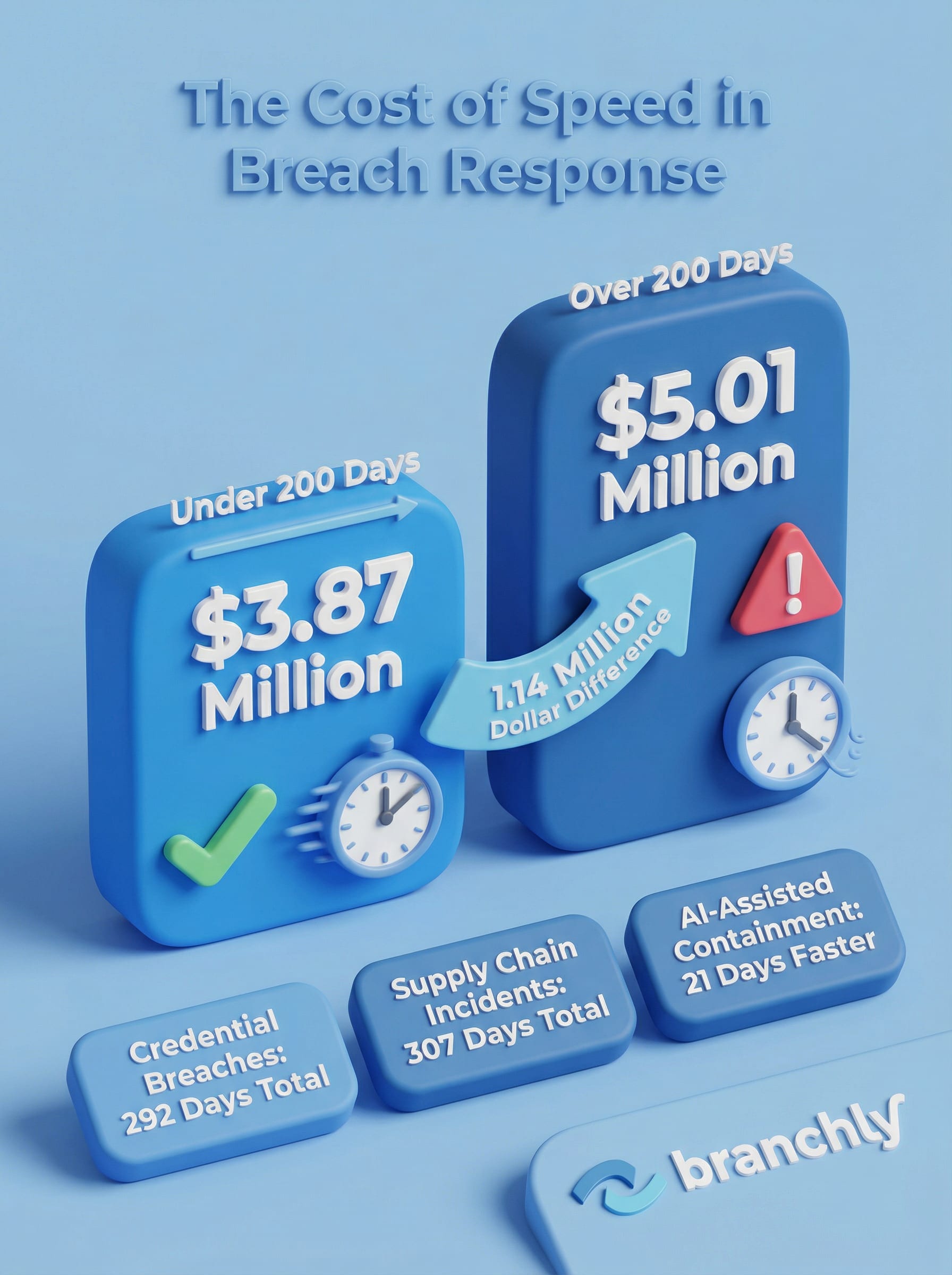
Organizations using AI and automation contain breaches in 51 days on average, compared to 72 days for those relying on manual processes. The 21-day difference translates directly to reduced financial exposure.
The 64-day containment average masks huge variation. Credential-based breaches take 88 days to contain. Supply chain compromises can take even longer because the threat originates outside your direct control. Insider errors, by contrast, get contained 28 days faster than average because the source is easier to identify and address.
What Resolution Actually Requires
Resolution is where most organizations underestimate the work involved. After you've contained the incident, you still need to eradicate root causes, patch vulnerabilities, restore systems from clean backups, verify data integrity, and confirm no residual threats remain. This isn't a quick process.
Eradication means removing every trace of the threat. If malware infected your systems, you're hunting down every variant and confirming it's gone. If a physical security breach occurred, you're reviewing access logs, changing locks, and updating badge permissions. If a vendor relationship caused the problem, you're renegotiating contracts and implementing new controls.
Recovery is the most visible part of resolution. You're bringing systems back online, restoring data, and resuming normal operations. But you can't just flip a switch. Every restored system needs verification. Every recovered file needs integrity checks. You're testing to make sure you didn't reintroduce vulnerabilities or restore corrupted data.
The 200-Day Cost Threshold
Breaches taking longer than 200 days to identify and contain cost $5.01 million on average. Those resolved in under 200 days cost $3.87 million. The $1.14 million difference shows why speed compounds savings.
For multi-location organizations, resolution gets complicated by scale. A ransomware attack might be contained at headquarters in three days, but rolling out patches and verification checks across 200 franchise locations takes weeks. Each location has different hardware, different staff capabilities, and different operating schedules. Your resolution timeline is only as fast as your slowest location.
Why the Gap Between Them Costs You
The time between containment and full resolution is when costs accumulate. Your systems are partially functional but not normal. Staff are working around problems rather than solving them. Customers are experiencing degraded service. And you're burning resources on temporary fixes that don't address the underlying issue.
Third-party incidents illustrate this perfectly. When a vendor breach affects your operations, you can contain your exposure relatively quickly by cutting off access. But resolution requires the vendor to fix their systems, verify the fix, and restore your integration. That process takes 12.8% longer than internal incidents and costs 11.8% more. You're stuck in limbo, unable to fully operate but unable to switch vendors overnight.
Healthcare organizations face the longest gap. The average breach in healthcare takes nearly 40 days longer to detect than other industries, and costs average $7.42 million. The regulatory environment means every step requires documentation, every communication needs legal review, and every system change needs compliance verification. Speed matters, but so does getting it right.
Pre-Built Recovery Playbooks
Organizations with incident response teams and regularly tested plans save $2.66 million per breach on average. The preparation work pays for itself multiple times over when an incident occurs.
The financial impact grows non-linearly. The first week of an uncontained incident is expensive. The second week is more expensive per day. By week four, you're dealing with compound effects. Lost customers don't just represent immediate revenue loss. They represent lifetime value erosion. Regulatory fines aren't just one-time hits. They come with increased scrutiny and higher insurance premiums.
The Ransomware Problem
Ransomware involvement jumped from 32% of breaches to 44% in 2025. This isn't just about encryption. Modern ransomware attacks include data exfiltration, meaning attackers steal your information before encrypting it. Even if you contain the encryption quickly, you're still dealing with potential data exposure.
Containment for ransomware is relatively straightforward: isolate infected systems, block lateral movement, preserve forensic evidence. Resolution is where organizations stumble. Do you pay the ransom? Do you restore from backups? How do you verify your backups aren't infected? What do you tell customers about data exposure?
Each decision adds time. And time adds cost. Organizations that pre-decide their ransomware response policy contain and resolve faster. They've already determined their payment threshold, backup verification process, and communication strategy. When an attack happens, they're executing a plan rather than inventing one under pressure.
Breach Lifecycle by Incident Type
Credential breaches: 292 days total | Supply chain: 307 days | Insider error: 230 days
For franchise networks, ransomware creates a unique challenge. If one franchisee gets hit, do you isolate their systems from the central network? Do you notify other franchisees? How do you prevent the same attack from hitting others? The brand is at risk even if the breach is technically contained to one location.
How Business Continuity Fits In
Business continuity planning bridges containment and resolution. While your technical teams work on eradication and recovery, your continuity plan keeps operations running. This means pre-identified workarounds, backup vendors, manual processes, and temporary system configurations.
Credit unions understand this better than most. When a core banking system goes down, containment means protecting data integrity and preventing transaction errors. But customers still need access to their accounts. Business continuity means having phone-based transaction procedures, branch-level workarounds, and clear communication about limited services. You're managing two parallel workstreams: fixing the problem and maintaining operations.
Recovery Time Objectives (RTOs) and Recovery Point Objectives (RPOs) define acceptable gaps. If your RTO for transaction processing is four hours, you need containment and temporary recovery measures in place within that window. Full resolution might take days, but your continuity plan ensures you meet RTOs throughout.
The Testing Gap
Most organizations test containment procedures through tabletop exercises. Far fewer test full resolution workflows, including system restoration from backups and verification protocols. This gap shows up when real incidents occur.
The integration point matters. Your incident response plan should trigger specific business continuity procedures automatically. When a POS system outage is detected, your continuity plan for manual transactions activates without waiting for approval. When a data breach is confirmed, your customer communication templates go to legal for review while technical containment proceeds.
What Speed Actually Requires
Fast containment and resolution don't happen by accident. They require preparation that most organizations skip. Pre-approved playbooks eliminate decision paralysis. Pre-vetted communication templates prevent legal bottlenecks. Pre-configured backup systems reduce restoration time.
Automation handles the repetitive parts. When a system outage is detected, automated workflows can isolate affected endpoints, notify relevant teams, activate backup systems, and log all actions for compliance. Humans focus on judgment calls: Is this isolated or widespread? Should we fail over to backup or try to fix the primary system? Do we need to notify regulators?
The organizations cutting containment time in half share common characteristics. They've mapped their critical systems and dependencies. They know which vendors affect which operations. They've documented recovery procedures for their top 10 risk scenarios. And they've tested those procedures within the last six months.
Cross-functional coordination speeds both containment and resolution. When IT, operations, legal, and communications teams have pre-established protocols, no one waits for permission. The incident response team contains the technical threat. The legal team prepares regulatory notifications. The communications team briefs customers. The operations team implements workarounds. All simultaneously.
Start With Your Top 5
You don't need playbooks for every possible incident. Start with the five scenarios that would hurt your organization most: system outages, data breaches, supply chain disruptions, physical security incidents, and key staff unavailability. Build containment and resolution protocols for those first.
Measuring What Matters
Most organizations track mean time to detect (MTTD) and mean time to respond (MTTR). These metrics matter, but they don't tell the whole story. You also need to track containment time separately from resolution time, cost per day of disruption, percentage of incidents resolved within RTO, and number of locations affected per incident.
The gap between your fastest and slowest location responses reveals process problems. If headquarters contains an incident in two hours but your franchise locations take two days, you have a training or tooling gap. If some branches can restore from backups in 30 minutes but others need four hours, you have configuration inconsistencies.
Post-incident reviews should analyze bottlenecks in both containment and resolution. Which approval took too long? Which system dependency wasn't documented? Which backup failed? Which communication went to the wrong stakeholder? Every incident teaches you how to get faster next time. But only if you're measuring and learning.
Audit trails matter for more than compliance. They show you exactly where time was spent during an incident. Three hours waiting for legal approval to send customer notifications. Two hours trying to reach the on-call engineer. 90 minutes searching for the backup administrator password. These are the friction points you can eliminate with better preparation.
Summary
The difference between containing an incident quickly and resolving it completely determines your financial exposure, reputation impact, and regulatory risk. Organizations that cut their breach lifecycle from 300 days to 200 days save over $1 million per incident. The key is preparation: pre-approved playbooks, automated containment actions, tested recovery procedures, and integrated business continuity plans. Speed doesn't come from working faster during a crisis. It comes from eliminating decision points, approval delays, and process gaps before the crisis happens. Start by mapping your five highest-risk scenarios, documenting containment and resolution steps for each, and testing those procedures quarterly. The investment in preparation pays for itself the first time you need it.
Key Things to Remember
- ✓Containment stops incident spread; resolution eliminates root causes and restores systems. The gap between them is where costs accumulate.
- ✓Breaches taking over 200 days to resolve cost $1.14 million more than those resolved faster. Time translates directly to money.
- ✓Organizations using AI and automation contain breaches 21 days faster than those relying on manual processes.
- ✓Pre-approved playbooks, tested response teams, and integrated business continuity plans save an average of $2.66 million per breach.
- ✓Credential-based breaches take 292 days total; supply chain incidents take 307 days. Know your specific risk profile and prepare accordingly.
How Branchly Can Help
Branchly collapses the gap between containment and resolution by automating the preparation work that slows most organizations down. Our platform generates scenario-specific playbooks for your highest-risk incidents, with pre-approved containment actions and step-by-step resolution workflows customized for each location. When an incident occurs, one-click activation triggers automated containment measures, notifies the right teams, and launches your business continuity procedures simultaneously. Real-time dashboards track progress across all affected locations, showing exactly where bottlenecks occur. And our intelligence layer learns from every incident, automatically refining playbooks to eliminate steps that slow response. The result: containment that happens in minutes instead of hours, and resolution that follows a tested path instead of improvised chaos.
Citations & References
- [1]
- [2]
- [3]Mastering Containment: A Guide to the Most Critical Phase of Incident Response reliaquest.com View source ↗
- [4]
- [5]
- [6]Incident Response & Business Continuity Tabletop Exercises: Key Differences | Cherry Bekaert cbh.com View source ↗
- [7]Resilient by Design: Fundamentals of Business Continuity and Incident Response - YHB CPAs & Consultants yhbcpa.com View source ↗
- [8]
- [9]
- [10]
- [11]
- [12]
- [13]Average Time to Detect a Cyber Attack 2025: Critical Detection Statistics Every Business Must Know - Total Assure Blog totalassure.com View source ↗