
Introduction
Picture this: A core banking system goes down at 9 AM on a Friday. Your operations manager is juggling calls from 47 branch locations, tracking a vendor ticket system, coordinating with IT, drafting customer communications, and fielding questions from the executive team. By 9:03 AM, she's already missed a critical detail that will cost you three extra hours of downtime.
This isn't incompetence. It's cognitive overload, and it's the silent killer of crisis response. Research shows that emergency dispatchers can experience cognitive overload within the first 90 seconds of a high-stakes call. Your crisis team isn't immune. When working memory capacity gets exceeded, decision-making deteriorates, situational awareness collapses, and errors multiply. The people you're counting on to save the day become the bottleneck.
What Cognitive Load Actually Means in a Crisis
Cognitive load theory explains how your brain's limited working memory handles information. Think of working memory as a small desk where you process immediate tasks. You can only fit so many papers on it before things start falling off.
During a crisis, that desk gets slammed with data: location status reports, stakeholder questions, vendor updates, regulatory requirements, communication approvals, and task coordination. Each piece demands processing power. When the demand exceeds capacity, performance tanks. Emergency physicians managing multiple high-acuity patients face the same problem. Frequent interruptions and time pressure create cognitive overload that leads to medical errors and psychological stress.
In multi-location organizations, this gets worse. You're not managing one situation, you're managing 50 simultaneous variations of the same incident. Each location has different hours, staff availability, customer impact, and recovery timelines. Your brain tries to track it all. It can't.
The 90-Second Window
Research on emergency dispatchers found cognitive overload can hit within 90 seconds when responders must process large data volumes, coordinate multiple channels, and relay critical information under time pressure. Your crisis team faces identical constraints.
How Stress Amplifies the Problem
Cognitive load and stress feed each other in a vicious cycle. Moderate stress can sharpen focus. But high stress narrows attention, creating tunnel vision. Your crisis manager fixates on one urgent email while missing the bigger pattern forming across your locations.
This follows the Yerkes-Dodson Law: performance improves with arousal up to a point, then collapses. A study of emergency physicians found their average cognitive load scored 5 on a 9-point scale during typical shifts. That's optimal. But when complexity spikes or distractions multiply, cognitive load shoots into the danger zone where stress and workload correlate directly with errors.
Emotional responses make it worse. Anxiety, urgency, and frustration don't just result from cognitive overload. They increase it, creating a feedback loop. Your stressed-out regional manager makes a snap decision that creates three new problems, which increases stress, which degrades judgment further.
The Hidden Cost of Task Saturation
Healthcare studies show that heavy workloads and high patient-to-staff ratios directly increase error rates. The same applies to crisis teams managing too many locations with too few resources.
Decision Fatigue Is Different From Cognitive Overload
Decision fatigue happens when continuous decision-making drains mental energy. Every choice your crisis team makes, no matter how small, depletes their capacity for the next one. Should we close this branch? Notify customers now or wait? Escalate to the executive team? Route this message through legal?
After dozens of decisions, people start procrastinating, making errors, or defaulting to the easiest choice rather than the right one. Research on clinical alert systems found that for every additional reminder per encounter, acceptance dropped 30%. When alerts repeated frequently, acceptance fell another 10% for each five-percentage-point increase in repetition.
In crisis response, decision fatigue manifests as paralysis or recklessness. Your team either freezes, unable to choose a path forward, or rushes through decisions without proper consideration. Both outcomes are dangerous. The manager who spent the morning making 40 micro-decisions about branch status is now too mentally exhausted to properly evaluate whether to activate your disaster recovery site.
Why Experience Matters More Than You Think
Experienced crisis managers handle higher cognitive loads better than novices. Not because their brains are bigger, but because they've built mental shortcuts stored in long-term memory. Senior paramedics and experienced pilots rely on well-developed schemas that let them automate routine pattern recognition, freeing up working memory for complex decisions.
Your veteran operations director doesn't need to think hard about basic response steps. She's done them 30 times. Her brain recognizes the pattern instantly and jumps to higher-level strategy. Your new regional manager, facing his first multi-location outage, burns mental energy on every single step because nothing is automatic yet.
But here's the problem: you can't wait 5 years for everyone to build that experience. And even your veterans hit cognitive limits when situations get complex enough. That's where systems matter. Research shows that shared mental models, clear leadership structures, and streamlined information displays help distribute cognitive demands and prevent overload across the entire team.
Train for Cognitive Load, Not Just Knowledge
Stress inoculation training and cognitive drills help teams perform under pressure. But training alone won't fix systemic information overload. You need to reduce the actual load, not just prepare people to suffer through it.
The Multitasking Trap
Multitasking during a crisis feels productive. It's not. Your brain can't actually process multiple complex tasks simultaneously. It switches rapidly between them, and each switch costs time and accuracy. Studies show multitasking impairs memory, attention, and goal tracking. People mix up tasks and take unsafe shortcuts.
Watch your crisis team during an incident. How many browser tabs are open? How many Slack channels are they monitoring? How many phone calls interrupt them per hour? Each interruption doesn't just steal 30 seconds. It fragments their mental model of the situation, forcing them to rebuild context when they return to the primary task.
This is why crisis coordination often feels chaotic even when everyone is working hard. People are busy, but their attention is shredded across too many channels. The solution isn't working harder. It's reducing the number of things demanding attention at once.
What Actually Reduces Cognitive Load
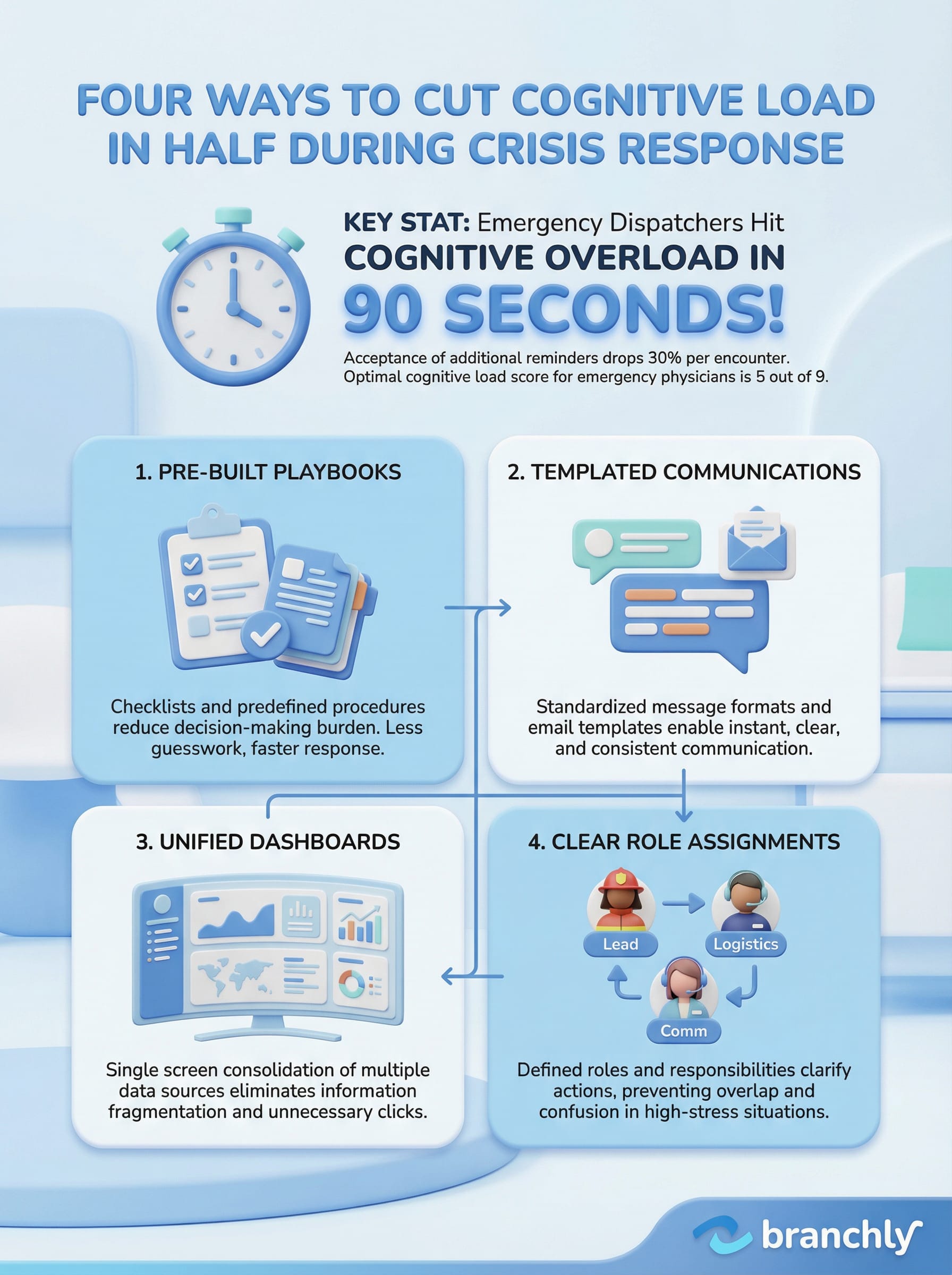
Pre-built playbooks cut cognitive load by eliminating the need to invent response steps during the crisis. But static PDFs don't help much when you're managing 50 locations. You need dynamic systems that automatically adapt steps based on location attributes, time of day, and severity level.
Pre-approved communication templates eliminate the panic-writing that burns decision-making energy. When your manager doesn't have to compose customer notifications from scratch while coordinating vendor calls, she has mental capacity left for strategic decisions.
Centralized dashboards prevent the browser-tab chaos. One screen showing all location statuses, task progress, and bottlenecks means your team isn't burning cognitive resources hunting for scattered information. Research on emergency coordination shows that aligning input and output modalities reduces processing effort.
Role clarity matters enormously. When everyone knows exactly what decisions they own and which ones to escalate, you eliminate the cognitive drain of constantly figuring out who should do what. Shared mental models across your team mean less explanation and coordination overhead during the incident.

Four Ways to Cut Cognitive Load in Half
Pre-built playbooks, templated communications, unified dashboards, and clear role assignments
The Compliance Dimension
Regulated industries face an additional cognitive burden: real-time compliance verification. Financial institutions must document every decision, maintain audit trails, and follow specific escalation procedures. That's more mental load on top of an already maxed-out team.
Systems that automatically log actions, timestamps, and approvals remove that burden. Your team doesn't need to remember to document. It happens automatically. They can focus on response instead of audit trail construction.
Sleep, Shift Work, and Cognitive Reserves
Cognitive load doesn't reset when your shift ends. Sleep deprivation, extended hours, and irregular schedules degrade cognitive function and increase error rates. Healthcare studies show this clearly: tired providers make more medication errors.
Your 24/7 operations face the same issue. The manager covering the overnight network outage is working with reduced cognitive capacity by 3 AM. If your crisis response process is already cognitively demanding when people are fresh, it becomes dangerous when they're exhausted.
This is another argument for automation. Simple, repetitive coordination tasks should never require human cognitive load at 3 AM. Save your team's limited mental energy for the decisions that actually need human judgment.
Build Depth, Not Just Coverage
Don't rely on one exhausted hero. Cross-train multiple people so you can rotate responders during extended incidents. Fresh cognitive capacity beats experience when the experienced person has been up for 18 hours.
Why This Matters More for Multi-Location Organizations
Single-location organizations face cognitive load during crises, but the complexity scales linearly. Multi-location operations face exponential complexity. Each additional location doesn't just add one more item to track. It adds interactions, dependencies, and decision branches.
A network outage affecting 40 branches means 40 different customer impact levels, 40 different staff situations, 40 different recovery timelines. Your brain tries to model all of it simultaneously. It can't. Without systems that aggregate, prioritize, and automate coordination, your crisis manager drowns in detail while missing the strategic picture.
Franchise networks face additional complexity: independent operators with varying experience levels. Your franchisor team must coordinate response across locations where the owner-operator might be handling his first serious incident. That means more explanation, more hand-holding, and more cognitive load on your central team.
Calculate Your Cognitive Load Score
During your next incident, count how many different information sources your crisis manager consults, how many decisions they make in the first hour, and how many communication channels they monitor. If the total exceeds 20, you're in the danger zone.
Testing Reveals Cognitive Overload Before Real Incidents
You won't discover cognitive load problems by reviewing your plan document. You discover them by running realistic exercises and watching where your team struggles. If they're frantically flipping through multiple documents, hunting for contact information, or asking the same questions repeatedly, that's cognitive overload in action.
Good testing also builds those mental schemas that help experienced responders perform better. Each drill strengthens pattern recognition and automates routine steps. But only if the drill is realistic. Tabletop discussions where everyone reads from a script don't create the cognitive pressure of real incidents.
The Real Cost of Cognitive Overload
Cognitive overload doesn't just slow response. It creates cascading failures. The overwhelmed manager misses a critical vendor update, leading to incorrect customer communications, which damage reputation and require executive intervention, which further overloads the crisis team.
Your best people burn out. Research shows that sustained cognitive overload correlates with stress, fatigue, and reduced job satisfaction. The operations manager who successfully coordinates one brutal incident might not stick around for the next one if the experience was needlessly exhausting.
Organizations that ignore cognitive load treat their crisis responders as superhuman. They're not. Their brains work the same way as emergency physicians, paramedics, and dispatchers. All the research on those high-stakes professions applies to your team. The question is whether you're going to design systems that work with human cognitive limits or keep pretending those limits don't exist.
Summary
Your crisis team's performance isn't limited by knowledge or dedication. It's limited by working memory capacity and cognitive load. When you force them to juggle dozens of information sources, make continuous decisions without pre-built frameworks, and coordinate across many locations manually, you guarantee cognitive overload. The result is slower response, more errors, and burned-out people. Systems that reduce cognitive load through pre-built playbooks, templated communications, centralized dashboards, and clear role assignments don't just make response faster. They make it possible for human brains to actually function the way you need them to when everything is on fire.
Key Things to Remember
- ✓Cognitive overload happens when information demands exceed working memory capacity, leading to errors, tunnel vision, and decision paralysis.
- ✓Emergency dispatchers can hit cognitive overload in 90 seconds. Your multi-location crisis team faces identical time pressure and information volume.
- ✓Decision fatigue is different from cognitive load. Each decision drains energy, reducing capacity for subsequent choices.
- ✓Experience helps by automating routine tasks through mental schemas, but even experts hit limits during complex incidents.
- ✓Pre-built playbooks, templated communications, unified dashboards, and clear role assignments cut cognitive load by removing mental work that doesn't require real-time human judgment.
How Branchly Can Help
Branchly's AI-powered platform directly addresses cognitive overload by removing the mental burden of crisis coordination. Pre-built playbooks that automatically adapt to each location's specific attributes eliminate the need to invent response steps under pressure. Pre-approved communication templates mean your team never wastes decision-making energy composing messages during incidents. A unified Command Center dashboard provides real-time visibility across all locations without the cognitive drain of tracking scattered information sources. Clear role assignments and automated task routing ensure everyone knows exactly what they own, cutting coordination overhead. Automatic compliance logging means your team can focus on response instead of documentation. When you reduce cognitive load, your people make better decisions faster, and they don't burn out in the process.
Citations & References
- [1]An exploratory investigation of the measurement of cognitive load on shift: Application of cognitive load theory in emergency medicine - PMC nih.gov View source ↗
- [2]Report: Quantifying Cognitive Load of Emergency Dispatchers | Simplesense simplesense.io View source ↗
- [3]diabeticstudies.org View source ↗
- [4]tpmap.org View source ↗
- [5]The Impact of Cognitive Load on Decision-Making Efficiency · Global Council for Behavioral Science gc-bs.org View source ↗
- [6]The Association Between Cognitive Medical Errors and Their Contributing Organizational and Individual Factors - PMC nih.gov View source ↗
- [7]
- [8]An exploratory investigation of the measurement of cognitive load on shift: Application of cognitive load theory in emergency medicine - PMC nih.gov View source ↗