
Introduction
When severe weather or safety threats emerge, financial institutions face a critical question: close the branch and protect people, or stay open and serve customers? The answer isn't simple. A $40 million deposit base generates approximately $1.6 million in annual revenue, creating powerful financial incentives to remain operational. Yet the liability risks, employee trust issues, and potential for catastrophic outcomes make the decision to stay open equally dangerous.
The regulatory landscape adds complexity. Permanent branch closures require 90-day advance notice to federal regulators and affected communities, but temporary safety-driven closures operate under different rules. Understanding when each applies, who has authority to decide, and what documentation protects the institution creates a framework most credit unions and community banks lack.
This analysis examines the regulatory requirements, hidden costs, decision-making frameworks, and technology systems that help institutions balance financial performance with employee safety and regulatory compliance.
The Regulatory Landscape: Permanent vs. Temporary Closures
Federal regulators distinguish sharply between permanent branch closures and temporary emergency closures, with dramatically different compliance requirements. The Office of the Comptroller of the Currency requires national banks to provide 90-day advance notice before permanently closing any branch, including detailed justification for the closure and evidence of efforts to meet community credit needs through alternative means. The FDIC imposes similar requirements on state-chartered banks.
Credit unions face analogous rules from the National Credit Union Administration, which requires advance notice to members and regulators before permanent branch closures. These requirements exist to protect community access to banking services, particularly in underserved areas where branch closures can eliminate the only physical banking presence for miles.
Document Everything
Maintain timestamped records of closure decisions, including weather conditions, safety assessments, and authority approvals. This documentation proves essential if regulators later question the closure or if liability claims emerge.
However, temporary closures driven by immediate safety threats operate under different standards. Weather emergencies, natural disasters, civil unrest, or facility safety issues justify temporary closures without the 90-day notice requirement. The Federal Reserve's guidance on business continuity planning explicitly acknowledges that institutions must prioritize employee and customer safety during emergencies, even if it means temporary service disruptions.
The Hidden Costs of Staying Open During Danger
The financial calculation appears straightforward: keep branches open to maintain revenue and serve customers. But this analysis misses substantial hidden costs that emerge when institutions prioritize operations over safety. Liability exposure represents the most significant risk. If an employee sustains injury while working during conditions the institution knew to be dangerous, workers' compensation claims can escalate into negligence lawsuits arguing the employer failed to provide a safe workplace.
Employee Trust is Fragile
Requiring staff to work during conditions other employers deem unsafe damages trust permanently. Employees remember who valued their safety and who didn't when severe weather threatened.
Beyond legal liability, employee morale and retention suffer when institutions require staff to report during conditions most employers consider too dangerous. Financial institutions compete for talent with employers who close at the first sign of severe weather. When a credit union remains open while schools, government offices, and private sector employers send workers home, the message to staff is clear: your safety matters less than transactions.
The reputational risk extends to members and customers. Social media amplifies incidents where financial institutions remain open during emergencies while other businesses close. A single photo of employees struggling to work during dangerous conditions can viral, damaging community relationships built over decades. The revenue from one day of operations rarely justifies the reputational harm.
Building a Decision-Making Framework
Effective frameworks eliminate the need for crisis-moment decisions by establishing clear triggers, authority, and communication protocols in advance. The best approaches define objective criteria that automatically initiate closure protocols. National Weather Service warnings—tornado warnings, blizzard warnings, hurricane warnings—serve as unambiguous triggers. Government declarations of states of emergency provide another clear signal. Facility safety issues like power outages, HVAC failures, or security threats trigger immediate closures.
The framework must specify decision authority to prevent delays during emergencies. Branch managers need clear authority to close their locations when conditions meet defined triggers without waiting for approval from regional supervisors or executives. However, the framework should also establish escalation protocols for ambiguous situations and require post-event reporting to ensure accountability and enable continuous improvement.
The Real Financial Impact of Temporary Closures
Analyzing the true financial impact requires looking beyond immediate transaction revenue. A branch generating $1.6 million annual revenue from a $40 million deposit base produces roughly $4,400 daily. Closing for severe weather eliminates that day's revenue, but only partially. Digital banking channels continue functioning, allowing members to conduct essential transactions remotely. The transactions that don't occur digitally typically defer rather than disappear—members complete them when the branch reopens.
Compare that deferred revenue to the costs of remaining open during emergencies. Hazard pay for employees who report during dangerous conditions, additional insurance costs if claims arise, potential legal fees defending negligence allegations, and lost productivity from employees distracted by safety concerns all erode the financial benefit of staying open. The calculation shifts dramatically when considering reputational harm and employee retention costs.
Technology Systems That Enable Confident Decisions
Modern crisis management platforms automate the decision process by monitoring threat feeds, activating pre-approved playbooks, and coordinating communication across distributed teams. Automated weather monitoring systems track National Weather Service alerts for every branch location, automatically flagging conditions that meet closure triggers defined in the framework. This eliminates the need for manual monitoring and ensures consistent application of closure criteria across the organization.
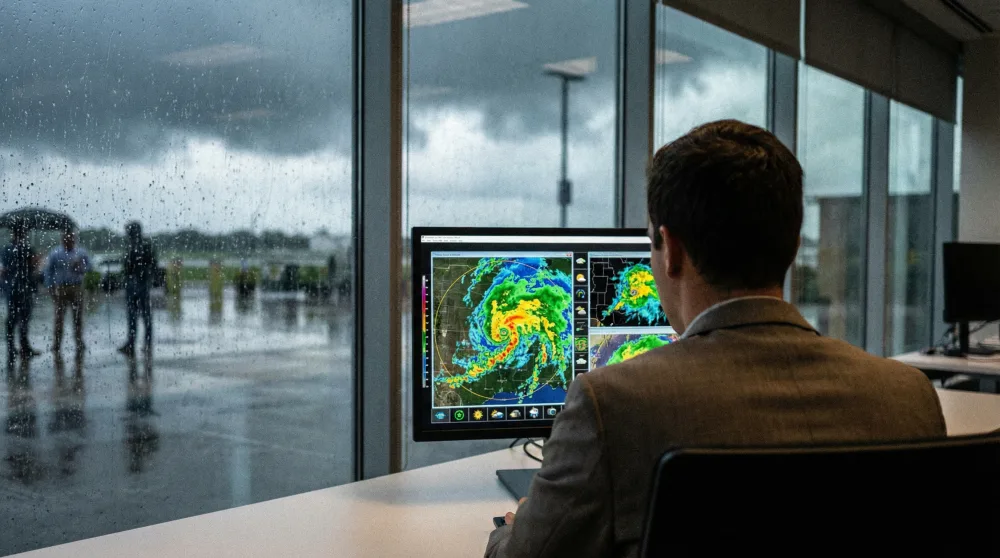
Real-Time Decision Support
Automated monitoring enables confident, defensible closure decisions
Pre-approved communication templates eliminate the scramble to craft messaging during emergencies. Legal and compliance teams review and approve closure notifications, employee safety instructions, and member service disruption messages before crises occur. When a closure event happens, managers simply activate the appropriate template, confident that messaging meets regulatory requirements and maintains brand consistency.
Summary
Branch closure decisions require balancing competing priorities: financial performance, regulatory compliance, employee safety, and community service. The institutions that navigate these decisions most effectively recognize that temporary closures during genuine emergencies cost far less than the liability, reputational, and employee retention consequences of forcing operations during dangerous conditions. Clear frameworks, objective triggers, and automated systems transform reactive crisis management into proactive risk mitigation.
Key Things to Remember
- ✓Permanent branch closures require 90-day advance notice to regulators, but temporary safety-driven closures operate under different rules
- ✓The hidden costs of staying open during emergencies—liability, employee trust, reputation damage—often exceed the revenue at risk
How Branchly Can Help
Branchly automates the entire branch closure decision process, from threat monitoring through regulatory documentation. Our platform tracks weather conditions across every location, automatically activates closure playbooks when triggers are met, deploys pre-approved communications to employees and members, and maintains complete audit trails proving decisions were based on objective safety criteria. Financial institutions using Branchly eliminate the guesswork from emergency closures while ensuring consistent application of policies across distributed branch networks.
Citations & References
- [1]
- [2]
- [3]
- [4]
- [5]